There are chains of trust which are established for SSL certs, centered around the idea that if we can believe Mozilla et al. that the server responding is who they claim they are. Up until now, that is good enough to establish the trust needed to accept the 2 keys in the connection are connected, and then a secure connection could be established to the host server.
Mozilla et al. could claim trust for Microsoft and then MS would be an intermediary for Mozilla. There is a long history of sketchy intermediaries like GoDaddy and others that root certificate providers like Mozilla would block at times due to abuse.
This leads to users, usually ones that are not that technically savvy, seeing 'insecure' warnings on a page that actually offers HTTPS. ..but since the root servers no longer accept them as trusted, everything that GoDaddy supported, and every intermediary (child) cert which they approved would no longer be trusted and you would see a non-secure warning.
Which leads to users that are not that technically savvy learning to always click "Load it anyway!" and not think about it, even in financial management firms. Ask me how I know...
And I immediately turned it off because that just invites utter churn and stupidity. Part of that is just CC though, their compaction is miles behind Codex.
Hyperbolic to be sure, but I think it’s fairly common for people to get into programming for fun as a teenager, turn that into a well-paid job, realize that programming jobs are often entirely different from programming as a hobby, then feel trapped because all the experience they have is in programming, and finding an alternative starts to look like competing with recent college grads for entry-level office jobs (ask a 22 year old how that’s looking these days), an expensive degree, or something menial for $15/hour or less.
First world problems, perhaps, but also a microcosm of our broader societal divergence, where a reasonably comfortable middle is increasingly being replaced by growing working and upper-income classes, with very different lifestyles.
Programming jobs differ wildly though. Working as a solutions architect is different from working at a startup, or a big corporate, or a company making video games, or a big tech company like google.
If you love programming but hate working at your current programming job, the problem might be the company.
I realized that AIs will need to keep us around much like we keep around an old DOS box running a specific program. There are so many analogue outputs in the real world that they still will not be able to take in as well as humans can.
I ate Kiwis for years before someone told me most people DO NOT eat the skins. I looked at my bag of kiwis, and the even the damn monkey mascot was holding a spoon...mocking me...
Also eating skins turns kiwis from a fruit you have to spend time to preprocess (halve + grab spoon) to an immediate snack.
This may sound insignificant to many but for the extremely lazy like me, this is the difference between going to waste and being consumed for many fruits.
You can just break them into two roughly equal halves and use your teeth to scoop out the flesh. No need for either a knife, a spoon or any kind of preprocessing. I've been eating them that way for decades.
> Also eating skins turns kiwis from a fruit you have to spend time to preprocess (halve + grab spoon) to an immediate snack.
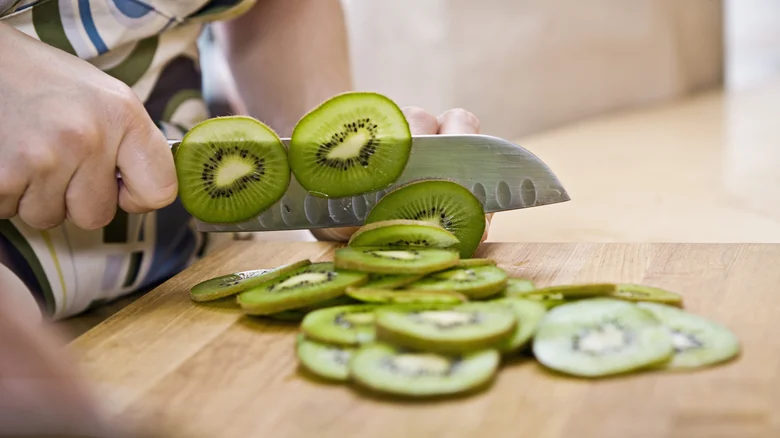
Both of your comments sound foreign to me. In my experience, kiwis are eaten with the fingers, including the skin, but they are prepared by slicing. The form you eat is a collection of circular discs, cross sections of the original fruit.
Well, thank you for editing your post to not ask me if I only like microwave dinners.
I guess maybe it's a cultural thing - I've never seen anyone ever make mash potatoes with skins inside, and mash is a dinner staple here(in fact both here in the UK and Poland where I'm originally from).
When I wash kiwis I rub the hairs off, and then cut them into thick slices, leaving the skin on. Trying to skin or eat them with a spoon is just a pain, and I don’t find the skin unpleasant.
I’ve seen a lot of people also just wash/rub the hairs off and bite straight into them, though I find this can make a mess if they are too soft.
Don’t worry, my kids eat the skin too. I guess we forgot to tell them not to and they didn’t find it unpleasant. I tried a bite for my own edification and I did not find it pleasant.
That said, I usually eat peanuts with the shell and all. Though don’t eat too many that way, the shells are definitely not getting digested, so chew well. Also there is probably a higher chance of dirt or other stuff you don’t want to eat being on the shell, but I don’t usually eat peanuts anyway so never been a problem for me.
Kiwi fuzz irritates my throat, so I rub a lot of the fuz off, and then use a straight bladed knife to "shave" the rest off. The skin gives a tart contrast to the fruit center. I'm sure there's lots of valuable nutrients in the skin too
The golden ones (as opposed the green variety that are more common in the US) are significantly tastier (at least, universally shared opinion among everyone I forced to try them) and have basically no fuzz/hair.
I'd like to see the the cited source for that statement.. I've always eaten the skins of kiwi fruit. its offers a nice tangy counterpoint to the sweet flesh. Eating it without the skin just sounds boring.
In the US, Business' are treated like people with free speech rights. If it would be cheaper for them in the long run to use ai and robots instead of humans, they will figure out a way to make it so.
I don't know if he's right, but Peter Zeihan thinks the breakdown in globalization will negatively affect the ability to continue to improve the chips that AI depends on[0]. Too many steps in the supply chain, too widespread, too vulnerable to deglobalization.
An invasion of Taiwan would definitely slow progress but it wouldn’t stop it.
We already have sufficient hardware that algorithmic (software) improvements alone should get us to GPT 7 / Greek Reference 6 even if not a single new chip is delivered to an AI data center ever again, starting today.
Maybe, maybe not. It's not unreasonable that these systems cap out at some point, or perhaps fizzle away entirely.
The businesses that create these systems are not profitable and run at a massive historical and go-forward loss.
New data centers required to operate these systems are facing increasing pushback at local levels. New construction is not guaranteed. Energy and power grid constraints exist as well.
Government regulation is way behind. What happens when (if) mass layoffs due to AI occur? How does the population react? Theoretically AI can be regulated out of significant progress, or outright existence for many purposes. At the end of the day, US and other prominent governments make the calls, not corporations.
Lots of goddamn awesome computers fizzled out. The Amiga being a prime example. Besides you can't just wave your arms in the most vague terms and then deny that survivor bias was ever a thing.
So your argument is that AI is more lika Amiga than computers? I'd say that Amiga wouldn't fizzle out if it wasn't superceded by pc. It very well may be that transformer architecture is going to be superceded by something like jepa or other world models but it doesn't change much.
Survivor bias is always a thing but it's not everything. All surviving things are not equal and neither are all gone things. If there are such things. Some cls technology never dies. There are new games written for 8-bit Atari today.
These inventions all stopped disrupting the world and just became a part of it. The question is whether LLMs are going to just take their quiet place, or profoundly change (or eliminate) humanity in a self-feeding frenzy towards singularity.


Mozilla et al. could claim trust for Microsoft and then MS would be an intermediary for Mozilla. There is a long history of sketchy intermediaries like GoDaddy and others that root certificate providers like Mozilla would block at times due to abuse.
This leads to users, usually ones that are not that technically savvy, seeing 'insecure' warnings on a page that actually offers HTTPS. ..but since the root servers no longer accept them as trusted, everything that GoDaddy supported, and every intermediary (child) cert which they approved would no longer be trusted and you would see a non-secure warning.
reply