Last year people were asking "if AI is so great then where are the new apps?". Then data for 2026 came out and now the IOS app store has a 84% percent year-over-year increase in new app submissions.
For that other stuff you mentioned like the right click menu. Those huge corporate projects suffer more from layers of institutional dysfunction and will be very very slow to show any improvement. Their dysfunction can't be solved with just faster coding.
Using AI to build more features is easier than using AI to improve existing projects. People will gradually figure out how to do latter too, it'll just take longer.
That's just volume though. I also know, and have no trouble believing, that github is going down partly due to the weight of all the vibecoded pushes. But that does not necessarily translate to people's needs and wants being covered, for all we know iOS just has a plague of unused POCs.
Do you have actual productive examples? As in, products with a real userbase that couldn't exist or be scaled pre-AI? Genuinely asking, I might have missed some large hits. The closest I can remember was bun rewrite kerfuffle, which seemed more a marketing action than anything.
If we sorted through all those new apps and ignored all the crap, I'm pretty sure we would find an overall increase in actually useful apps. I just shipped a new app myself, and I think it's useful, and I wouldn't have finished mine without AI assistance.
> products with a real userbase that couldn't exist or be scaled pre-AI?
Coding hasn't been the bottleneck for product creation for a while. So I don't think there are going to be many examples that fit that exact criteria. Any app idea was 'possible' before, it just took more developer hours to do it. So now teams are doing more things that were weren't worth the effort before, but are a lot more feasible with AI assistance.
> If we sorted through all those new apps and ignored all the crap, I'm pretty sure we would find an overall increase in actually useful apps. I just shipped a new app myself, and I think it's useful, and I wouldn't have finished mine without AI assistance.
App store revenue actually decreased! That suggests that the apps are largely not useful, unless you make the implausible assumption that nearly none of them are charging money.
If they were actually useful though, demand shouldn’t stay the same — more niches should be getting filled. If they’re just clones of each other, then yes
It’s interesting that people claimed the exact same thing when computers were being introduced to the work place int the 80s and 90s. Lots of papers showing how productivity didn’t go up at all and using a paper and pen seems to be just as efficient as using a PC.
Even in the 19th century, when electricity became widely available, there was no productivity gain for 30 years at least. This is a well understood phenomenon.
Ah you must be referring to this off the cuff comment by Robert Solow in a book review: "You can see the computer age everywhere but in the productivity statistics" (1987)
It's an interesting question and very much not resolved. It indeed led to a flurry of studies in the 1990s, and more recently to several updates and meta-analyses.
The problem of "does computer technology investment causes increased productivity" is an interesting issue in economics and statistics. It is far from clear that the (immense) investment in computers over the past several decades has caused a corresponding excess growth in productivity.
Some of the literature published after 2015 that I have read on this topic:
"Information technology (IT) productivity paradox in the 21st century"
> Thus we are still unable to confirm or reject the existence of an IT
productivity paradox
"Benchmarking the IT productivity paradox: Recent evidence from the manufacturing sector"
(This one was published in 2006 but I find it relevant because it does a very well scoped analysis in manufacturing firms thus addressing the oft-mentioned argument that computer technology may leverage task productivity in a way that is hard to measure in aggregate)
> However, many scholars from both sides of the IT paradox debate agree that difficulty still exists in specifying how to assess the IT contribution, and the availability of reliable data sets
> Regardless of the final decision to differentiate or conform, our results make a compelling argument that more spending does not necessarily mean better IT productivity.
"Lessons from three decades of IT productivity research: towards a better understanding of IT‑induced productivity effects"
(This is one of the most inclined to disagree with the existence of the paradox, and still very cautious in the language used for writing the conclusion, e.g.:)
> But to not at least consider the ongoing technological change as an important determinant of the deceleration in productivity growth seems ill-advised."
(This I'm quoting from the submitted manuscript. I haven't gotten around to reading the published version yet, but:)
> Since the size of the effect helps make the right decision in business-related investments, our result of ICT elasticity being very close to zero with values, about 0.3% for productivity and no effect on profitability, supports the argument that there are better forms of investment to be made
This is just ~2 - 4 years after ChatGPT launched, and despite very shallow adoption (only ~6% of all work hours.) As a sibling comment indicates, it took almost 2 decades for the Computer Revolution to be visible in national level statistics.
Also note this study was originally published in 2024, then revised in 2025, but this preliminary evidence has been around for a while, if people wanted to find it. It's even been posted to HN a couple of times, somehow it just doesn't get the attention you'd think it should get, even if it was just to poke holes in the conclusions.
> Since the release of ChatGPT in late 2022, artificial intelligence (AI) has been widely expected to raise productivity. But aggregate productivity data have so far offered a more muted signal: Utilization-adjusted total factor productivity grew only 0.07% over the four quarters ending with the first quarter of 2026
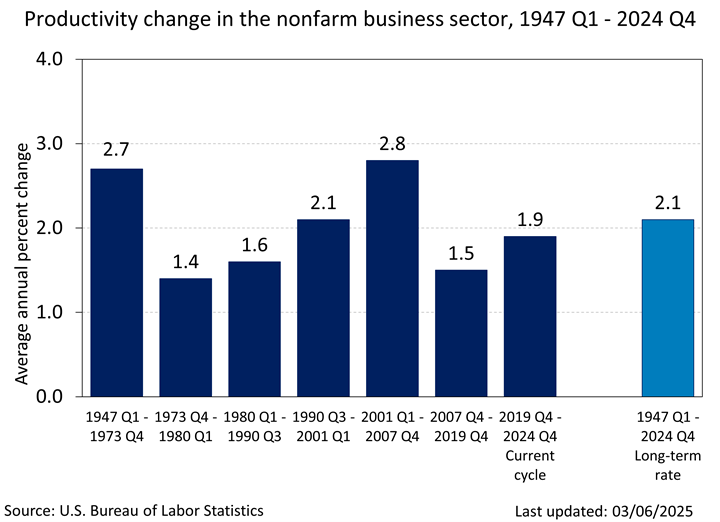
> When we feed these estimates into a standard aggregate production model, this suggests that generative AI may have increased labor productivity by up to 1.3% since the introduction of ChatGPT. This is consistent with recent estimates of aggregate labor productivity in the U.S. nonfarm business sector. For example, productivity increased at an average rate of 1.43% per year from 2015-2019, before the COVID-19 pandemic. By contrast, from the fourth quarter of 2022 through the second quarter of 2025, aggregate labor productivity increased by 2.16% on an annualized basis. Relative to its prepandemic trend, this corresponds to excess cumulative productivity growth of 1.89 percentage points since ChatGPT was publicly released
These long term data suggest that this "excess" remains bellow historical productivity growth
The analysis bellow, more recent than the one you pointed to, is from May 2026, and an even stronger argument to support your position on the side of "computer technology investment caused a delayed excess growth in productivity". And as you can see at the end of my comment, they still write a very tentative conclusion.
To be clear: I do not take a position. I think this is an open question, a very important one, and I am not fully convinced that the exponential growth in the investment on computer technology over the past 50 years has led to a corresponding gain in productivity, nor that it is entirely a drag and a mechanism for increasing firm size and driving asymmetric profitability concentrated in ever fewer firms as the increased concentration in the capitalization of American stock market index composition would indicate.
That said, the strongest case I have seen for the position that we are beginning to see these delayed gains is the letter I linked above, and it still takes care to conclude:
> As more data become available, it will be important to continue to monitor whether current patterns represent the early stages of a new era of booming productivity or merely a temporary uptick in an otherwise slow-growth environment.
> These long term data suggest that this "excess" remains bellow historical productivity growth.
That's partly because we are discussing productivity growth. Today's productivity growth is on top of the substantial productivity improvements that have been compounding due to past booms like the Computer and Internet one. So in relative terms the growth looks modest, but in absolute terms this is substantial.
Also that BLS chart is a bit unhelpful because it shows time periods covering multiple years and does not isolate the years after ChatGPT launched, which is what the St. Lous Fed looks at and finds interesting indications. Like currently productivity growth is 1.3 percentage points above what was forecasted just before ChatGPT was released. This discrepancy is not fully explained by other factors and lines up with other data sources related to the effects of AI.
The letter you linked is relevant, but it is trying to make a much broader point than I am. Note that:
1) it's asking whether we have entered a "high-growth regime" meaning a period of sustained productivity growth, and itself points out that it necessarily requires years to play out; and
2) its point of reference is the 90s when the computer revolution had truly kicked in after almost two decades of adoption starting in the mid/late-80's, during which any impact was famously hard to find: https://en.wikipedia.org/wiki/Productivity_paradox
So what is astounding is that the effects of the AI revolution may be visible in national-level economics data after only 2 - 4 years since the technology was introduced, and we're already wondering if we have shifted into a "high productivity growth era"!
I'm sorry I don't understand what you mean when you discriminate productivity growth from productivity improvement.
> So what is astounding is that the effects of the AI revolution may be visible in national-level economics data after only 2 - 4 years since the technology was introduced, and we're already wondering if we have shifted into a "high productivity growth era"!
I feel compelled to repeat the conclusion from the letter I linked. I used it as an example of how much of an open contention the productivity-from-computer-technology issue remains
> As more data become available, it will be important to continue to monitor whether current patterns represent the early stages of a new era of booming productivity or merely a temporary uptick in an otherwise slow-growth environment.
I wasn't trying to differentiate between growth and improvement, I meant to use them interchangeably, apologies for the confusion. What I meant is the relative amounts in the BLS chart are prone to being misinterpreted because that growth is compounding and the time periods depicted don't correspond to the time period we are interested in.
I realize the findings from these studies are tentative; in such a short timeframe such conclusions have to be. But I don't really see much open contention regarding the key question here, which I think is "Has AI had an impact on national level labor statistics?"
E.g. the conclusion you quoted simply says that it is not clear if this is a temporary uptick or a sustained boom. But it agrees that there has been a significant positive impact on labor productivity already, even if the impact on TFP is more modest. Which is what the St. Louis study looking at survey data, and corroborated by various other data sources, finds too.
If the question is whether this is a sustained "productivity boom", I agree that we don't know that yet. But if the question is whether there has been any productivity impact at all, I would say there are multiple indications of that.
You are focusing too much on an informal letter. There are lots - I am talking dozens - of peer-reviewed papers discussing the so-called "productivity paradox"
There is a lot more to this discussion than one time series from the BLS, I have linked just 4 that are worth skimming elsewhere in this thread.
I am not trying to prove a point one way or the other. The topic interests me and there is a lot of analysis available on the problem of finding the productivity growth in economic data corresponding to the ever increasing investment in computer technology.
To me it is clear that it is an open problem, and the literature available is a great reflection on statistical methodology in economics.
> But if the question is whether there has been any productivity impact at all, I would say there are multiple indications of that.
That is indeed the question, and I have not found one paper that conclusively states that there is clear evidence or clear absence of a measured statistical effect.
Once the previous goalpost gets demolished on HN, there's always someone new to put a new one. We aren't quite there yet but eventually the goalpost moves to something that is just impossible to even measure. That'll be the end game surely
1. the metrics you mention are hard to measure and usually lag
2. the metrics might not be moving yet, because AI accelerates everything a little bit, and most of the hype is still the promise rather than the actuality
3. people are using the gained productivity to speed up secondary tasks / do different work, because applying it to their main work is still complex or not of sufficient quality
Considering the amount of literature I have found and read on this topic so far, covering 30 years of analysis specifically in the context of productivity driven by investments in computer technology, and using data covering 130 years of economical statistics, its methodology and limitations, I am deeply skeptical of any 3 point dismissal of this problem as being easy to explain away such as your own.
I said elsewhere, I don't have any beliefs about this problem, I am deeply fascinated by the difficulty involved in productivity analyses and especially by the question of missing productivity that we should expect to be driven by the huge investments in computer technology that have been observed over the past half century - and quickly accelerating of late.
It's a fascinating topic and I intended merely to point out that quantifying computer technology driven productivity growth is a hard problem. Any facile conclusions one way or the other are suspicious in my view.
It is not clear to me at all that building and buying more computer and data centers and software is an obviously good investment that should only be increased because it raises productivity. That is the discourse, but there is a very conspicuous lack of hard data to support that claim, and lots of pages going back and forth and proclaiming at the 'conclusions' sessions of papers and chapters that the problem is indeed hard and the work done so far is at best inconclusive.
more code faster is competing against some of the largest tax hikes of the last ~70 years, economic uncertainty on what the taxes tomorrow will look like, combined with an energy crisis.
Are you claiming productivity should be growing much more slowly then it is over the past few months or years? Can you show me any analysis that supports that claim?
Because I have seen plenty of analysis published in the past 30 years that puzzle over the productivity growth stagnation in the face of an exponential growth in capital expenditure in computer technology.
So by all means share with me some of the groundbreaking results showing that we can finally see more productivity growth than would be otherwise expected by the conjecture.
There's a difference between task-level productivity, which AI has been shown to increase, and effects on the macro. You're talking about the latter while most people here are engineers considering the former.
It's still unclear if task-level productivity gains bubble up, but it's also still early and I'm not sure we should expect to see immediate results there.
> I'm pretty sure we would find an overall increase in actually useful apps
I think you're probably right but at what point does it become diminishing returns? I have observed the app market to be overly saturated for years and rarely download something other than a mobile-banking update.
It became diminishing returns years ago, long before AI.
But absent a central planner for all human endeavor, people are free to see if their particular brilliant idea will be the one in a million that gets traction.
> If we sorted through all those new apps and ignored all the crap, I'm pretty sure we would find an overall increase in actually useful apps. I just shipped a new app myself, and I think it's useful, and I wouldn't have finished mine without AI assistance.
I don’t think this is happening, at least not on any scale that makes any of this actually useful. One off success stories do not make a revolution.
It absolutely has generated a massive amount of slop, though. The problem is that you still need intent and while I think LLMs can help you free up and push through annoying boilerplate or tedious spots where known solutions exist, you still need to design these things and that’s something I’ve not seen an LLM be too helpful with.
What you're saying wouldn't be hard to prove, you're acting as if we aren't aware of usage statistics. We can even tell if MAU (monthly active users) are increasing or not for particular apps. So we are aware of them and what do they actually say?
In the gaming space, retro console PC ports have absolutely exploded in the last year. People are modding old games with 4k textures, ray tracing, DLSS 5, widescreen support, uncapped framerates, dual-screen (e.g. Ayn Thor), etc. PS5 emulation has gone from almost nothing to AAA titles in-game in like 2 months, and apparently now runs on xbox (lol).
The other day someone posted a reverse engineered GPU driver for their Mac[0].
Anyway, what makes you think those pushes aren't individuals meeting their own needs? I expect it will take a while for this to really sink in, but the future is people asking the computer to build exactly the app they want.
Also, English localizations of even super-obscure foreign retro games.
Most of those might be not as good as fan translations from dedicated people with good knowledge of English and the original language (especially for very context-dependent languages like Japanese) but they are definitely good enough to follow the story and play through the game.
whats the large hits that have happened in the past couple years?
I think ai has raised the floor quite heavily on what it takes to be a large hit.
all those vibecoded pushes are people building bits and bobs and variations on each other, instead of buying it or using a common service. If it could be done by ai, it will be written off as unimportant.
Has anyone said that AI is fixing user research, actual idea generation, marketing and audience reach? Or are you assuming that better code should be making all of that irrelevant?
It either delivers better outcomes or fails to do so for not being as general and useful as touted.
The original sales pitch from the major player in this technology hype cycle is "cure cancer, fix global warming, take over the economy". Not "more LOC".
Not OP, but I ported a legacy .NET WebForms application to Blazor. The actual code migration was completed over roughly a 48-hour period, followed by fairly extensive testing.
We were fortunate to already have a strong end-to-end test suite written in Python, so we could run the new application against the same tests and verify that the existing functionality was preserved. QA found around 20 bugs, which we fixed pretty quickly before launching.
After the migration, we also moved the application's authentication from Shibboleth to Entra OAuth and deployed it to our OpenShift infrastructure. We couldn't do that with the old WebForms application because our cluster doesn't have Windows worker nodes, so the legacy app had been stuck running on VMs. Getting it onto OpenShift gave us another operational and cost-saving benefit beyond simply modernizing the codebase.
I did this back in January, when the models finally became capable enough for this kind of work. I believe I used GPT-5.2 through Codex. Successfully completing this project is what finally got me fully on the AI bandwagon. I had used AI before, but mostly for smaller tasks like writing code, refactoring individual methods, or making isolated changes.
The application is now modernized, more stable, faster, and more functional than it was before.
I think the project worked as well as it did for two important reasons. First, I had deep domain expertise in both the application and its surrounding systems because I was the original developer. Second, our QA team's test suite was comprehensive enough to validate the functionality that actually mattered. AI dramatically accelerated the work, but there still needed to be someone who understood what the application was supposed to do and a reliable way to verify that the new implementation behaved correctly.
None of this means we couldn't have done the migration without AI. We absolutely could have. The difference is that AI made it possible to do it at practically zero cost in terms of engineering time and money compared with the alternatives.
We had wanted to move away from WebForms for years, but with the size of our team and the constant stream of new feature requests, there was never a realistic opportunity to stop development for months and focus on a rewrite. I estimate that doing the migration myself without AI would have taken at least six months to do properly. The other option would have been hiring a contractor, which I would estimate at $80,000 or more over six to nine months.
Based on my token usage, those roughly 48 hours of working with Codex to port the application cost about $150. Those were January prices, so I don't know what the equivalent cost would be today.
For me, that was the project that changed AI from something useful for assisting with individual coding tasks into something I saw as capable of fundamentally changing the economics of software engineering work.
I'm running several. They're not "large hits" but they're providing value to thousands of people. They couldn't exist pre-AI because core functionality depends on LLMs.
What you're missing is that slop has increased 20x but quality new releases have also increased 5x. Unless there's something in your niche though you'll mostly see the 80% slop so I get why you feel that way
I have this theory that the economics of AI development would make it so it's much more viable to make in-house, custom, apps rather than paying subscriptions for apps. I have even seen this play out on a personal level. A friend of mine who has no dev experience vibe-coded something custom that evite does. So it's possible measuring the number of apps miscounts ones that are not public or shared. I'm not negating anything you said, just adding something about metrics on apps.
At the 60 person smb (travel industry) I work we've taken web development in house for the first time, created new user experiences that sat on our roadmap for years, created custom AI solutions on top of our Fresh desk tooling, and (predictably) created a number of internal productivity tools.
The actual bottom line result is very fuzzy. Cost are shifting, by spending less on agencies but in return opening up new positions or shuffling people internally.
We don't see a clear increase in revenue, nor can we accurately tie retaining revenue to our AI initiatives.
Workplace satisfaction scores remain similar, with a few outliers (e.g. some people's work got incredibly exciting, while a few others are terrified by all the change).
Time will tell if this all leads to anything meaningful for the business.
i used to be in charge of these sorts of decisions for my team. the thing most people don't think about when it comes to rolling your own software is the upkeep. in other words, you don't _just_ pay for the software. you pay for someone to keep it running so you don't have to wake up at 2am to deal with angry customers.
Maybe one day but right now in order to get any meaningfully usable app with AIs you need to pay way more in AI sub than monthly sub of a bunch of apps. It doesn’t make sense right now to build especially your own if you’re not a company. Also it’s not clear how long we’ll have this heavily subsidized subscriptions.
This I can believe, also seen it on a personal level.
But I'm not sure about the long-term effects of this, we just shifted the "subscriptions for apps" to "subscription for an app" AND you must now maintain said apps.
We know it's easy to produce working code now, what's missing is useful software that actually solves a problem. What problem does that toy OS solve? The main point of toy OSes has been education, but you learn nothing when using an LLM. So all of this is just pointless energy consumption, it's not solving any real problems that people have.
Last time I looked the other app stores didn’t show anywhere near that much of a bump (that was a several months ago though).
And a few months ago I went through a random sample of new apps on the App Store and the vast majority were just wrappers for AI APIs. So it was more of a new gold rush situation than a productivity bump.
> Last year people were asking "if AI is so great then where are the new apps?". Then data for 2026 came out and now the IOS app store has a 84% percent year-over-year increase in new app submissions.
That's exactly the opposite of what I want to see. As an app store user, I want to see fewer, higher quality apps, not more shovelware or slop.
>Last year people were asking "if AI is so great then where are the new apps?". Then data for 2026 came out and now the IOS app store has a 84% percent year-over-year increase in new app submissions.
People mean where are the good new apps AI made possible. Of course it has a 84% year-over-year slop app submission.
If the cost to produce goes down, unless the demand is elastic, you'd expect fewer big hits in favour of a more fragmented, more competitive space all earning less.


For the question where are the alternative OSes? Here is one that I've seen. There's probably more - https://www.reddit.com/r/ClaudeAI/comments/1wfpydl/i_asked_c...
For that other stuff you mentioned like the right click menu. Those huge corporate projects suffer more from layers of institutional dysfunction and will be very very slow to show any improvement. Their dysfunction can't be solved with just faster coding.
Using AI to build more features is easier than using AI to improve existing projects. People will gradually figure out how to do latter too, it'll just take longer.