Amplification of commentary and opinion is much easier now. It’s also a lot easier to play into people’s fears.
There’s a wide range of political motivations for this sort of thing too. Not just AI taking jobs, but convincing people to vote against their best interests, or even supporting radical religious groups whose values would persecute you. This sort of rhetoric feels noisier than it ever did decades ago.
Sometimes I wonder if filmmakers have the right of it. They need to show what's going on in the computer to a distracted audience in a heartbeat. When they pull that off on screen, I wonder if us software devs should be taking notes.
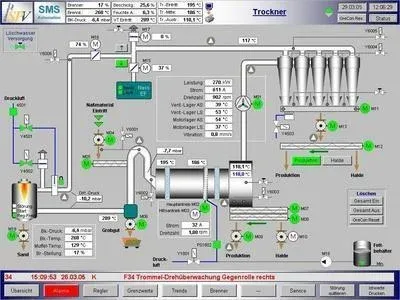
Isn't that what dashboards are for? They may not look like simplistic LEDs, but being able to "see" what the automation is doing is something everyone that's ever made automation wants to do. It starts with making logs before migrating to live dashboards.
Its basically that staring at the log patterns in graph form or system stats you get a pretty good idea of what 'normal' looks like and anomalies stick out pretty quickly.
Though having a person interpretingthe degradation progress and relaying it to the rest of the team could be a usable scene.
A guy I went to high school with used to do that for a living. I have no idea what they call it, but it's basically theatrical UI, where the screen has to act and usually deliver a bunch of exposition.
I can't recall where I saw it, there's at least one company working on this issue specifically for nursing staff. Everything beeps in hospitals, but there's no rhyme or reason to it, so room call responses are delayed, serious alarms can be missed, etc.
IIRC, the company's idea is to create a harmonious sound bed when everything's fine, and make different kinds of "out of the norm" alerts use a variety of sounds so that nursing staff get more info about what's wrong before finding the thing thats sounding an alert and looking at its screen.
This company's goal is to ... change an aspect of hundreds of different million-dollar highly regulated machines made by dozens of different multi-billion-dollar worldwide companies? And somehow make money doing this? Good luck, I guess.
Could this be resolved with a capacitor? LED can stay on for at least a second or two once the camera is off? Not sure on exact components but this feels solvable and only problem may be slim design of their laptops.
Indeed. TBH if I was running a Google- or even OpenAI-scale company (3000+ devices) I'd probably invest into creating a useful Linux distribution and hardware configuration myself (at that scale, it could maybe start to make sense).
Red Hat had most employees running a custom corporate RHEL build or Fedora on Thinkpads prior to 2018 or so, and even then most employees moved to Mac as soon as they were allowed to do so.
I was a true Linux believer, and I still switched to a Mac because I needed things to just work. Poor battery life, awful HiDPI support, strange driver issues all contributed. Yes, I could fix them. I opened bugs and could talk to the engineers responsible to get things fixed ASAP. Even so, it was a second full time job keeping up with it.
Most big tech companies let you pick Mac, Linux, or Windows. Whatever you’ll be the most productive with. Whatever you prefer. Most devs (75%?) seem to pick Macs. To each their own though.
Google just announced Googlebooks, which deeply integrate with Android, even running Android apps from your phone, on your laptop. Both amd64 and arm64 architectures available.
TIL: B-S-J-Z (China) in the rankings means Beijing, Shanghai, Jiangsu, and Zhejiang.
Instead of testing mainland China as a whole, the OECD allows these four specific provincial-level jurisdictions to represent China in the triennial PISA rankings for 15-year-old students.
It will only amount to 3% of the US population. China’s cut out amounts to 13% percent. A 1.41 billion is a lot of people and I understand they don’t want to skew the results. If just taking account that slice, which a quick search says it’s 180 million people, that reading is more than half of the US population. It’s a matter of scale. I’m sure they can add some other provinces to total the US population and still have a higher score.
TBH, its EVEN more filtered than that. Zhongkao cuts out "dumb" kids. Migrant kids with wrong houkou can't drag down BSJZ scores, i.e. "dumb" kids get filtered out. But dumb is relative, IIRC PISA does ~10 Chinese provinces, even the shit tier ones that don't make BSJZ cuts had global average PISA 20 years ago, i.e. when those places were legit impoverished. Those provinced developed a lot since, their scores should regress towards tier1 mean - relative to growth a third tier city has more now than 1st tier 20 years ago. The main skew is like 20-30% of actually dumb kinds, because they got diverted to vocational, their education fine but less rigourous.
Eitherway, hard to say, but look at proxy indicators, there's fuckload of "dumb" Chinese international students... i.e. those who couldn't hack GaoKao that are basically A students in western tertiary. And as others have mentioned, BSJZ + kids that pass zhongkao is basically more 2+ standard deviation talent pipeline than OCED combined, disproportionately directed at technical tertiary, i.e if you want to know who has most big brains whose going to be doing the cooking in the future, BSJZ is good indcator.


reply