Hmm, that seems like a pretty cynical point to make. He still deeply is in the field of mathematics, as a math educator. He even makes this exact point in this video, that communicating math is still a hard and respectable part of the profession.
As a math educator doing what you love you requires an audience.
Its kind of in Grant's incentives to push the interest for mathematics, because without an audience he won't be able to keep doing what he loves.
Like, my old uni has a history department, and had an Egyptian history teacher. This was at some point deemed a pointless use of resources because there was no role in society except for teacher of the same subject after that, and the classes shrunk, and she ended up getting offered a role in admin. She was not happy in that role.
I first think of React's re-licensing from Apache, where under the new license if you sued Facebook for patent infringement for any reason, you would lose the patent grant to use React.
React was already quite prominent in web technologies, but that license pointed a loaded gun at any business smaller than Facebook who wanted to use React. They opened it up to its current license, MIT, as the backlash built.
First off, in actually using Zola or Hugo, there really is minimal difference in syntax, and I really have to squint to see whether there is stylistic input from their host languages.
Second, people should use the tools they want to to get the job done. If they already know Hugo, and they want to create a blog, it's fine that they use Hugo.
Finally, the bigger decision that the blogger seems to be trying to make is to avoid LLMs in writing, which I admire, and IMO is the far more important technology choice in making their blog.
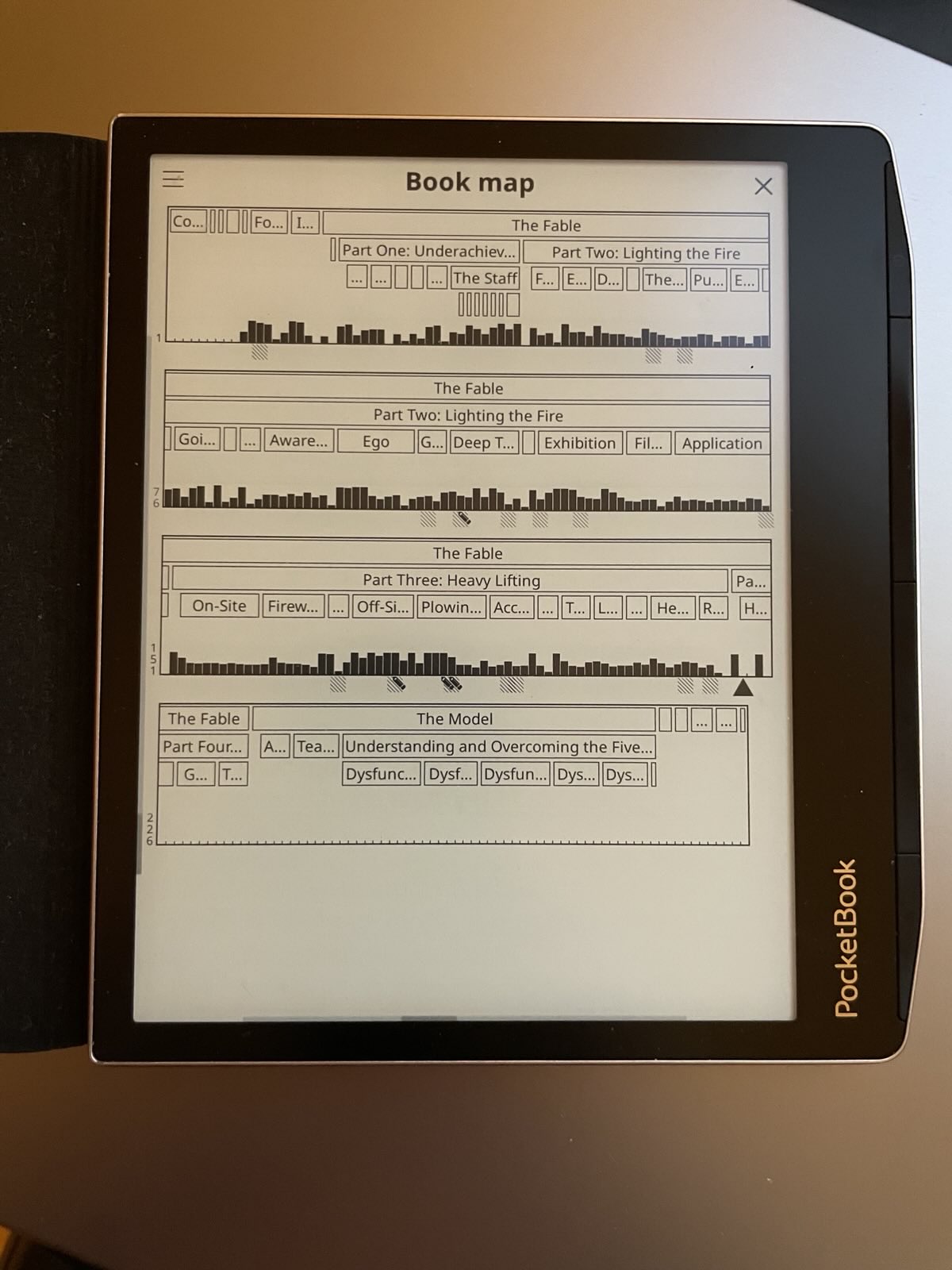
The thing I find the most valuable on KOReader is something I haven't seen mentioned yet: the book map[0]
It shows you chapter and section divisions in a single screen, along with black bars to show you which pages and chapters you've spent a lot of time on. I use this very often to jump back to pages or chapters, or look at which parts confused me. It also visualizes where bookmarks and notes are. When you want to see a segment in more detail, you click there and it brings you to a 6-page zoomed-in view.
Let alone being more useful than the Kindle or Kobo UX, it's more useful than the book UX.