No one is forcing Mozilla’s hand (afaik) and no one is actually thinking “if Firefox had a chatbot that might convince me to move over”. Youre right that it is not a “both sides” thing, its a “Mozilla thing”. Through and through.
Business 102, something that's obvious to anyone who's ever worked a customer facing job but incredibly elusive to a lot of people who went straight to management, is that some customers are net negatives and you should not cater to them. They have some combination of ignorance, stupidity, and/or malice which results in them costing more employee time and/or "goodwill" than you'll ever make from selling things. Your business is better off not having them, and even better if they go off to inflict themselves on your competition.
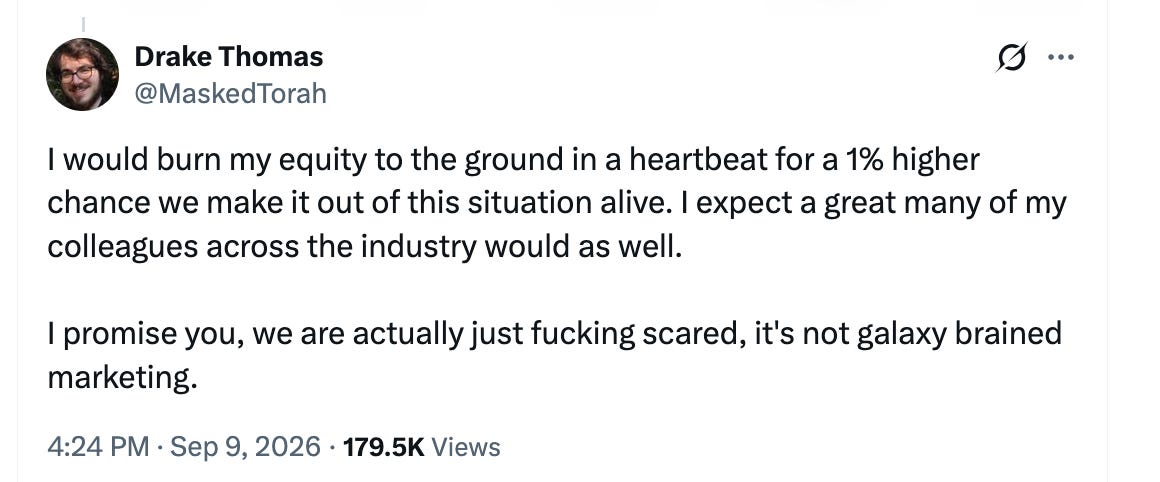
Is this belief falsifiable? Consider e.g. the fact that Daniel Kokotajlo left OpenAI due to his concerns even though it meant leaving equity on the table.
The language doesn't really cover things correctly.
You don't expect privacy in public in the sense that you might bump into other people that know who you are.
That doesn't automatically mean that you expect walking into a public area means a system will start investigating you and seeing if you match with crimes.
Assuming everyone in public is a suspect and continually investigating them, is a big change in how society works.
It's the same with all of these issues; the frog always gets boiled. In the same way the people who drafted the Constitution/Bill of Rights couldn't have imagined AR-15s, they could never have imagined a (practical) surveillance network capable of tracking people (historically and in real-time) in the way Flock, Axon and these other shady fucks do.
>Assuming everyone in public is a suspect and continually investigating them, is a big change in how society works.
Well that's not exactly how it would work.
Everyone is tracked, but only certain people are watched. That added to the fact that any nation with a sufficiently complex legal system has no law abiding residents. You've always broken some law, somewhere.
So it would be more like:
>[Pick any person from] everyone in public [and the system has the capacity to list the reasons why that person] is a [criminal]
These systems aren't perfect recognition oracles - there are lots of errors, especially as you scale up the technology. At the end of the day, it's a probabilistic identification correlated to a stream with a mix of of reported or suspected crimes. Your framing completely misses the reality. I'd argue that the OP's language is a much better fit.


reply