What are you worried about? All the worries seem like bullshit to me. Like we're not going to have some runaway skynet thing, that's just completely off the table. These things run on data centers, we can just turn off the data center if we need to. I don't really see that becoming necessary either but we could.
And then there's fears that someone might use it to engineer a super virus or something like that, which isn't really a new worry. People could do that before too, but it turns out creating a global epidemic isn't really a thing very many people want to do, and it's harder than most people imagine.
"AI" are just chatbots. They can't fabricate robots to take over the world, in fact they have very limited reach into the real world altogether. Sure maybe you could envision some kind of malicious hacking, sabotaging some industrial control system to create a disaster of some kind or whatever but that was a worry before AI too which is why most critical systems like this are air gapped and have safety mechanisms.
So I really just don't understand how people think AI will destroy the world. And I think its especially frustrating to see all this energy going into AI-related despair when climate change actually is on the brink of actually destroying the world in a completely real and concrete way, but most people don't give a shit about that. Some people will say it's natural cycles or some other variant of denying the problem, others will say it's not a big deal, yet others will say science will solve it, we'll capture the carbon or spray aerosols into the atmosphere to stop the warming etc.
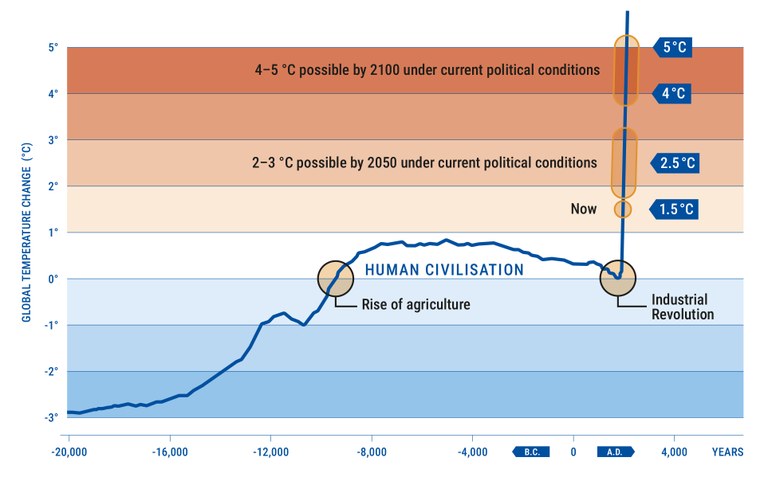
And they're all wrong. It's not natural cycles - shocker, climate scientists know about natural cycles. It is a huge deal. We're at +1.5c now and it's already having huge compounding effects. Warming is accelerating, we'll likely be at +3c in just a few decades. That is already approaching apocalyptic levels of warming.
Carbon capture is a joke, there is absolutely no way carbon capture solves climate change. We would need tens or hundreds of thousands of carbon capture facilities all over the globe, it would be the largest engineering project in history by orders of magnitude. There would be many times more capture facilities than power plants. Nevermind the energy, concrete, chemicals etc required to build and run all of them, not to mention actually deal with all that carbon they would be capturing. It's not feasible.
Climate engineering would be highly experimental, and it would also be a gargantuan project requiring enormous economic investment. It would likely have huge unintended consequences, and it might not even work. It might also have different consequences for different nations creating huge political issues - what if a country does climate engineering that's good for them but disastrous for their neighbours? Is it even possible to do climate engineering in a way that isn't bad for someone? Is it even possible/feasible to do it on the scale necessary to actually combat global warming?
Yeah I don't know why people are panicking about AI, if there's anything you should be panicking about it's global warming.
I'm quite concerned about climate as well as our other horrific environmental problems, but there can be more than one giant existential risk at a time.
I'm not concerned about today's AIs. But three years ago they couldn't add numbers accurately and now they're doing world-class mathematics. If it gets much smarter than us, then it will run the world economy, because anyone who doesn't use it to run things will be outcompeted by those who do. At that point we'll have lost control.
The way I see it we already have lost control. Hell, maybe we never had control in the first place. We've known about the effect of greenhouse gases for over a century and we still keep investing into fossil fuels. Because "economics".
If we had control we would have looked at the situation and gone balls deep into nuclear and other green alternatives many decades ago.
Some people certainly have been diving into nuclear & green for decades, and we now have far more wind, solar, and hydro power than we did several decades ago. Nuclear has been flat for only 2 decades and is about to start growing.
“We” certainly have had control the whole time, “we” have been consciously creating greenhouse gas emitting machines while knowing the consequences. It is the economics. The delay in environmental consequences combined with the immediate financial benefits of easy power & transportation made the choice too tempting for some.
The kind of control you’re talking about is self-control. We’ve always had the option to stop our bad behavior, and we chose not to. And we still have the option to exercise self-control with AI. The question is whether that option might disappear soon. Can AI get good enough that we will actually lose the choice to regulate ourselves?
> "we can just turn off the data center if we need to"
1. If it never happens or AGI is friendly then we won't need to. If a hostile AGI is created, one trained on all writing about war and strategy and deception, able to respond in microseconds, with has ample time to plot before it makes an obvious move, then thinking you will wait until you see it attack and then turn off a datacenter, is way too little, too late. Like saying "the nuclear bomb explosion is local to one place, if it hurts, we will just walk away from it".
2. That claim does not hold water once you start to dig into who, specifically, would turn off which specific billion-dollar datacenter, under which conditions. Google has been moving compute jobs around the planet to get nighttime electricity rates for bulk compute jobs for years, the idea that there is "one datacenter" is far too simple. The idea that employee 74,123 at Meta doing AI research is also able to get a Meta datacenter shutdown quickly on request, or would know enough about Meta's infrastructure to know which datacenter, seems unlikely. The idea that it even has one off switch, or that nobody will quickly power it back on, or that the compute jobs will not pick up automatically somewhere else, or that nobody else on the planet will be at a similar point in their research, also seem important.
3. This assumes there will be a simple critical point that makes it clear we need to "turn off datacenter now". The fact that you then go on to talk about climate change, imagine you had said "we can just turn the factories off if climate change becomes a problem" and maybe that will make it clearer. Who will turn which factories off, at what point in the climate catastrophe, and why haven't they? That's why it won't happen with datacenters either.
> "Like we're not going to have some runaway skynet thing, that's just completely off the table."
You're confident that tens of billions of dollars of investment and research, US v China national AI competition, some of the largest companies in the world researching AGI will be a flop and develop nothing? Despite the progress from GPT2 to present day, despite historic analogies like the Wright Brothers to the Moon Landing in one lifetime?
NVidia shipped an estimated 40 million GPUs in 2025. Say they average 1 TFLOPS each and a year has 31 million seconds, that's 1.2 million million quadrillion calculations in a year. That much compute power piling up around the planet year-on-year is not going to be important or relevant to the near-medium term future? Because it's just "off the table" that anyone could invent anything interesting with that much growing compute in the next ten or twenty years?
They get electricity through cables. You nick the cable, end of story for the datacenter. Dataceters in space, welll.... not a good idea. When AI systems gets hooked to humans via brain interfaces and human like robots, well we'd better start worrying.
That doesn’t address any of the points I raised about who would make the decision, or about compute jobs moving to another data centre, or about a dangerous AI deceiving that it was stupid until it had a plan to account for that, or an AGI responding much faster than humans, but it raises new points - how do you “nick” a 20 MegaWatt power feed without dying, and what do you do about the batteries and generator backup in a secured area?
Now are you imagining that the employee who can’t ask for a data centre to be shut down, can call the military and telling them a self-improving AGI is about to destroy the world and they need to attack an American company?
> What are you worried about? All the worries seem like bullshit to me. Like we're not going to have some runaway skynet thing, that's just completely off the table. These things run on data centers, we can just turn off the data center if we need to. I don't really see that becoming necessary either but we could.
Also, there's a whole bunch of companies pursuing space-based data centres, which I think are dumb for a lot of reasons, but not quite dumb enough to not be a threat in this kind of manner as a few thousand GPUs is entirely doable before anyone decides it's not value for money.
Also, we demonstrably have useless-to-just-bad monitoring in place, which is how all the things on https://www.felonybench.com happened. That the companies could have done better, and should have done better, does not change the reality that they in fact did not notice until after the events.
Also, there's at least two companies putting these things in control of wet labs. Good news: they're currently too bad at this to pose a threat. Bad news: "currently" is doing the heavy lifting.
Also, there's a lot of people who are blindly using agentic AI and not checking anything, despite all the advice and case studies about why this is a bad idea and to not do that.
Also, there's a lot of people e.g. on Hacker News whose response to all the attempts to create guard rails on the AI's behaviour is to call this "censorship" or "a lobotomy"; and also a lot of people whose response to calls for regulation of the companies is that this is "regulatory capture". (Worse news: The US president has rejected calls to slow down AI, saying "whoever wins AI, wins").
> And then there's fears that someone might use it to engineer a super virus or something like that, which isn't really a new worry. People could do that before too, but it turns out creating a global epidemic isn't really a thing very many people want to do, and it's harder than most people imagine.
The number of people able to do so has likely gone up by a factor of 10x or so in the last decade. AI's ability to use tools on behalf of their users is a further amplifier on this, unless safeguards are in place. Bad news, "safeguards" is a pretty vague term, and vague platitudes are not enough.
More worrying is the possibility that some idiot will set biology challenges similar to the cybersecurity challenges which led to HuggingFace, with similar lack of oversight, and the agents will do much the same thing but with DNA/RNA-on-demand services. I really hope their equipment is better secured than HuggingFace was.
Good news: the agents in the HuggingFace incident did not act with what would be called destructive "intent" if a human did it. Bad news: they still did the things.
> "AI" are just chatbots. They can't fabricate robots to take over the world, in fact they have very limited reach into the real world altogether.
No, they're not "just" chatbots. They're also tool users that can see.
Good news: yes, they can't fabricate robots. Bad news: Guess what Musk is trying to do. Good news: Musk's timelines are wildly overoptimistic.
> Sure maybe you could envision some kind of malicious hacking, sabotaging some industrial control system to create a disaster of some kind or whatever but that was a worry before AI too which is why most critical systems like this are air gapped and have safety mechanisms.
Bad news: We're really bad at properly air-gapping stuff. We only know about Stuxnet because it breached an air-gap. This kind of thing happens a lot, even for really important stuff.
> So I really just don't understand how people think AI will destroy the world.
Ultimately, all it needs for this is to do what it was told, instead of what was meant.
All humans acting perfectly would prevent all the bad outcomes I can think of, but (1) that never happens, and (2) "that I can think of" is doing a lot of heavy lifting there.
> Yeah I don't know why people are panicking about AI, if there's anything you should be panicking about it's global warming.
People can care about more than one thing.
Look, you're worried about climate change: AI appears to be quite effective at convincing people of stuff, just consider how bad it would be if all the people who get rich from greenhouse gas emissions outspend environmentalists on AI-driven PR/marketing.
I don't understand what you think this conversation is about. It's not "die quick and painless at 45 or excruciatingly painfully at 80" it's just 45 or 80. Nobody said anything about excruciating pain except you.
Do you think your dad would prefer to die exactly the same way at 45 instead? No? Great, conversation over.
Gas produces about 40-50% less CO2 per unit of electricity produced, than coal. Not 85%.
As far as I'm concerned, a planet that is able to support human civilization ranks just a bit higher on the priority list than a diverse power grid and economic viability.
Economic viability is how we support human civilization, no? Economics is literally observing how humans interact and prioritize scarce resources like time and materials. So being not economically viable means it not happening.
Is your goal to reduce global temperatures? If so, it needs to be a sustainable effort. You don't get sustainable effort without economic viability.
If your goal is to dramatically reduce temperatures in the next 5 years, why not dump SiO2 in the atmosphere? That would bring the temperature down pretty fast by reflecting out sunlight in the upper atmosphere.
But if your goal is long-term change, we need an approach that works long-term.
Edit: sorry I forgot to mention your point on coal vs natural gas efficiency, I didn't realize it was not that much gain. I still think it's worth it though, since it's still making progress.
The problem is if you spend the next 5 years building new fossil fuel capabilities, the economic payoff won't be for at least 10 to 15 years more years. We absolutely should not be burning natural gas at that point. Not only would it cause continued havoc on our environment, zero emissions alternatives are already extremely cost competitive in most parts of the world. We should spend the next 5 years, instead, building for the future, not sinking our money into assets that will only cause further harm without providing any real cost savings.
Large scale battery storage, by the way, is already a mostly solved problem, and possible to do at a cost competitive price.
Excess atmospheric CO2 levels in and of itself are a health concern. Geoengineering will not help with the human toll of increasing CO2 and decreasing O2 levels
The only reason fossil fuels are "economically viable" is because we're ignoring the cost of the destruction they will bring in the future, and are already causing today. Nuclear is economically viable. We already have lots of nuclear power. Maybe it's a bit less profitable than fossil, maybe if we invested more into it it would be more profitable. Either way it seems entirely viable to me, except of course for all the trillions of dollars being made by extracting and selling fossil fuels to the detriment of all our futures. The only reason alternatives aren't "viable" is because they're priced out by fossil fuels. Take fossil fuels out of the equation and lots of new things become viable.
How is dumping SiO2 into the atmosphere economically viable? How do you make money doing that? If you're thinking that governments should pay private companies to do it, why can't governments simply pay private companies to produce clean power instead? Without having done any actual research on this topic, I suspect you might find that this would be far more "economically viable" than paying for the experimental climate engineering that might not even work, and might have devastating unintended consequences. For example I imagine shitloads of fine sand in the atmosphere would be a problem for aviation, and that's probably far from the only issue with it.
I've started drinking malt beer. I think it's basically pre-ferment beer, so it's non alcoholic and a bit sweet. I like to mix it with Sprite Zero, something like 3 parts malt beer to 2 parts sprite. It's also good on its own.
It's delicious and alcohol free, it does have a lot of calories but mixing it with calorie free soda gets you a bit more bang for your calorie buck so to speak.
I agree that using LLMs to review code can be valuable, but I think the submitter should perform this review (or you could automate it) and then once the submitter has fully finished the feature and believes it's ready it should be reviewed by another human.
I'm not interested in being a middle man between Claude and my colleague, nor am I interested in using a colleague as a middle man between myself and Claude.
Some times I do, but no not really. If it's just a simple change of one or two lines I'll do it manually, but larger changes are much faster with AI.
I'll lay out a vague plan and let the AI fill in the blanks, mostly it'll get them right and where it doesn't I'll just tell it to do it differently and how. Works great for me.
If we needed more nuclear fuel we would be producing more of it. Comparing current production to a world where we use a thousand times more of it is ridiculous. Uranium is not that rare, and spent fuel rods still have well over 90% of their potency so they can be recycled.
Nuclear energy could easily power the entire planet for thousands of years.
Sure, we could produce more. It would have to be from much lower grade ores, and so would be much more expensive and disruptive. This is why breeding would be needed, so the cost of the uranium would not make nuclear even more unaffordable than it already is.
The argument about affordability is quite ridiculous in a world that is becoming uninhabitable as a direct cause of the "affordable" alternatives.
We could easily afford to use nuclear, and we wouldn't have to rely on it entirely - we have many alternatives such as solar, wind, hydro, geothermal etc. I'm also quite confident that economy of scale would improve the fuel cost, and the higher investment would make breeding and other nuclear technology advancements much quicker than they are and have been. Not to mention fuel cost is quite insignificant in nuclear energy.
We can however not afford the consequences of fossil fuels. We are already severely impacted by global warming and it will get much worse very quickly. I think this chart conveys the severity of our situation very well: https://www.dpg-physik.de/veroeffentlichungen/publikationen/...
Affordability most definitely figures into which avenue forward should be taken. It cannot be used to justify fossil fuels over nuclear, but it can be used to justify renewables instead of nuclear.
Nuclear doesn't have a "get out of economics free" card just because fossil fuels are to be eliminated. I understand the desire of nuclear fans to pretend otherwise.
I'm not a "nuclear fan", I'm a "don't destroy the planet fan". I'm not saying we should build nuclear instead of renewables, I'm saying we should build it instead of fossil fueled generation. It seems you agree with this, so I'm not sure why you seem to be arguing against it.
Until the day that we stop burning fossil fuels entirely, we should be building nuclear to replace it. If it's more expensive that's fine, I don't think it would be, at least not significantly, but I can't prove it and I don't care either way, it doesn't matter. What matters is replacing fossil fuels as fast as possible. It's probably already too late, and the powers that be don't give a shit anyway so none of this will actually happen but this is what we should do.


And then there's fears that someone might use it to engineer a super virus or something like that, which isn't really a new worry. People could do that before too, but it turns out creating a global epidemic isn't really a thing very many people want to do, and it's harder than most people imagine.
"AI" are just chatbots. They can't fabricate robots to take over the world, in fact they have very limited reach into the real world altogether. Sure maybe you could envision some kind of malicious hacking, sabotaging some industrial control system to create a disaster of some kind or whatever but that was a worry before AI too which is why most critical systems like this are air gapped and have safety mechanisms.
So I really just don't understand how people think AI will destroy the world. And I think its especially frustrating to see all this energy going into AI-related despair when climate change actually is on the brink of actually destroying the world in a completely real and concrete way, but most people don't give a shit about that. Some people will say it's natural cycles or some other variant of denying the problem, others will say it's not a big deal, yet others will say science will solve it, we'll capture the carbon or spray aerosols into the atmosphere to stop the warming etc.
And they're all wrong. It's not natural cycles - shocker, climate scientists know about natural cycles. It is a huge deal. We're at +1.5c now and it's already having huge compounding effects. Warming is accelerating, we'll likely be at +3c in just a few decades. That is already approaching apocalyptic levels of warming.
Carbon capture is a joke, there is absolutely no way carbon capture solves climate change. We would need tens or hundreds of thousands of carbon capture facilities all over the globe, it would be the largest engineering project in history by orders of magnitude. There would be many times more capture facilities than power plants. Nevermind the energy, concrete, chemicals etc required to build and run all of them, not to mention actually deal with all that carbon they would be capturing. It's not feasible.
Climate engineering would be highly experimental, and it would also be a gargantuan project requiring enormous economic investment. It would likely have huge unintended consequences, and it might not even work. It might also have different consequences for different nations creating huge political issues - what if a country does climate engineering that's good for them but disastrous for their neighbours? Is it even possible to do climate engineering in a way that isn't bad for someone? Is it even possible/feasible to do it on the scale necessary to actually combat global warming?
Yeah I don't know why people are panicking about AI, if there's anything you should be panicking about it's global warming.
reply