This. I hate that Claude Code is taking the fun part of my job, but the reality is that Claude Code Opus 5 can one-shot a script in 15 seconds that would have taken me 45 minutes to write.
I don't begrudge the business for making the prudent choice of making me use AI, I just sort of lament that what I spent years enjoying and getting good at was so utterly derivative that it was perfect for the LLMs. It would be insulting if it weren't just a fact.
Every time you don’t write the script you lose a little of the ability to do so.
Just like if you don’t read you will lose the ability to.
These skills are not innate to us and can be forgotten over time.
I wonder if it will get to the point where people don’t even know what to ask for. Or how to judge if what the machine produces could have been better. Or if it does what they think it does.
Yes, sadly, coding is a skill that can and (before long) will be forgotten by all but a niche dedicated few. It will go the way of assembly language, smith-ing, weaving, bread-baking, meat- / fish-gutting, hunting, remembering phone numbers, driving manual (and, before long, driving in human mode), hand-writing, horse-riding, wood-chopping... you get the picture. The price of progress!
Not wholly. It’s under study. I don’t mean in the sense that you can’t read words anymore. I mean in the sense that comprehension and attention go down.
I don't know that anyone suggested it wasn't OK to enjoy programming.
My problem with AI is that it now excels at the part of the job that was my favorite (writing code) and it leaves me to do the part that I suck at (being a manager). In 18 months or so my job satisfaction has gone from pretty high to abysmal.
Look, people are going to pile on and talk about how much they enjoy coding now.
Those people have processed this change differently or sooner or later than you have.
This is ok. You will process the change, and you'll come out stronger for having done so. It takes time to decide what you want to do in the world, and even more time to decide how to react to the world changing and moving away from your planned path. And it takes even more time to actually see if the world is moving in a way incompatible with your plans.
It will be tempting to cycle into negative predictions and negative self-talk. This will not help, and will not be productive.
You, ryandvm, built a career around something you love, and that is amazing. You can choose to do it again, to find something you love, to be stalwart about how you work and who you work with, or any number of other options. The thing that nobody can change is your agency.
I struggle with the nature of work every day, and have for months. It has caused me to re-evaluate what I work on, why I do it, how I structure my finances, where my kids go to school, literally everything. Still the ship turns, as it must.
You sound like you're processing this well. I think I'm in the group of people you're talking about who aren't processing it well. What kind of conclusions have you come to regarding that list (what you work on and how, finances, kids, etc.)?
* I made the classic mistake of assuming the present was permanent. It never is anyway, small changes always ruined the present. The accumulation of small changes over my career has changed the way I work probably as much/more than AI has changed it this year, if you can believe that.
* I discussed the family budget with my wife, and made a plan to halve our income requirements. It will require a race in the short term, but allows a coast later on. This is key for me - almost all my tension regarding this phase is about the future earning potential of our household. If that goes away, who cares how work changes?
* I made the other classic mistake of not remembering how much I have changed and adapted over time. The breadth of things I have worked on is pretty remarkable, and the things I have learned to do are crazy. While things are changing fast now, they aren't changing quite as negatively or immediately as some claimed they would. There's room to adapt.
* I stopped assuming I had to work the way people said I should. Aside from CEO mandates, there's a ton of wiggle room in how you produce code. I read changesets and make manual adjustments to the pattern, etc. I write my own parts when I want to. I specify a design that I want rather than asking for whatever the AI wants. I get to own everything but the typing that way, and my RSI is improving dramatically b/c of it.
* I use AI to set up programming challenges when I feel disconnected. It sets up a tangible problem, and acts like a coach only when I need it. I use this to preserve the feeling of sharpness. Earlier this year I challenged myself to write, in C, from man pages only, a "ping" and "traceroute" clone. I did so on a flight back from a work trip.
* And I started reaching out to friends to hang out more. It's hard to doom about AI when your friends and you are having a beer and playing Container or Captain Sonar. Life has always been what's "out there" not what radiates from your monitor.
All of what you said is wonderful, and I want to particularly call out this:
    I stopped assuming I had to work the way people
    said I should. [...] I get to own everything but
    the typing that way
I think this gets to the heart of my disconnect with the "I miss coding" crowd. I still get to do most of the stuff I found fun w.r.t. creating software.
Typing the actual lines of code was fun, sometimes, but it was never the goal. I feel like I'm still solving the same problems.
I agree 100%. I did enjoy writing code, but at the end of the day, it's the building/designing/problem solving that I enjoy. Whether it's related to software, woodworking, small engines, etc.
From a recent post here on HN, my agent stored it without the URL, it exists just as text for me to get philosophical with, I do that with insights such as above, so here is a quote:
Derek Thompson, in "I Know Why the Mathematicians Weep": "If intelligence becomes less uniquely human, we may come to value more highly what remains uniquely human: our capacity to relate and to care for one another".
Funnily my bot was called Cladius van der Bot, nice name ;)
There are actually a lot of professions that either directly or indirectly rely on that. For example, therapists and social workers of many stripes, actors, writers, musicians, etc benefit directly from that, for at least some sub-disciplines/genres. Indirectly, almost every job where you interact with others directly to provide a service or sell a product (which is many, many things, and more than might first come to mind).
I doubt most people will be developing a rapport with an AI agent trying to sell you that contract at work, or helping you when you're irate and have escalated a problem a few times.
> There are actually a lot of professions that either directly or indirectly rely on that. for example, therapists and social workers of many stripes, actors, writers, musicians, etc benefit directly from that, for at least some sub-disciplines/genres.
All of those except for therapy are awful career fields. Musicians, actors, artists (outside the tip top of the field) are all the butt of jokes about how broke they are. Social work chases people out once they realize how powerless they are for such poor pay.
Therapist might make out well for a bit, but it seems like a loaded term these days .
> All of those except for therapy are awful career fields. Musicians, actors, artists (outside the tip top of the field) are all the butt of jokes about how broke they are.
If you're aiming for the top, sure. There are plenty of people who make a living doing stuff like that and are happy because they enjoy it. You're unlikely to be one of those people if you move to an area where there's an extreme over-supply and try to "make it big", or try to be "pure" to the art and eschew commercial options. e.g. An actor in LA, the starving artist in a loft in NY.
> Therapist might make out well for a bit, but it seems like a loaded term these days .
Loaded how? I was thinking of psychologists, licensed mental health professionals, physical, occupational, and speech therapists.
i dont meant to come across as too harsh, but that is something that you will have to figure out. if companies are less inclined to give salaries for technical skills, then its on us to figure out how our current skill sets become marketable.
even the job of freelance engineer is customer relation. how good are you at extracting product requirements? understanding a clients workflows? these take relational skills and are often what freelancers are paid for, beyond the ability to produce code.
It's about as specific as we can get atm I guess. I have no idea, I just know we VALUE human connection, there is unique human value in it. We value each-other.
Maybe we just sit around campfires and tell stories as the billionaires warm their hands on their burning data centers.
Don't forget that everything anybody owns is just a system we invented, my house, my garden, only a piece of paper that we all accept keep others from it.
We can reinvent ourselves. Idk, to me this is a comforting thought. But I agree it's still lacking. It's not simple, discussing things online helps develop language and vision around it.
Speaking of inventiveness: I was listening to a history of hip-hop, and I started imagining an alternative past, with LLMs arising in the 80s, and AI inventing rap and rap culture. That fantasy is instructively ridiculous, AI doesn't invent things, it isn't cultural.
Specifically, LLMs are stochastic creations which as such are strongly mean reverting in their generation. If you want to compose something delightfully new and different then an LLM is extremely unlikely to produce what you want, though it will fail quickly and with complete confidence.
That wasn't my intent. The intent is that the prevailing pushback that coding is more fun now doesn't apply and need not. That OP has to come to terms with that they want from the new world, even though nobody can say for sure what they world is, other than "currently different"
You could divide "your future" into two paths, conservatism (not the US amalgamation) and "missing the times that'd been", or continue move forward and adjust as the world change, which it always will, both in positive and negative directions. Things are changing, this is hard to disagree with, even if people disagree how things are changing, most people probably need to rethink a lot of their assumed perspectives, as I too had to do, faced with what I believe to be new realities.
I don't feel like it's patronizing to remind people about achievements they've accomplished and that they're still a capable person. Nothing we say to each other here on HN should be taken as "This is how you must live you life" but more like "Here's is something I hope helps you, if not, no worries", as we hopefully assume good faith out of each other.
Really wonderful comment. Thanks for sharing. I've noticed myself spiraling into doom-and-gloom scenarios about the future of this job (and therefore my future), and I've found it really unhelpful and really unproductive, in the sense that it sort of narrows my mind into a tunnel vision of decreasing possibilities.
I too have lost something I loved, I gained it after years of relentlessly focusing on maximizing what I loved and minimizing what cost me energy. And now the world flips on me.
The good news? I got pretty good at consciously finding the energy givers and drainers and optimizing for the givers, so I'll just keep doing that. I'll either start enjoying micro-managing LLMs, or find something else entirely. Or find that the LLMs need less and less micromanaging, or start enjoying whatever they need next year. (Point an army of agents in a direction?)
I came from the molecular biolab with Linux as a hobby, then when to software dev and infra. What's next ? Idk, I still love biology, keeping eyes and ears open...
The job description fundamentally changed to the point where we're expected to do something very different.
No amount of processing will move someone from ordering a steak to just enjoying their given peanut butter sandwich instead. They ordered the steak, and now the restaurant is telling us all too bad there's no steak anymore - eat your damn sandwich.
I don't think the metaphor works because a job is an agreement to exchange labor for money, not a service or a product that you purchase. But for the sake of argument, let's grant it. If a restaurant gives you a peanut butter sandwich instead of a steak, you can go to another restaurant that provides better service. Similarly, if an employee doesn't like the terms set by their employer, they can move to a different company, or start their own company on their own terms.
To quote the lovable DHH, "writing code by hand is no longer an economically viable activity"
To adjust the metaphor a bit.. the cows have revolted and we can no longer get any steak.
If writing code via AI is an order of magnitude faster there won't be companies hiring people who want to code by hand. If you try to start a company by doing so then you'll lose to competitors without that restriction.
The choices left are: be homeless, change careers completely or suck it up and do something you don't like after being career-catfished
When you think through the 'change careers' path it also sucks and might not even be viable for many
I'm lucky I like coding with AI.. but I have worked jobs I hate and it's hell, and there's no amount of processing it that'll fix it except getting out of the situation
A non-zero amount of people are preparing (or have already) to leave the industry entirely.
Even if one were to continue doing everything by hand, it will still be harder compared to others who aren't. As in, companies will come to expect more/faster work than you are capable of, so it still affects us old farts that don't want to change.
We'll find something else, sure, or just retire... but not everyone is/was ready to.
I'm not sad on a personal level per se, I can still be positive and look to the future, but I lament what we increasingly no longer have.
I think this is basically the right attitude. The focus should be on what you really value intrinsically, and what changes you want to see in the world. Those determine the goals you set, which determine how you choose what to learn, what to work on, and what tools to use. The metaphor of a "career path" was always questionable, but even more so now. The most important skills are dealing with uncertainty and ambiguity and being able to adapt to new circumstances.
The thing about this debate is that "writing code" is not at all an atomic task. You need to actually type out code of course, but also edit, think, analyze, design... (not meant as clear or non-overlapping categories; but you get the idea) and you might feel very differently about some of those things than others.
Am I insane? I could never imagine speaking to somebody like this in real life. I'm not saying this was ill-intentioned but there's something about this comment that comes off as REALLY weird to me. It's like religious/cult-speak.
You're not insane. And if you are insane, you're not alone, because I used to get a similar feeling when I was first exposed to this kind of discourse. It creates cognitive dissonance in people like you and me, because you can clearly see that it was well-intentioned and grounded in the idea of empathy, but it ends up lacking empathy in ways that people like us consider important.
The comment you're referring to aims to be helpful and empathetic, but the fundamental problem with it is that it essentially dismisses the very real problems people are raising. It tells you that the change is inevitable and that you shouldn't and/or can't fight it. It tells you that what you're dealing with are your own feelings and, although they're "valid" (in the sense that it's understandable and human to have them), you need to work on overcoming them or finding a way around them. And if you can't, then you should either move out of the way of the progress or you'll remain unhappy.
It's an incredibly frustrating way of being talked to, one that I've seen managers employ quite a lot. I call it the "management aikido", because it takes your own impetus and turns it back on you, by reframing whatever issue you brought up to put the onus on you. Most of the managers I've seen use this technique believe they're doing a good thing by "empowering" you to deal with problems. What it does, in fact, is discourage you from raising issues in the first place.
On top of having the same "management aikido" vibe, @jvanderbot's comment ends up being "socially insensitive", for lack of a better way of describing it.
Over the course of history, we've seen great shifts -- typically tied to technological evolution -- that caused significant suffering to a group of people but (arguably) ended up being a net positive for our society. And when we look back, we inevitably feel a sense of empathy for those people and we recognize that what happened to them sucked and we express the hope that maybe next time we could do better as a society.
And then it happens again, like it's happening now, and we not only fail to do better as a society, but we talk like trying to do better is unreasonable.
That, in essence, is what makes @jvanderbolt's comment sound "religious" to you: the unquestioned assumption that what is happening is supposed to be happening and that it's you who has a problem that you have to work on.
Yeah I think you nailed it. I also think there's a degree to which we pretend victims of economic injustice aren't "real", for lack of a better word.. If the original comment was re-framed around vehicular manslaughter or rape, I think people could more clearly see that it isn't really empathetic. That's why the sheer reaction that it got from so many people kind of blew me away.
I'm definitely stealing "management aikido" by the way, thanks for that. :)
> You, ryandvm, built a career around something you love, and that is amazing. You can choose to do it again, to find something you love, to be stalwart about how you work and who you work with, or any number of other options. The thing that nobody can change is your agency.
I've always taken the view that it was luck - lucky that my interests aligned with the market, lucky the market put value in what I am interested in doing, and lucky that I was given the chance.
I was never in it for the money, I was always in it for the enjoyment, and I will remain in it for the same thing.
The market for my knowledge and skills might come and go, there might have been a brief moment in history when someone like me could make a living off these skills, but like so many other creative careers that time was always going to be fleeting
Writing code was the "downtime" for me, it existed between boughts of intense problem solving. With AI agents my time is shifting heavily towards solving problems and I have less downtime as a result.
With LLM and current economic situation my job is doing 5 things at once and after 7:30h my brain is just in panic mode. On remote this isn't a huge issue but in the office (which I'm obligated to be twice a week) I just don't know what to do so I eat 3 meal 5min each pretending this is normal.
Then the next day after this brain haemorrhage inducing experience I just waste 2h remotely on gathering mental capacity to simply know what next I need to do and next 2 says I repeat until weekend.
Simply because my boss is developer in love with LLM and machine gunning 20 PR daily.
Not to mentioned PR with more code than I can reasonable can understand and say anything about it in a project I didn't touch.
So, currently I can only say I hate my life. I'm looking for an idea which pays similar but is as mindless as humanly possible
I don't know your full situation, but as someone who has gone through full-blown real burnout: it's not worth it. In this economic situation, we do need to grind to keep our jobs but if you're getting close to burn-out I would *strongly* advise prioritizing avoiding burnout.
I went from being a passionate programmer spending all my free time working on code, to be unable to write a single line for even my most loved personal projects for 6 months. Fully awake, in the middle of the day, I would boot up my computer and within 10 minutes my body would put itself to sleep. I'd wake up hours later with my laptop barely past the login screen. It took me 6 months before I could do personal projects again. 1 year before I could do professional work again. 2 years before I could juggle both. I've fully recovered (or at least I did right before LLMs hit the scene), but it takes a lot of time and I lost a lot of money not working for that year. If I could go back in time, I would have quit that job earlier because it is far easier finding jobs as a passionate developer rather than a recovering burnout.
"Gathering mental capacity to simply know what next I need to do" is not a waste. That is work. In fact it is the most important work with LLMs. If you spend all day in a hammock dreaming up what next needs to be done (and it's the right stuff), and then type a few sentences into the LLM to generate it overnight, that is better time spent working than spending all day cranking out 20 PRs that are of mid-low value.
Yeah, if you're wandering in random directions all day long (20 PRs a day is rarely working towards a clear goal) then you're not going to get far. Taking some time to figure out where you're headed is probably way more beneficial in the long term. And it's also something LLMs suck at, they interpolate extremely well but haven't got a clue what's next.
Do they know they are, essentially, expending you?
It seems like your boss is doing work that doesn’t actually add value without you to review the code. But maybe the company isn’t set up to fairly evaluate the fact that review provides more value than creating code, with a workflow like your boss’s?
> Do they know they are, essentially, expending you?
I don't about the OP's specific situation, but there are definitely managers and management consultants that consciously try "expend" their employees.
Jeff Bezos is a famous example. IIRC, to avoid "complacency," he wants constant turnover of employees. Hire new people, burn them out while they're new and enthusiastic, then replace them. That's why it's occasionally leaked that Amazon consider such-and-such employment market mined out (e.g. everyone's either worked for them or is wise to their ways), so they have recruit further afield.
My boss is young, passionate guy overhyped with LLM claiming at least once a weak my and my colleague days are counted and LLM will fully replace as and we are cost.
When I joined I thought this is peaceful place, after a month this changed tremendously.
And this is third job like this in a row so I have no hope to find anything even slightly as peaceful as 5y ago
> claiming at least once a weak my and my colleague days are counted and LLM will fully replace as and we are cost.
This is just what bad managers everywhere have always done: try to make their employees scared for their jobs. They usually believe it's motivating, or some such nonsense.
Watch some of the youtube videos about how to stop giving a fuck. And look for another job. There are plenty of jobs, even in software now, that have better management.
I think the fun part of stuff you could do is setting up dev environments that are augmented. Not only the code creation part. But also the reviewing, testing , quality benchmarking and more. Arranging this is not easy and definitely an engineering challenge.
Maybe this will provide some historical context. Capitalist automation is an anti-worker, anti-union ideology even though in theory automation is a good thing. When automation is used to reclaim time for workers or to increase pay, it is a good thing. When it is used to dispossess people or enforce work speedups, it is anti-worker.
I learnt sheet music and played my first two piano pieces from scratch. It's the kind of meditative when you pay attention to learning little bits of it.
Speaking of which, why is AI still so bad at reading sheet music? Only Astra seems to be doing relatively OK but is crazy expensive at around $3 per page in my experiments. All the others are just rubbish, at this task that I expected to be a solved problem, to be honest.
> I don't know that anyone suggested it wasn't OK to enjoy programming.
Outside of LinkedIn Lunatics and social media engagement bait, I agree that nobody is saying you can't enjoy programming.
Of course we can all still enjoy programming. I still do some personal projects manually. It's fun and it also keeps my skills sharp.
It also makes you realize how much non-optimal stuff slips into entirely AI written codebases if you're not paying attention to the code. I can push on Opus 5.5 or Astra all day and get output that works, but when I get into the code and start processing it myself I ask a lot of questions that result in "You're absolutely right!" responses followed by having the LLM clean up what it did.
The sad part is knowing that the golden window or programming job enjoyment has closed. We had a relatively small window where software jobs paid extremely well to do work we enjoyed. My happiest career memories were working with small teams at startups where we would sit in a room together and be focused on coding for hours.
I'm sad for a second reason: The years before AI took over, my jobs had been trending away from that focused coding time for other reasons. The trend in the industry was to stuff companies full of roles like product owner, scrum master, cross-functional project managers, and other roles. These are highly valuable in small quantities with the right people in place, but at some point it got out of control. Most of the companies I was with felt like a constant circus of meetings and debates over what to build, with little time left for that focused coding work anyway. I still cringe when I remember a meeting with a CTO who explained his target ratios for engineers to designers to product managers to engineering managers to project managers where we realized software engineers were becoming a small minority on the software engineering teams. I disliked it at the time, but now I'm extra sad that my last window of possible focused paid-to-code time was spent mostly in meetings and Slack debates.
Part of the problem is that senior management in many organizations is so damn bad at, well, organizing the organization. Both the people and the software architecture. There really is something to an approach like everyone credits to Amazon: small team with a discrete product and proper architectural boundaries, communicating to other applications in known predictable ways with a proper process on both ends for making changes.
When you do that, a team can just go. Instead, in many places there's all this bullshit about "Application X is built by Team A, but Team B and C will do the QA." Or "Team D is in charge of Applications Y, Z, and Q, so they can't get to your feature request for Q this PI, because they've got high-priority work for Y and Z." So now you've self-blocked all work on Q just by screwing up your org chart. And we haven't talked about the fact that Team A is in the US, Team B is in Europe, and Teams C and D are in India, so now let's add time zone nonsense to all of the above stupidity.
You don't need as many of those ancillary roles if people involved actually understand Lean and how to run an SDLC, but in my experience, there are too many devs who don't care about anything other than slinging code and too many managers more interested in expanding their own rice bowls and looking important than in actually streamlining how stuff makes it to prod. And then you need a pile of PMs or Scrum Masters to sort out the mess.
> My problem with AI is that it now excels at the part of the job that was my favorite (writing code)
My problem is it doesn't even do that. LLMs still aren't good at writing code (despite the hype) and you have to review everything they produce, which takes just as long as writing it myself would. But the industry is falling all over itself to use them to write code, doing a worse job than humans would. It's extremely frustrating.
I agree it’s very mixed, it strongly depends on what you are developing, how big and established your codebase is, how opinionated you are about simple vs overdone, how many subtle and nonlocal interactions your codebase has, etc. Plus the more experienced you are the more you are likely to reject the AI solution as not well considered, whereas to someone new may think it looks plausible and confident.
They're great and you don't have to review everything.
From what you're always commenting, I could believe that you were exclusively using Haiku 4.5, which would explain how the tool produces only garbage while the rest of the world pretends AI was great.
Just out of curiosity, do you use like Opus 5.5 in Claude Code, and you still find the results inadequate?
they're about as great as an average developer. See rsync fixing their fabled code for some time now. They also have more output than the average programmer. so...
I’m not the commenter you’re replying to, but IME with the recent models (like Opus 5.5, Fable, etc) - yes, still inadequate. As a sibling comment states, it’s average code. Which also makes complete sense.
That bar is too low for me
Yes, they're very good at writing code now. The problem is that we (or at least I am) drowning in code that runs and does something that resembles the problem you asked it to solve, but that something is frequently semantically incorrect.
Something has to give; the constant onslaught of slop and workflows changing every few months just isn't sustainable. Either we slow the fuck down and figure out what we're even doing here, or the AI improves so much that we're all out of a job.
If anything, I enjoy programming more now with AI assistance, not vibe-coding. The depth and breadth of my work has increased greatly (yes, I still read and write a lot of code and documents, that the agents build on); I'm like a kid in a candy store.
Projects that would have seemed too daunting now seem feasible to tackle. I could even get started on implementing my dream language, or a knowledge management system for agents, or ... the possibilities are endless.
Now, my software engineering is for my own company, maybe that makes a difference. There is no one breathing down my neck to use more AI where it does not make sense, or to use AI this way or that. I am in the driver's seat, and I only delegate to AI what I need it for, and what it is good at. There is still much that is required of me that the AI cannot do, not anytime soon.
> Now, my software engineering is for my own company, maybe that makes a difference.
That is 100% the difference. Most people working as employees aren't passionate about the company as an entity. They won't love your baby like you do. What they did love was taking your baby for walks; now they're left with just changing dirty diapers.
Ever since AI reached a certain level of quality, I haven't been able to stop (vibe) coding. I've discovered that I really enjoy designing and building products, more than tinkering; occasionally, I come across algorithms or other technical details that I find interesting, and I switch to manual mode.
At some point in my career, I just got tired of having to read tons of documentation for fragmented libraries and frameworks, and AI is a "solution" to that.
Cynically, this could be seen as plumbing, but there's an art to designing efficient and usable products, that I personally enjoy very much.
I've seen plenty of people here claiming things like "anyone who enjoys coding hates AI," "anyone who enjoys the process as much as the outcome hates AI," "anyone who's creative hates AI," etc.
It's all projection to make themselves feel better about their difficulty adapting to change.
I phrased it fine. No-one knows your intentions. If you don't think it comes off as insulting then feel free to disregard, but I (and others, apparently) think it does.
Trying to silence someone (“You should have..not commented”) is pretty rude.
Seems like the same old story. Rude people defending other rude people so that they can collectively continue to justify their own rudeness. Usually with arguments that don’t stand up to scrutiny. And usually using a fresh account.
While interests have a wide variety of norms, communication has a much smaller space of shared norms, and "strange" implies a negative value judgement in most of them. I'm comfortable with my comment.
I feel that the fact that people feel the need to pile on people who enjoy writing code is a problematic trend on HN, whereas telling them to maybe consider other peoples' priorities and preferences is not. The paradox of tolerance is apt here.
> At some point in my career, I just got tired of having to read tons of documentation for fragmented libraries and frameworks
Well that’s your problem right there, also a wider problem in programming culture. You might have had a lot more fun if you minimized dependencies and just built everything else you needed on your own. That’s fun, more fun than Vibecodin anyway. That said most programming jobs even in yesteryear was framework management so I’m not surprised people are happy to give that off to AI.
Been working on my own ORM / Framework for 15 years at this point. Had a laundry list of things I wanted to finish that would have taken me another 3-5 years and it was done in about a month. Still controlled every function name, every preference, every comment, even went in and manually rewrote function names and adjust how it did things. At one point I had to manually intervene in an algorithm because the AI fucked it up badly. Most of it's first try was garbage. It's true. But still in the end I didn't really have to type it out. Sometimes you've been living and breathing a code base for so long that you can just skim the function names and their contents and be content. So that's what happened. It only took a few sessions and I was done.
So it's over. Not only is it "done" exactly to my preferences with exactly all the right method names and configurations I have always dreamed of. It also has 100% unit test coverage AND on top of that I have a suite of benchmarks profiling it against similar libraries in order to provide an honest assessment.
This would simply not be possible before AI. It's a little bittersweet that my ongoing project is "done" but now I'm building things with it. So it's not all bad.
I encourage you to stop calling it "vibecoding" when you are, I presume a long time software engineer, and shove your hand into the guts of the code and force it into the submission sometimes.
> just built everything else you needed on your own
Exactly what I'm doing. Made my own task manager. Have my own harness. Have my own fork of $browser. Whatever.
> Exactly what I'm doing. Made my own task manager. Have my own harness. Have my own fork of $browser. Whatever.
Dude you didn’t build anything. If you hired some programmers last year, to code up your task manager would you go around claiming that you “built” your task manager? I don’t understand where this “I built this” comes from.
Your joy is that something that was uneconomical before is cheap enough for you to buy now, which is fine, but don’t go getting it mixed up with actually building something.
Feeling hurt I exposed for what you actually are. Someone consuming AI token subscriptions. Really, it’s a genius of marketing that AI companies convinced their customers that they are builders and creatives when they precisely delegate that away to their models.
> You might have had a lot more fun if you minimized dependencies and just built everything else you needed on your own.
From my anecdotal experience it absolutely is more fun (I yearn for the early days when this happened more), but it's also extremely inefficient and slow when you need to ship a product, and increasingly difficult when your code has to run on high-level platforms (like the web, mobile, etc). Building frameworks and re-inventing wheels is one of my favorite things to do, but it rarely makes business sense to do that unless you're in a very niche space.
Yeah, but therein lies the difference between coding as a hobby and software engineering as a profession. The latter tends to promote DRY overuse of dependencies, whether the dependencies were invented in-house or not!
> "I just got tired of having to read tons of documentation for fragmented libraries and frameworks, and AI is a "solution" to that."
That seems like an solution to the kind of programming that is piping together little pieces of business logic with all kinds of different APIs and services all over. I agree that AI is helpful to distill the piles of documentation and things to learn.
But I mostly enjoy a different kind of programming where you work on a big complicated problem / business logic that sits mostly within the bounds of a defined language setting. The craft of finding more and more elegant, far-reaching, and correct abstractions, and then being able to build things out confidently from those well found abstractions is, in my mind, the greatest joy, and also what AI seems the worst at.
> I just got tired of having to read tons of documentation for fragmented libraries and frameworks
> AI is a "solution" to that
Reading AI documentation/notes is better then? Or is the implication that you can oneshot all apps/code without reading the claudespeak that explains it?
There's no question that you can have it implemented without reading most of the explanation.
Not necessarily one-shot, but still in a fraction of the time it would take you to manually wade through the implementation.
This was pretty much already the case half a year ago, with some more patience and tolerance for worse UX.
Nowadays we're getting to the point where the autonomous implementation can deliver UX like software produced by teams at Apple or Google and the like, and with optimized performance.
I've always enjoyed hacking on random projects and AI does that really well. Every crazy idea I've ever had can be iterated on, and takes way less time now. Sure it's awesome that I don't have to spend hours throwing together a bunch of python and bash scripts, but it just happens instantly now. That's why I actually like Copilot autocompletion for side projects, because I can build something and still save a massive amount of time tinkering with limited blockers. I wish there was a better middle ground between "one shot this" and writing everything yourself.
i'm the same way, and my personal projects are being created in a similar way.
i'll have a specific technical architecture in mind -- API specs, a list of cloud services, a general idea about how code should be broken into modules. i'll write it all out and let the pieces get filled in by AI.
it's not really 'vibe coding' as the term was originally envisioned where you just describe a top-level goal (e.g., "make me a new version of minecraft. no mistakes please."). it's a different level of abstraction where the models are primarily doing implementation and not design.
for me this lets me do the fun parts of designing software BUT i don't have to slog through documentation and learn a bunch of DSLs to get it going.
I think blog author's point was that even if AI is faster and better at coding, it's still okay to write code yourself - at least as a hobby - because that's something you enjoy.
I'm much more on your side personally though, because first, when you know there's a better and faster way to do something it does take away from the enjoyment of doing it the old way. Some of the enjoyment for me came from being unusually good at something vs. everyone else.
And second, even my hobby projects are always something that I want to make real, more than they are something that I want to do just for the fun of working on them. Even though I enjoyed the programming and puzzle solving process, the end product is still the main goal. So I'll be using AI at home as well (and it is nice to reify projects faster than before).
And all this also ignores the fact that even "only" losing your enjoyment of paid work, and not your hobby work, still sucks!
Having said all that, I recently read Use Of Weapons (1990) by Iain M. Banks and this passage encouraged me about the future:
  "Can’t machines build these faster?" he asked the woman, looking
  around the starship shell.
  "Why, of course!" she laughed.
  "Then why do you do it?"
  "It’s fun. You see one of these big mothers sail out those doors
  for the first time, heading for deep space, three hundred people
  on board, everything working, the Mind quite happy, and you think,
  I helped build that.
  The fact a machine could have done it faster doesn’t alter the fact
  that it was you who actually did it."

  "Hmm," he said.
  "Well, you may 'hmm' as you wish," the woman said,
  approaching a translucent hologram of the half-completed ship,
  where a few other construction workers were standing,
  pointing inside the model and talking.
  "But have you ever been gliding or swum underwater?"
  "Yes," he agreed.
  The woman shrugged. "Yet birds fly better than we do, and fish
  swim better. Do we stop gliding or swimming because of this?"
  He smiled. "I suppose not."
  "You suppose correctly," the woman said.
  "And why?" She looked at him, grinning. "Because it’s fun."
I am surprised how many people like the actual writing part, it always felt to me like doing micro in an RTS game. I know a lot of people love that too but I always played RTS games to feel like a general. But I'm still in the camp of reading every single change the LLM does, so I feel like I get the best of both worlds, but maybe that will end up being a waste of time soon. Like if the job ends up being just writing and reviewing MD files for the agent to digest I'll hate it too.
Edit: I really don't understand the down votes, what did I say that's do bad?
It's funny how differently people see things. I find reading/reviewing LLM generated code to be much more difficult and tedious that writing it myself.
I just don't get how you can properly reason about the code if you're not involved in writing it, though.
I keep giving AI-assisted programming a serious try, but time and time I land in the exact same place: reading the code is more exhausting than writing the code, _and_ I end up with a far worse understanding of what is being built than if I had just written it myself. The fact that LLMs tend to write _way_ too much code certainly doesn't help.
And what makes me sad is that, if you follow this line of inquiry, you eventually realize that capital isn't challenging the value of humans _writing_ the code, but rather the value of humans _understanding_ the code. Because, as I've experienced many times when talking to those how have completely bought in on the hype, the answer is always to just "let the AI handle that." AI writing too much code? Have it summarize it for you. Your understanding of the code is worse than if you wrote it yourself? If it works, who cares!
And yes, I think we are well on our way to becoming Markdown jockeys.
You probably micromanage the LLMs architectural choices. Thats actually a bad idea, you will probably get better results if you let the LLM decide the architecture and just tweak it where its assumptions are wrong. It has much more context than you in its codebase anyway. Then you won’t feel like a general more, but you’ll be much more productive :)
I have a mix of heavily reviewed and more vibe-coded projects, and the ones where I manage the architectural choices end up working a lot better, even just for the LLM itself. I can get features built much quicker with less tokens and bugs. Meanwhile the more vibe-coded stuff always takes longer and sometimes gets bugs
Edit: To add to that, even in my "micro-mangaged" projects, the parts I didn't review end and treat like a block box temporarily up being the parts that introduce bugs.
I’ve seen advanced models implement function calls in an interpreter by instantiating an entirely new interpreter to handle the call, so no I’m not going to delegate architecture to the agent. And no, it didn’t do that because it had more context.
I’m in a similar boat, though I’ve found some solace in that AI development (for me at least) has also made other kinds of work more enjoyable. Previously, since I enjoyed programming, problem solving, and learning more than the end product, I tried to work on projects where I would learn as much as possible which had interesting problems to solve that would make me a better software engineer.
Now I can work on much larger and much more challenging projects where I care more about the end result than learning little details.
Something has certainly been lost, but I’ve at least gained something else in return. I can also do use an empirical approach now, like testing whether a big change would be beneficial without having to map it out and try to estimate the effect. This has made what I try to work on more research-like than engineering-like; I’m trying to figure out if something is possible rather than how to best implement something I know is possible.
I still worry that soon there won’t be any way to contribute economically, that the machine will eventually be better at everything, but this is a much broader problem than just software or even engineering.
> excels at the part of the job that was my favorite (writing code)
AI excelling beyond a human at writing code is not an objective truth.
I would say even without AI, a manager telling a developer what to code or how to code, will never be better than that engineer themselves being the driver and the developer.
For me personally, quality code has a strong human component. Only I know what's best for the code, based on:
1. my deep understanding of the long history of the organization and of its mission and concepts
2. my intricate personal relationships with the users and the other developers
3. all of my hundreds of unique, personal experiences troubleshooting problems, which are always a combination of code and interpersonal relationships, the open source community, and opposing stakeholders.
Until AI becomes AGI (and that's a big if) and you can train it on 43 years of experience, it will just be an approximation of a true person's holistic engineering pedigree. It will always be asymptotic to true competence. It will always be second-best, even with a human driver.
It really depends, it seems. Through my coding career I always had interesting, and maybe a bit too big ideas for consumer software, bogged down by the fact that I like to code interesting algorithms but not business processes and interfaces. And in that sense AI is really a miracle for me - I no longer need to get bogged down by tedious work, I can focus on architecting the software and interesting algos (nothing seem too big nowadays) and have AI code it, debug it, and deploy it in a fraction of time it would take me if I had to code it entirely! Also, I no longer need to learn all these modern frameworks that keep spurring like mushrooms. In fact, frameworks are not a necessity when AI can vanilla JS everything anyway.
It is an amazing time to be alive, scary and uncertain, but amazing nonetheless :)
Good to hear opinion like yours, I am of the same opinion. I use AI in the same way as you describe.
Now I understand the meaning of the famous opening sentence of the 1859 novel A Tale of Two Cities by Charles Dickens:
“It was the best of times, it was the worst of times, it was the age of wisdom, it was the age of foolishness, it was the epoch of belief, it was the epoch of incredulity, it was the season of light, it was the season of darkness, it was the spring of hope, it was the winter of despair.”
Yes they are. We just had a workshop where the managers previewed our “software factory”. A big pile of skills, hooks, CLAUDE.md files, an elaborate spec and test system based on many markdown files.
All features should now be created via this workflow. It’s basically a ticket going in, a few rounds of questions back and forth with the LLM, then waiting for an hour until it finishes.
Then having to read/review 2k lines of AI-generated code. It’s terrible.
Conversely for me AI is letting me focus on the part I actually enjoyed: organizing and planning systems, and powers through the parts which were just a grind to get there.
By far my biggest use at the moment is just getting all the software I use to function as I want it too.
It also leaves the part of reviewing the code (which I have realised is really quite different skillset from writing code - it needs a sense of something is fishy here or why is this even here or can't this look better).
It may be obvious to conclude that good programmers are good reviewers but I think all variations exist. I wonder how many people don't like their jobs anymore because they don't like reviewing code written by AI.
> My problem with AI is that it now excels at the part of the job that was my favorite (writing code) and it leaves me to do the part that I suck at (being a manager).
I have always been the opposite, despite mostly having IC roles in my career. Still, I don't enjoy the change, mostly because the UX of this tooling is absolutely miserable when you need to do anything serious with it. I am past the point where I thought it was user error and think it's just fundamentally baked into the ecosystem to be annoying to work with. At least in most management situations, the employee isn't going to gaslight you, question every tiny decision you make (or worse, subvert ones it finds more 'favorable' for itself) or just make up wild, easily disprovable bullshit in a constant stream of verbal fecal matter. I've worked with maybe one person that came remotely close to that and they were easily ignored. This stuff's persistent and unavoidable.
I am getting a lot more done, but I am a lot more tired.
> My problem with AI is that it now excels at the part of the job that was my favorite (writing code) and it leaves me to do the part that I suck at (being a manager).
I love solving problems, programming was always about that for me. The sucky part was always "I know the solution and written it out, now I need to use a text editor to actually make it work like that", and the fun part was always figuring out how to solve the problem, making sure it actually does solve it in real-life, and once it's been implemented, iterating on it until it gives people some sort of pleasure to use.
Most of the other passionate programmers I've met in life have thought about programming the same way, all of us favored approaches with less code, not more, because typing sucks and is slow, and more code means more bugs. I haven't met any of you "I love typing special characters into a computer" people in real-life, and I'm wondering where I could, because clearly it isn't just you who feel like this, seems there is a somewhat large section of programmers who enjoyed the typing experience more than the problem solving part of programming.
What's always been clear, is that people get into programming for different reasons, and some of those reasons might no longer lead to the lucky life of working with what you love and get paid handsomely for it, which sounds terribly sucky and scary, and I do feel for the people that now have to face this.
I think calling people like the op (and using quotation marks) those who 'love typing special characters into a computer' is a total strawman. I don't think OP is mourning being a typist lol.
Maybe I took "the part of the job that was my favorite (writing code)" too literally but quite literally, there are people who say this is the joy for them, the entering and writing of code, and shared this point of view on HN before, it wouldn't be the first time somehow said so. Maybe it's you who are being a bit insensitive here, as clearly some people do like that particular activity.
Regardless, I apologize if I misunderstood "writing code", I take that to mean "typing code" as the other stuff we do around is more "problem solving" than anything else, regardless of what the activity is (thinking, designing, troubleshooting, etc).
No it doesn't, which comment? None of them say that.
Nobody enjoys anything that isn't problem-solving, with debatable exceptions for drugs and hormones. Fun is learning. The learning is either subtle and inexplicit, or partly subtle and inexplicit. You engage with a medium, you interact with the work, you make edits, you learn stuff. If you're shepherding an AI then you do all that on a different level, in a different way, a way that isn't better as such. You're doing a different thing. (Meanwhile, the AI doesn't have any fun.)
There can be something satisfying about typing on a keyboard just like writing (calligraphy) can be satisfying. For example, I love writing on a chalkboard. But it's not my primary reason to do what I do. So I think the people commenting will mostly be like that.
Well, I can't speak for the person above, but in my case typing out the code is part of solving the problem. Plenty of times I've thought I had a great idea in my head, and then in the process of writing it out found better understanding and an even better approach. Some of that can still be emulated with LLMs -- you can read the output and have it tweak things where you find oddities, but its still not really the same, and I miss having that process of discovery and improvement.
I can't speak for anyone else, but I've never really clicked with a "plan everything upfront, and then all that's left is writing the code" process
I've also never really experienced that professionally. I started as a professional programmer in 2012 and I've always been pushed to do some form of "agile" where you figure stuff out while you work because building detailed specs upfront is too costly and time consuming
So now I'm being told it's fine to pivot to these AI tools and it's awesome, you just plan upfront and execute. But I genuinely don't think I have those skills. My workflow has always been "have a rough idea where we're going and fill in the blanks as we go"
So now I'm trying to adjust to this new work, planning upfront with more detail and I'm struggling.
Coding is how I used to work through problems. I was really good at it. Now I feel like a fraud. Just a hacker, not a software engineer. I don't know how to get to where I need to be, and I'm really unsure I even have it in me to learn and entirely new way of being
I went from feeling on top of my life, my career on a great trajectory, and really confident I could build anything that anyone needed, to feeling completely worthless
And there's such little empathy out there for anyone going through it like me. AI is here now loser, keep up, get on board or get replaced.
If you read this far thanks. And if anyone has any advice for me, how to go from "thinking through problems by coding your way through them" to "doing the thinking upfront" then really, I'm all ears.
I've commented elsewhere about this but so many are flippant towards your feelings and it's quite sad.
Comments such as "now that economically 'traditional coding' no longer works" get over it. Or a recent one "get over your anthropocentric view of intelligence, AI is here now".
These views (and many more besides) are short sighted, I do think anthropocentrically. The economy is a proxy for the lives of real people, the economy matters only because it deals with real people. People who feel, have agency, who live and die.
Two super AI's talking to each other maybe the most intelligent things in the universe but they don't matter.
Humans matter, human lives matter, human feelings matter.
> And there's such little empathy out there for anyone going through it like me. AI is here now loser, keep up, get on board or get replaced.
I think that this really needs to be internalized by a lot of people. I really appreciated when my boss sat our team down and said "Yeah this is the new normal, and I know its not what you signed up for. Its fine to feel sad that your job is changing in such a dramatic way." No, it didn't help anyone actually adjust, but sometimes you just need someone to empathize and tell you its OK to feel bad about this when everyone around you is excited.
> If you read this far thanks. And if anyone has any advice for me, how to go from "thinking through problems by coding your way through them" to "doing the thinking upfront" then really, I'm all ears.
I'm trying to replace it with "thinking through with AI" to limited success. A lot of people recommend having the AI "plan" the thing and review the plan, which is OK. I've also had it do a prototype and poked around a bit, summarized the learnings, and then did it again in an iterative manner without rough edges I've found. Whether you are given the space to do that is up to your org -- its hard sell to "do it again" but I've found that the second attempt leads to better results since I can prompt my way around the problems. Sometimes this also leads to a "Not even wrong" moment where I found out that I framed the problem wrong and the AI dutifully carried out doing the wrong thing.
I wrote a thing about this (https://www.klio.org/theory-of-llm-dev-skepticism/) back at the beginning of the year, in a totally different era of AI dev tooling. What you're describing is what I called there "bottom-up" programming.
Unfortunately, I don't have a lot of first-person advice for you; as I say in that essay, I was also a bottom-up programmer for a long time and was deeply skeptical of top-down approaches. What changed my opinion and my practice was just doing things for long enough that I started having a sense of where things were going to go before I did the exploratory work to find it out, and eventually the exploratory work was unnecessary and I could create a basically-correct top-down design early on. I don't know how you build that experience without actually getting in the reps (which has some implications for future generations of developers, if we have any).
That said, my second-person advice would be to use the agents for the design part of things, too. "Here's the problem, how would you design it?" and then have a conversation with them, push back on the things that seem wrong, imagine reviewing this as a finished design from a coworker and seeing where it looks right and where it doesn't. Ask why it designed things a certain way; suggest alternatives for it to evaluate and think about what it's weighing. Basically borrow the robot's experience to augment and build up yours.
Actually, most of the stuff discussed in this thread are all ideas that those old-school software scientists already talked about long ago. Go look up the papers Bélády wrote back in the day.
I don't have a good answer, but a question of my own. I wonder if there are only the two extremes: write everything manually or one-shotting without looking at the code?
One-shotting without review is very quick but has its downsides: burnout, less understanding of the code base, less interacton with your colleagues, you miss the poor choices the LLM made so the code base might rot.
Writing everything manually is much slower and in some circumstances not what you want anyway.
Is there a middleground where you get significant parts of the productivity/speed increase but retain the most important parts of the manual process? I have found I preferred the copilot style of working, but the interface was not really optimized.
Instead of spewing out code at 20x speed can we settle for 5x and remain in control? That would be my ideal and more sustainable, right?
My favorite part about gushing about the new age of AI development is how oblivious the authors always seem to be about the next phase.
It's always some variation of: the LLMs are incredible and gaining logical and reasoning ability at an astounding rate, but fortunately they will always need me to sit here to hit the "Enter" key.
until 1) software is saturated or 2) llms or their creators will take accountability for any issues its code causes i think there will continuously be the next phase
Tbh i dont see software demand being saturated anytime soon (which is why im bullish SWEs, and we're seeing both demand and compensation increase as of late), we keep moving up abstractions and increasing ambition and scope for new projects.
If all the companies use {frontier model} then your competitive advantage is what you have that is not legible to the model
There are a bajillion apps on the app store that get little to no recognition. Most software startups fail to find a foothold and go under. An uncountable number of FOSS projects have been seen by at most a handful of people, and even fewer who have used/cloned the code.
Well I mean - I don’t think it’s so much that you’re needed to hit “enter” - anybody who’s used an agent on full auto has already experienced that lack of need.
What is needed is a human at the beginning, to decide what needs to be done - and a human at the end, to decide whether it’s finished.
For a while at least, specialized knowledge will be a huge asset, if not necessarily strictly necessary, for the beginning and end.
Possibly even that might pass away - but I m a little more skeptical there, because a fully automated proceeds of choosing what to work on is really a whole different world altogether. It’s not just one where humans aren’t required to do menial tasks, it’s one where humanity isn’t required period - at which case, what’s the point of any of this.
I don’t see us getting to that point within my lifetime.
> fortunately they will always need me to sit here to hit the "Enter" key.
Nothing fortunate about it. That's the part I hate the most about today's LLMs. That you still have to do QA for them regarding the design. I should be able to arrive at cool result with 5% of current steering effort, if any. I still feel like a bottleneck between nothing and cool stuff existing. Unfortunately it's unavoidable until they read my mind and know what cool means for me.
While that sounds a little doomerish and probably for good reason, there is the obvious alternative.
Dont change. Software developers do not have to change anything they control their means of production and we dont HAVE to use any of this stuff. IF you are saying that there will be non-engineers willing to step in to hit enter (as in the business/product people) and LLMs will be good enough to do with it, Im ok with that.
I encourage business people to go down that path, especially since I have no organizational responsibility to help them. So if they run into even one little issue, I wont look at their code, I wont let it into a repo and I can just walk away.
There will be people who cross over and will want to help the people using LLMs and some will be technical. But it wont be in large numbers and it will be based on extraction and not pay very well at all. It will pay less every day as the LLM usage goes up to the CTOs desk.
More power to them! At the end of the day someone WILL have to hit enter, and it wont be me in some low paid slopshop.
What Im saying is the industrys future and mine are not intertwined. The tech industry is of no interest to me as a software engineer. They have jumped their own fake shark.
Ok but... You aren't planning to get paid to be a software engineer? Or you are? Surely this is the way in which the futures are entwined, for most of us?
> And yet, how also we have changed, and continue to adapt to the new ways of working.
Assuming this trajectory continues, the best case is the only adapting which we'll need is to sit in the assembly line chair: wages reduce to that of a skilled factory worker, little to no leverage in labor market, and economic precarity.
>the new era of swe will demand more and more long term business + product direction and relationship building skills
Why do you assume this to be the case? Look at your own company culture--has it not become increasingly siloed as people look to their own agents for most questions, tasks? What relationship skills are you building while talking to your chatbot all day?
>the trajectory leads us to all becoming mini-ceos directing our company of agents
Only if you completely misunderstand how business and economics works. The price of code is falling because it's turning into a commodity. The amount of people needed to produce it is drastically decreasing.
We consume more food than ever, but the % of people who work to produce food is far smaller than it was 150 years ago.
> has it not become increasingly siloed as people look to their own agents for most questions, tasks
doesn't feel like it, collaboration is more important than ever for high level direction even if nobody pair programs anymore. relationships feel more important than ever especially customer ones. theres no RL environment for competing in business
> We consume more food than ever, but the % of people who work to produce food is far smaller than it was 150 years ago.
Yes, because there is a limit to human desire for food, as we tend to get full. is there a limit to humanity's appetite for software? I would posit probably not, because software is infinitely abstractable and can be applied to any industry and domain
the price of code is falling but the value of differentiated ideas and market alpha is rising. human attention is scarce - as the mini-ceo with your army of agents, how will you compete with the other mini-ceos with their army of agents that can produce software at a whim?
> We consume more food than ever, but the % of people who work to produce food is far smaller than it was 150 years ago.
I’m not sure this analogy works. In fact I’d argue it’s the opposite. Food is an example of something that is relatively stable in terms of consumption per capita. There’s only so much food a person can eat, so if you make it easier to produce, then jobs producing it go down, as we’ve seen. But software isn’t like that at all. There’s essentially no end to how much software we can consume, and so as it becomes cheaper to produce, we’ll likely produce it in even larger quantities. Again, as we’ve seen.
> We consume more food than ever, but the % of people who work to produce food is far smaller than it was 150 years ago.
You need to normalize that with world population, or a bigger population and a smaller percentage could be the same number of people.
Of course it is still a bit simple, because the distribution will not be uniform per country.
Then we need to know why 150 and see how other numbers look like, ideally per region. My guess is industrial revolution but it is mixed with different timings and political events in different places.
Regarding
> What relationship skills are you building while talking to your chatbot all day?
Obviously talking to the client, or does your llm power itself on and starts working without any input from you?
I've actually been noticing this with a bunch of staff+ engineers at my current workplace. Previously what could be done with a TL plus 2 or 3 juniors can be done by a single person. I'm seeing some really sophisticated internal tools being built to help internal users with issues that previously required oncall engineer time.
> the new era of swe will demand more and more long term business + product direction and relationship building skills
This is what agile software development was always meant to be in fairness. It was the business people wanting to infantilise technical staff that created all the layers and walls away from users.
Maybe so, but what I have found in my career long before AI is that a significant of percentage of biz people lack the capability to think holistically or end-to-end. Product people are a little better on average. But at the end of the day it is senior technical folks with product and UX sensibilities who are able to determine what most stakeholders actually want. I find the infantilisation to be going the other way.
Enter key? Just talk to the LLM, no enter key needed ;-)
Now anyone who can talk can vibe code apps.
Personally I vibe code apps while driving. I still have to test them once no longer in motion, so im thinking maybe humans are still needed for testing but in a few years or more maybe not?
How so? For safety its the same as hands free phone conversations in the car which is perfectly legal. Also, it's much safer then looking/using phones (that's illegal) while driving, which millions unfortunately do now.
Also, talking and listening to AI for directions is safer where the Ai is like an intelligent person. An example the AI giving you contextual directions like that new mechanic you are looking for is next to your favorite McDonalds in XYZ city or town (provides context to something you're familiar with so you just drive to a familiar place).
>How so? For safety its the same as hands free phone conversations in the car which is perfectly legal.
The amount of brain power most people use while having a passing conversation is << than the brain power people use while trying to solve a problem, or reason about engineering abstractions.
I don't think this is a responsible thing to be doing unless you've completely relinquished all control of how things are built/designed/implemented to the AI.
Just because you __can__ does not mean you __should__.
You think programming still requires a lot of brain power? Definitely not as much as anyone who can talk can create software, iPhone apps, etc, etc.
Recently on a long drive I was working on an AI agent network concept talking it through and after each push to it's repo I would discuss more and prompt it to make more updates. On Wednesday at a bar with 2 unemployed software dev friends they were testing out my dating app Ive been working on in the car/in general. They provided me feedback on the dating app and boom GPT made the updates in less then minute.
"Just because you can___doesn't mean you should," I agree with you, as I wish this didnt exist, but it does and times always change. I'm personally embracing this new change!
>You think programming still requires a lot of brain power?
Maybe not for you.
>"Just because you can___doesn't mean you should," I agree with you, as I wish this didnt exist, but it does and times always change. I'm personally embracing this new change!
You can embrace AI agents all you want, but don't risk other peoples lives by distracting yourself while driving.
>The amount of brain power most people use while having a passing conversation is << than the brain power people use while trying to solve a problem, or reason about engineering abstractions.
Ok got it never have a handsfree phone conversation while driving if it involves a lot of brainpower. Which is super subjective and id say talk to chatGPT to create an idea of yours and see if your mind changes on this topic ;). It sounds like you have not talked to conversational AI to create software yet. cheers
Until either the enter key wears out and breaks, or we get pervasive sandboxes that act according to the users interests. It seems like Windows Vista UAC all over again for a new generation.
We'll keep doing it for as long as those making the blog posts keep making the same sort of blog posts we have seen on this cycle several times before. Slop begets slop, human or automaton made or a mix, and always has done.
I maintain a browser extension to nuke the endless stream of boring AI noise articles: https://github.com/ColdPie1/enough-ai-on-hn/ Sometimes it misses articles with less clear titles, like this one, and you gotta nuke 'em manually.
Musk built the first rocket capable of transporting a base, and humans, to Mars. NASA has nothing close to Starship, and if they ever did, it would come at a trillion-dollar cost to the American taxpayer.
NASA is currently the only organization to ever take humans beyond LEO.
Starship has only even achieved LEO once, in an unmanned mission a few weeks ago. Starship has so far cost about $15 Billion, the entire Saturn V launch program (excluding Apollo, to keep things apples-apples here) cost about $35 Billion in today's dollars.
It's not whether we were blue collar, the question is were we ever really creative? And as a software engineer, it's been a little dumbfounding, but I think the answer is "no".
I mean, I guess I always knew the code I wrote was pretty derivative - a little Googling here, a little Stack Overflow there; but for it to only take 18 months or so for the machines to take 90% of my job was a real eye opener.
I feel like we're in an age where a very small team of devs armed with enterprise LLM subscriptions could absolutely build and maintain an open source, reverse engineered, self-hosted implementation of all of Amazon's most high profile AWS offerings (S3, SQS, Lambdas, IAM, EC2, DynamoDB, etc.). All as a single, cohesive open source project.
IMO much of the product’s success was derived from the extensive snapshot + behavioural tests they created to validate parity with AWS.
The basic engineering loop was: 1. Write tests against AWS
2. Record all results
3. Run tests from (1) against emulator and diff with results from (2)
Like, theoretically, you could use their preexisting suite of tests to construct a pretty decent emulator, since the engineering + cloud costs of recording behavior has already been frontloaded, and resides within their snapshot files [2].
They're also good for extremely bursty loads. I use Lambdas extensively for a radar imagery API that delivers the images for an Android live wallpaper that shows weather radar.
That particular use case can go from hardly any traffic at all to a hurricane of traffic during something like, well, a hurricane.
For consistent processing loads, I think I could save money by just running on dedicated EC2 instances, but you cannot beat the instant scale of Lambdas.
There's nothing particularly special about Lambda's scaling. You can do the same with GCP Cloud Run[0] or Azure Container Apps[1]
Specify the maximum number of allowed instances and maximum concurrency per instance. Optionally configure more targeted scale rules. It will scale it from 0 - n as needed.
That's not how it works since each instance can handle multiple requests (up to 1000 per instance). So you may set this to scale at say 75% load level.
Indeed if you configured each instance as a single threaded handler, you will not have fun.
That's only how it works when misapplying mean() to characterise application performance. In your scenario, every request is hitting either an overloaded instance, or when scaled down, a 20-30 second wait for spin up, better hope they're neither interactive nor some jobs configured with a short timeout. The mechanisms are so completely different they're hard to even make meaningful comparisons between
> In your scenario, every request is hitting either an overloaded instance,
Why would this be the case? Cloud Run containers and an app runtime like .NET, Java, Go, Rust can inherently be multi-threaded, multi-connection. It can handle up to 1000 concurrent connections per container using just threads and async (assuming sufficient size). Any workload that requires hitting the DB or backend service (S3, etc) is going to I/O bound and sitting in a future most of the time anyways.
The container instances auto-scale by default to a configured n (0 - n) with the option to define specific scale points. If I'm sensitive to high bursts, this can be a matter of scaling at 50% capacity and a warm instance is available while the application still has headway.
Cases where this falls apart: DDoS in which case, I argue that 1) it is better in any case that it falls apart rather than absorbing that type of traffic spike, 2) such traffic is better filtered upstream in any case in an API Gateway + WAF.
I have worked with both types of solutions for different use cases (was invited presenter at Azure Serverless Conf[0]), but my take nowadays is that serverless containers are almost always a better approach since it provides much more flexibility.
Cloud Run doesn't bill when idle; it only bills when active.
So if you're at 50% capacity with lots of idle time, it can scale to 0.
Scale to 0 doesn't mean "cold". One easy way to keep both Cloud Run and Container Apps "warm" but functionally scaled to 0 for costs is to just ping it every few minutes with Cloud Scheduler set up on a cron pointing to a health endpoint.
When scale to 0, it only bills when actively serving a request. BUT, the instance doesn't go cold immediately; you are only billed while it is serving even if the instance is active.
If there's a 10s gap between requests, you are not billed for the 10s gap, but it is still effectively hot; instance does not stop. Request that comes back in 10s later does not have a startup penalty because the instance is still up.
How do you leverage this to build a high throughput system with no cold starts? Just prime it with a short single request (e.g. `/health`) before instance is stopped.
I often hear this argument that it is good for bursty load, but for real, there are a lot of inconvenient limitations.
For exemple, you don't really control the number of concurrent instances or the scaling except if you pay for very expensive provisioning.
So you might have to wait for 10s or more to have a new lambda instance spawning up and replying to your requests. And you might have to have your function finish in 15 minutes, deals with the strange concurrency and scaling rules lambda is based on.
That's the only bright point about all this. Trump is kind of a 1000 year perfect storm of fame, corruption, and psychopathy; and he's fast approaching his expiration date.
I don't expect any of us will live long enough to see a similar skid-mark on the underwear of humanity.


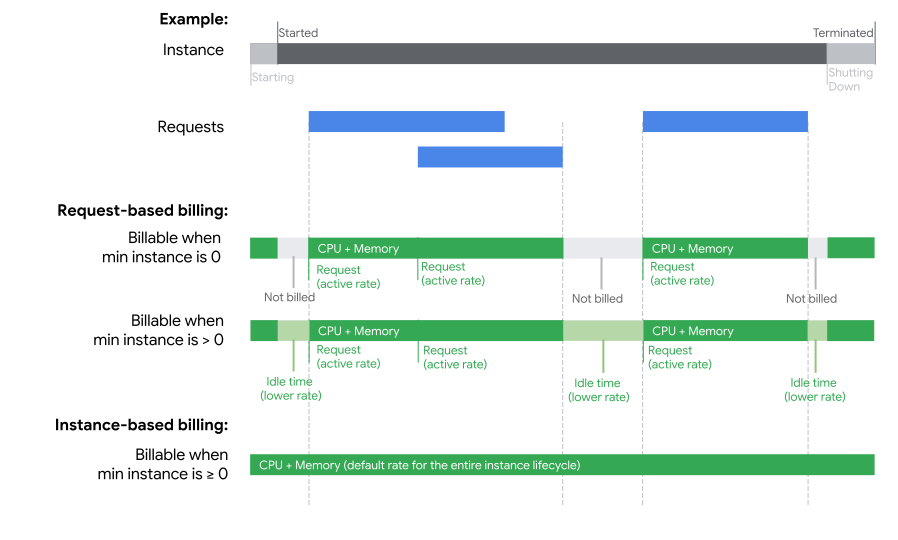
I don't begrudge the business for making the prudent choice of making me use AI, I just sort of lament that what I spent years enjoying and getting good at was so utterly derivative that it was perfect for the LLMs. It would be insulting if it weren't just a fact.
reply