Current Apple should show their new tests that demostrate the opposite.
(Edit) The full transcription of the video, faster than watching:
"You know, the first thing you think
about is this, right?
We thought about this years ago.
We've done tons of user testing on this
and it turns out it doesn't work.
Touch surfaces don't want to be
vertical.
It gives great demo.
But after a short period of time, you
start to fatigue and after an extended
period of time, your arm wants to fall
off.
It doesn't work. It's ergonomically
terrible. Touch surfaces want to be
horizontal.
Hence, pads.
For a notebook, that's why we've
perfected our multi-touch trackpads over
the years." -- Steve Jobs, 2010
I don't think vertical vs horizontal is quite the thing - people don't always hold their phones and tablets horizontally while using them - often they'd be almost vertical. But standard laptop vertical screen position is uncomfortable to use as a touch screen. I'm curious how that research would relate to how people normally use handheld touchscreens.
Intel has been making pretty good progress on efficiency the last year and efficiency is the name of the game, you basically can't do performance without it.
My less-than-one-year-old Core Ultra 9 275HX was supposed to be much more power-efficient than previous generations, but I’m not impressed with it at all. Yes, it’s a gaming laptop, but why does it need 70 watts just to idle? And when playing Factorio with a CPU-heavy save, the PC uses 170 watts, while my M5 uses 50 watts on the exact same save. I don’t know how much the CPU alone is to blame for this, but I’m tired of x86 and Intel. My Linux laptop/server with Ubuntu and an AMD CPU is somewhat better (Also a gaming laptop), though. It’s only drawing 25 watts while idle while hosting six web services. So, if I were to go by just my anecdotal experience, having used about 10 different laptops over the last five years, Macs are just in another league when it comes to efficiency. However, the AMD/Linux combination is getting somewhat better at a slow pace, while Windows/Intel is stuck with terrible efficiency.
First and foremost, China isn't energy-limited like the US is. A modern grid, lost of cheap power coming online every day. The worlds most advance ultra-high voltage transport links are tying the deserts in the west to the cities in the south.
It probably sucks for you if the proposed powerline goes through your house, but the need of the many come first.
Having cheap and plentiful power is a huge market advantage. It was one of the factors driving Norway out of poverty 100 years ago.
I think this is really a rosy image of China’s electrify situation. They have huge needs in the east and green energy in the west, they can’t build their UHV links fast enough. They are doing ok at keeping up, but there isn’t a surplus of cheap electricity lying around in the same places where you have cheap water as well.
What is stopping them from just building their data centers in the west where they have energy surplus? Not like you need to locate a data center inside a city.
Water. The west is really dry. We could throw in data lines as well but it’s really bottlenecked by water. Actually the only place in China with water in abundance is southeast China.
Also they really don’t have the chips to supply those data centers, and the government isn’t so crazy to go that aggressive on AI, they have lots of other priorities as well.
Chinese data centers like to use air cooled chillers for cooling, not evaporative coolers. It's simple because power for the chillers is cheaper than water for the evaporative coolers. The opposite is true in the US
For example see the data centers in china's inner mongolia region, china's data center Hub like Virginia is in the US, where Deepseek is building a data Center campus
Evaporative cooling is a matter of convenience and cost, not a necessity. Other cooling technologies can be used. Intel has already proven a closed-loop system can work just as well.
One of China's big sources of power is hydroelectric such as the Three Gorges Dam, so if you want electricity and water in one place, then there it is.
The US also isn't energy-limited. They'll just price out all humans living there from buying any electricity.
EDIT: This was obviously meant to be facetious with the intent to highlight the negative effects on the general population that datacenter buildout has in the US.
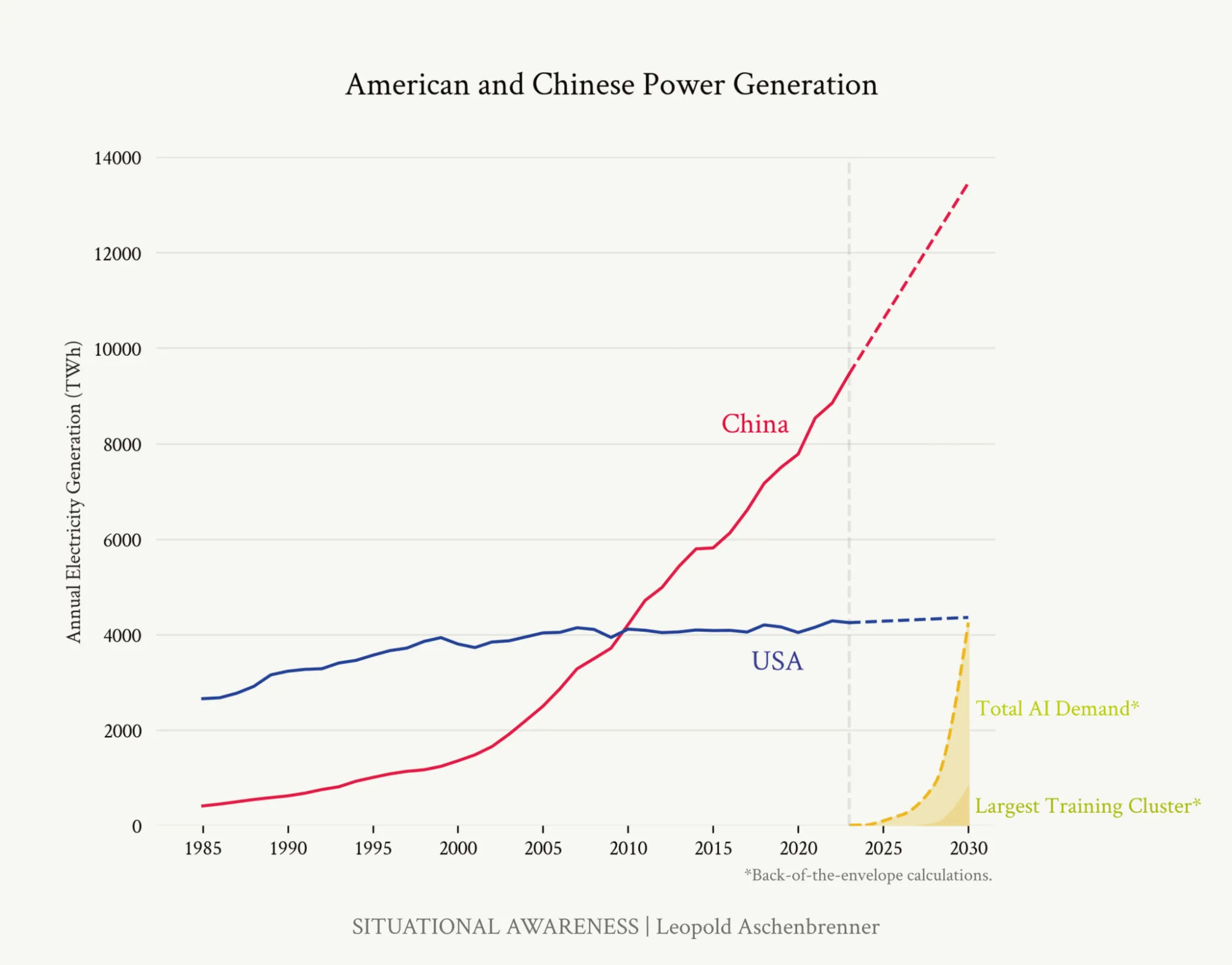
That graph features a completely-made-up superexponential AI growth curve coincidentally reaching 100% of US electricity generation in 2030, but even if you take the prediction up to 2026 at face value, it also agrees that AI is currently a small fraction of overall demand. Of course any individual data center site might struggle with insufficient local supply, but China would have the same problem if they wanted to build bigger data centers. (Production capacity is actually north of 25 000 TWh, but poorly utilized because of a mismatch in place and time between producers and consumers.)
> All media other than paper and stone will become extinct
Somewhat tangential...
I once worked for the national archives. Unlike libraries, the archives typically have the only copy of a specific piece of data. So if the lose the data, it is lost forever. My mission was to figure out how to deal with information storage in a millennial perspective.
There are tons of really interesting ways to store data. I think my favorite was printing QR codes on microfilm and then storing the film in an abandoned coal mine on Svalbard. The first frames on each roll with come with source code and instructions on how to decode the data.
FWIW; my recommendation was 3-way replicated object storage, until more stable form of storage presents itself and becomes reasonable.
Microsoft's Project Silica is intriguing and would be perfect for this if they can get the technology simplified and commoditized. It offers the Star Trek vision of mass storage that could outlast us. Not directly applicable to the needs in your case but is interesting.
The technology seems to work in the lab and the blocker is cheaper femto-second lasers. Others are working on similar approaches and there's likely to be real commercial projects in the future. As laser prices come down and patents expires, there is the possibility of a StarTrek-like glass storage media that can handle the flood of data being generated.
Real Soon Now™
Edit: The project is intended to be for Azure cold storage, so it's not directly consumer facing.
Considering that Azure has more marketshare than GCP we should not dismiss them lightly.
The fact that this is the case still kind of blows my mind. Azure? By those Windows guys? C'mon! Really?
Interesting: What was embedded in the QR code? An identifier for the object? If it's the object's textual data that is embedded: aren't archives as interested in storing the objects as as they are in the contents? Why not images of the object?


reply