My strategy: diversification. I run deepseek harness (which I made a vs code integration for and extended it a lot with plugins) and integrated it with my codex and claude subscriptions as well as an openrouter account. This way I can switch models and providers during my sessions and does not get blocked on such things.
Useful for
- outages
- running out of quota
- failing agents e.g. because of "cyber" flaging
Good diversification. I like to have a strong local model like qwen3.8-flash-next available because I live in the mountains and my Internet is not 100% reliable. I don’t get it that companies allow themselves to get locked in on one vendor. Two or more, with local makes more sense.
Okay, this is slightly horrifying to me but also a bit genius...
But I guess Anthropic models are trained for Claude Code's tool call shape (i.e. the edit tool). Does it deal well enough with the MCP tools that Deepseek harness gives the model instead?
I don't think that "Anthropic models are trained for Claude Code's tool call shape". It's all about system prompt and model description (which is part of that prompt).
I observe that most models can deal well with the tools you provide.
Form time to time I analyze my sessions to see which tools could improve my (or my agent's) work. E.g. a background timer/watcher is on my todo list, so that I can chat with the agent session while its waiting for some shell response.
> Okay, this is slightly horrifying to me but also a bit genius...
If you're old enough to remember CGI web services, originally every request to a web server for non-static content launched a binary. Most of the web ran on that approach for a long time, later optimized with things like FCGI.
dsh looks intriguing. Do they have any plugins that help effectively extend the context memory of each of the LLM's? I am starting to watch some videos on it but it will take me a while to get through them.
I think there are plenty ways to "extend the context memory". Compaction is the most obvious: reduce old context to it's core and free tokens. Another tool is session search. The models can look back in parts of the session that got "compacted away" and also in other sessions.
But honestly with 500k or 1m token sessions, I rarely run out of context memory and barely notice any loss of precision after compaction.
Alas, Teams are working, or at least the chat and voice call portions of it. So managers are in a calling and chatting frenzy right now, pulling every body else in.
Impressive. Even the average number of fingers seems to be correct ;-)
Looking at the failures, I wonder how much cherry picking went into the showcase.
that has actually been proved to be the case. the weight tweaking being done by abliteration does change token distribution in some cases precisely making LLMs produce tokens it wouldn't have otherwise (and therefore less reflective of training data)
It makes no sense to make the devices so thin and then having a fat camera. This requires a cover to equalize the size with the camera for haptic reasons. Better use this space for other stuff like larger batteries and make the device the same thickness everywhere.
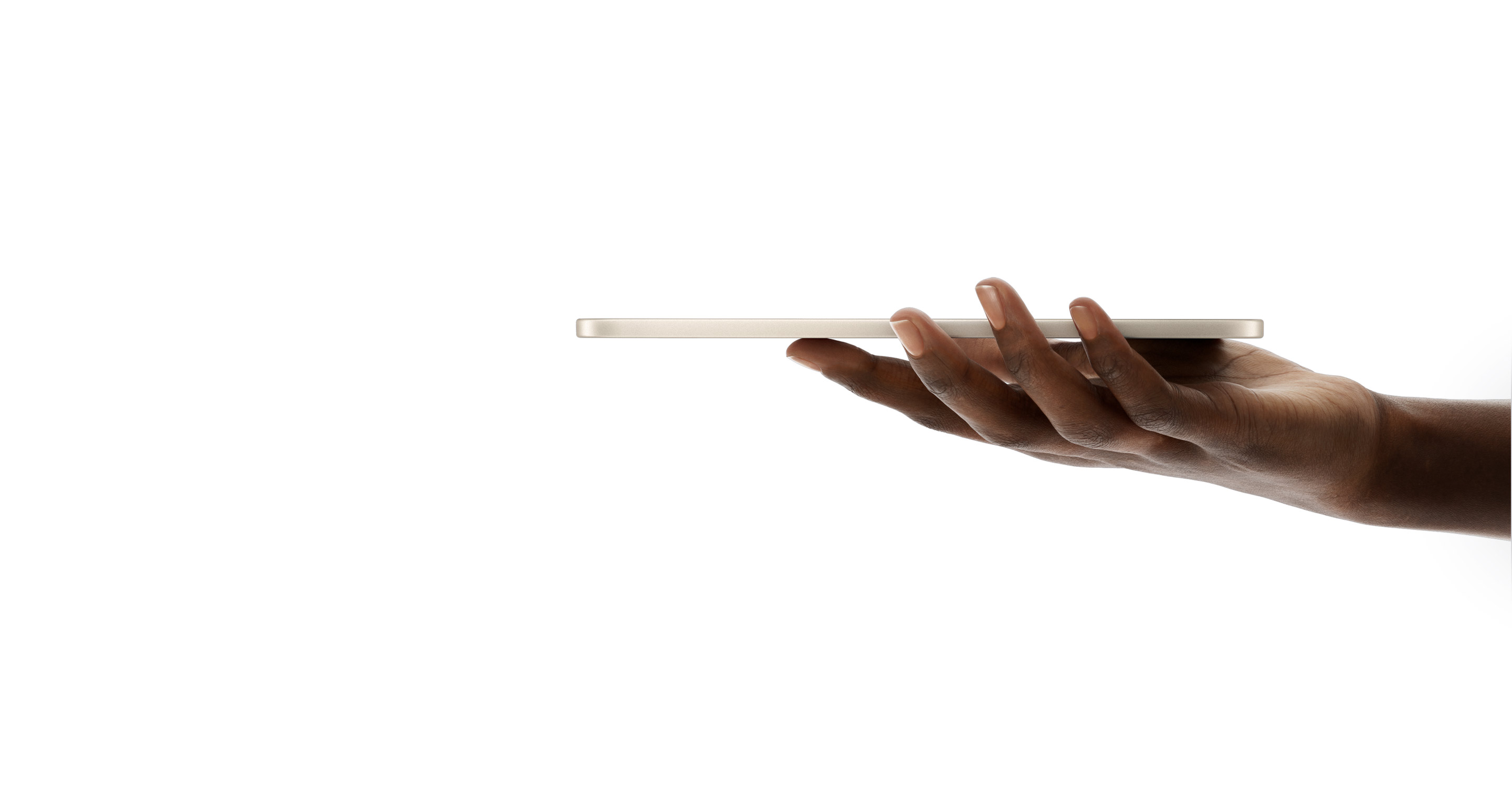
I would assume, however, that they didn't "fake" it - that they instead chose a filming position and lens such that camera was obscured behind the edge of the device (the edge facing the viewer is the far side from the camera). Bit of trickery for sure though.
> I would assume, however, that they didn't "fake" it - that they instead chose a filming position and lens such that camera was obscured behind the edge of the device
I’d suspect the same. From that angle, the camera bump is on the opposite edge; when I hold my iPad Air in the same position, the camera bump is also just about hidden.
That being said, I’d also suspect that Apple chose that angle deliberately.
Historically, Apple used real photos and video for marketing material, only lit and polished to perfection to create a sort of hyper-real effect. Nowadays, who knows.
I’ve seen enough parents at graduations and tourists to know people use it. Assuming they need the big screen because their vision is bad which undermines the need for a high res photo in the first place.
I presume it is a flattering angle instead of a falsified image. The camera bump is near the one large button, which was furthest from the camera when they rotate it, so the iPad could have been angled slightly to hide the bump. Maybe someone can try to reproduce it after it comes out to see if it is a false image.
this is directly side-on. they've def removed the camera bump. In the initial animation at the top where the hand grabs it too. the bump is very clear in shots later!
wait... could they have hidden it under the hand? and why does that person's thumb seem extra long?! the more I look at this the less I understand it.
Perspective is still at play. At arms length, on my phone, if I make it so the flat surface is completely aligned with my center of vision, the bottom side covers at least 1mm of whatever is on the underside. The closer one gets to the phone, the more pronounced the effect.
The video keeps triggering my sense of seeing CGI, but the hiding effect on display can absolutely be accomplished in camera.
> In reality the back was curved, and they took pictures from an angle that only showed off the edge of the screen and not how far back it curved
You only see the thickness at the back from an angle where you can't actually use the computer (and for many people, that whole angle is going to be against the wall). This is the good kind of design - making something appear beautiful without compromising the core function.
I'm distinctly less convinced about ever-thinner mobile devices that I immediately have to slap a case on...
The older iMacs that were the same thickness all the way across, they still looked good. Except they were some of the best machines to service. Literally two screws in the bottom, the whole thing split in half, and your hard drive, memory and other components were right there. I worked on tons of them and they were fantastic. It saved people money in the long run when they needed an upgrade because it took less time. Even replacing the screen or logic board in them was a piece of cake.
The argument is most people use a case regardless, so if it were the same thickness across the device, the iPad would be considerably thicker once in a case. That and weight. I don’t use cases so it bothers me too, but it does make some sense.
It's still very strange how much work goes into the materials for the case and the ergonomics and weight of holding the devices without a case just to assume everyone will put it in a case. I'm with you on iPads, they get too heavy/thick for their primary uses once in a case. The phones I sort of get but I still think it ruins a lot of the aesthetic choices they make about the case design.
I've always thought this too. An iPad with an integrated case would be able to fill the entire flat back area with a battery, and just have rubber on the edges where impact protection is needed. The existing design is really optimized around having an impressive experience in the store when holding an uncased product, before you inevitably cover it.
Why would you want an integrated case? The soft impact absorbing materials degrade much faster than the aluminum. Look at the average ipad users case and it's falling to pieces, you don't want that permanently fixed to the device.
There's also many users who don't need a case. A lot of ipads are POS systems that are fixed to the bench so they don't need a case either.
> Why would you want an integrated case? The soft impact absorbing materials degrade much faster than the aluminum.
Given that the impact-absorbing parts could be [0]
...rubber on the edges where impact protection is needed.
and could obviously be designed to be replaceable, either by a handy user or an Apple Technician, why wouldn't you want Apple to design the feel and balance of a device with a case that has built-in impact protection?
Apple's decision to make most of its handhelds out of various grades of "fragililum" has boggled my mind since they sold the first iPhone with an easily-shattered glass back. That choice makes sense for a conspicuous status symbol that people are going to take very good care of... but most folks either end up with one with damage that makes plain how theirs is not the kind of life that makes that possible, or they have installed some aftermarket shell that ruins the effect by covering up the conspicuously fragile part of the hardware.
I find it annoying too, I assume it's because thin and light devices sell more (both in promo photos and when used in Apple stores).
My mum's Samsung S23 Ultra has a ridiculous camera bump and rocks back and forth when you use it, even with some thinner cases. You need a super thick case for it to stay stable.
I have a hard time believing the camera bump isn't the result of intensive consumer psychology experiments. Setting a bare apple device down on a flat surface feels like chair with a leg sawed off. They need you to buy the accessories. This is part of making the ecosystem viable.
Half the time their mid-year fresh is just a new color, with a huge marketing push. If everyone has a case, colors become a moot point.
I also don’t think I’ve ever seen an Apple exec use a case, as it would imply the phones are durable and a case is needed, which they don’t want to convey. (Bumpers for antenna-gate aside)
The correct answer. The camera bump is intentional and so is building phones that aren't resilient to drops out of the box. What do you mean I can't have a phone with rubber bumpers on the corners?
I would be content if they'd stop making phones slippier than a wet bar of soap. My Pixel 8a is ridiculous, I don't know how they do it. If you have dry hands, it's nearly impossible to hold on to.
Yeah, I added a boring case on day 1 and would have trouble describing the feel of the bare device right now.
Found one on Amazon so I dodge Google's exorbitant plastic markup, and it is a relatively minimalist wrap that smooths out the camera bump and makes it more grippy in hand, in pockets, and on flat surfaces.
The behavior of those slippery phones in pockets is almost the bigger gripe to me. Like they are a new class of motion amplifier, trying to rotate and squirt their way out at the slightest twitch.
The curvature on the back of those is such that it's harder to rotate into a position so the thumb can hit the right button than a flat surface would be.
It also means that resting it on the arm of a recliner produces about the same result as just dropping it into the void to begin with: It's going to wind up there either way.
If they levelled it out you could surely fit a far larger battery in it too. I'd far rather have a device 1.5mm thicker with a battery lifespan twice as long and no silly bump on it.
Since basically everybody uses a case anyways, the important factors are weight and width with the case on. This design makes both of those significantly smaller than your suggestion.
Some people don't have iPhones though. Rare, I know. I have an iPad and my wife has an iPhone but I have never owned one at all and instead have always used Android right from the HTC G1.
To be fair, the iPad mini is a way better form-factor for camera use than any of the big iPads. I think the only time I've ever used the rear camera on the 12" iPad was to scan a document...
WAT. Just because you do not does not mean you get to dictate how others can use it. I know lots of people that use the rear camera on iPads. I'm one of them.
then everything would be just tiptoeing and nothing would be interesting.... it's not like someone saying that will actually cause Apple to get rid of it
Yes they are just whining into the void about something they can’t change. Great use of everyone’s time all around.
More likely though they’re trying to signal their membership to the in-group that’s always circle jerking on every iPhone/iPad post about SD cards, removable battery, thick small phone, flush camera, etc.
Tangentially related: this is the funniest rant about this "devices with a fat camera bump that don't lay flat" rant that exists: "Why?" - Lazy Posy: https://www.youtube.com/watch?v=aP7lYuyGTmg
More material, bigger battery = heavier device. For something this size I figure people want something they can comfortably hold in one hand for a session.
Perhaps if they put a very small lip around the camera lens and a physical bump on the other side so the device doesn't rock, at least it would be symmetrical and the glass would be slightly less prone to surface contact.
Not sure about the iPad Mini, but I've really only seen the bigger iPads with a case. There's just so much screen to damage, and you do really want some kind of way to prop up the bigger iPads. I very rarely remove my iPad Pro from its keyboard case.
False. That is a false statement. You said that "no one" wants these to be heavier, when in fact, many people would gladly accept a few nanograms of extra weight for a better battery. Look at everyone with a Clutch or Anker attached to their phone.
Density is insanely highly correlated with the perception of premium quality. No one’s increasing the volume of premium devices beyond what’s needed to hold components.
Yeah it's infuriating. I love how even Apple are embarrassed by it, since in the first two animations of people holding and rotating the device they've left off the camera bump, making it look smooth flat.
But don't you just need a big camera on your giant tablet? How will you ever manage if you don't have a nice camera on both sides of all your handheld devices? /s
If they put the tiny "front-facing" camera pointed out the back it would be enough for the vast majority of people I imagine.
That's the thing - I genuinely don't understand the user or usage Venn diagram : when and who will 1. Have an expensive ipad with them and require a good big camera, but 2. Not have an equivalently competent phone with them?
Don't get me wrong, I understand it happens - back when I did wedding photography, one of my massive pet peeves were the uncles and grandparents who stepped into the aisle with their massive tablets just as bride is starting her walk... But I do not understand it at all :-/.
I'd absolutely happily completely kill the rear facing tablet camera. I've had at least a dozen android and ipad tablets and I genuinely don't think I took a single photo with them - it'd feel weird and awkward and so ostentious.
(As always as a consumer, clearly I'm in minority here :-})
When I use the rear camera, it's part of a feature of some other app that clearly makes sense to use as a tablet. You're bogged down as it being used as a primary camera as a photographer. There are other needs for cameras other than portraits. Using the rear camera in an AR mode is quite handy in apps.
The most common use-case for the rear iPad camera in our household is stop-motion animation. There are some great apps for this, and the big screen (when effectively stabilized on a tablet stand or tripod + clamp) is lovely for composing and comparing frames.
Note that the uncles and grandparents are all old. When you get to a certain age, your eyes don't like to focus on small things like cameras. The elderly prefer tablets, and they want to be able to take pictures of their nieces and nephews and grandchildren.


Useful for - outages - running out of quota - failing agents e.g. because of "cyber" flaging
reply