People are primarily talking about the Chinese spy affair, but the impression I personally got on X was that the subsequently reported affair with a subordinate VP in Nvidia is what did him in.
What did him in was probably the board members/upper leadership getting visits by US officials and getting scared enough to fire him (and lawyering up themselves).
Everything that's happening here has to be interpreted through the lens of American attitudes towards sexuality though. In other countries such France no-one would bat an eye - about the infidelity, at least.
At one point it came out that the former president François Mitterand had a second family and a 16 year old daughter, and people basically just shrugged. There was no big scandal. People mainly just felt sorry for his wife.
There's a very American and very puritan side to this incident.
> In other countries such France no-one would bat an eye - about the infidelity, at least.
I'd disagree with you on this.
There have been several notable examples of public figures in Europe that had an affair made public and either stepped, suffered majorly in elections/polls, etc.
Gennaro Sangiuliano resigned after his affair became public. [0]
Laurent Freixe fired as Nestle's CEO after 1 year. [1]
Bernard Looney left BP "willingly" after multiple affairs came to light. [2]
It's multiple things mixed together. The spy angle.The infidelity angle. The involved with subordinate angle. Think what you will about the second, the others are still relevant.
(Besides, I don't buy the American puritan POV. Look at who is president right now. He got elected twice! And in between only lost narrowly.)
Yeah, I think a lot of people are overlooking that this is the most important executive in a nearly 4 trillion dollar company that is now seen as critical to the future of both the global economy and national security.
This is not the CEO of Olive Garden having an embarrassing sexual escapade. The context here matters. There's actually a small, but non zero, possibility the government tries to nationalize NVIDIA if their leadership don't seem to be on top of things.
The impression I get is that a lot of this is more public than it needs to be, and so it's clear that US/NVIDIA now want him gone, and this is all evidence that things aren't so rosey for NVIDIA, and so it's value drops.
Isn’t there a playbook for the Powell situation? She gets a payout, an extraordinarily generous separation package, signs some documents and agrees to forget about it as she retires or works on her hobbies or whatever. She still is working there, heck, what if there has been other impropriety? Maybe she didn’t get the same raises after the relationship ended..
I don’t think the board are the morality police. I don’t think they care too much but it’s in the news and it shows poor judgment on his part. Not cleaning up the Powell situation and possibly others shows incredibly poor judgment and hubris.
If I had given even one GPU to a Chinese spy--say nothing about $7.5bil worth of them [1]--I'd be going straight to jail. There wouldn't be any discussion of "oh, he made a mistake." People have been sent to jail over a lot less.
But I'm nobody. I just happen to work in the DC town business. Funny how us "nobodies" have to be "made an example of." Such impactful example making.
[1] So what is that? Like, 3 at current market rates?
Are you a cofounder, what technical level of expertise (stored in your brain) the state will lose if they incarcerate; are some of the most pressing questions authorities weigh before taking any decision.
> what technical level of expertise (stored in your brain) the state will lose if they incarcerate; are some of the most pressing questions authorities weigh before taking any decision.
Doing so violates so many things modern civilization is based on, I don't even know where to start.
Because intent matters more than the eventually outcome. If you are legitimately and genuinely duped then you are a moron, but not necessarily a criminal.
There's certainly a two tier legal systems, but I think in this case it largely goes in the other direction. Everything so far is based on unproven allegations, and the groups making the allegations have repeatedly lied in the past on geopolitically convenient topics - which this is. That doesn't mean they're also lying here, but it does mean that allegations should be taken with a grain of salt until proven.
And in this case it gets even weirder. The alleged Chinese spy is the head of a Singaporean company. The claim is that NVidia sold chips to Singapore, and that company's later actions violated US sanctions on China. Trying to pin this on Jensen is nonsensical. So I agree with the above poster that the reason he was ousted was probably behind-the-scenes intimidation of the NVidia board, because the US can certainly make life very difficult for them, even if no criminal acts can be proven.
If you sold a GPU to a Singaporean company, suffice to say you'd be fine - even if it was at the beckoning of a cute Chinese girl.
It all depends on whether Jensen Huang was aware of where all of those GPUs were going. If he was, and did nothing to stop it, he is complicit. If he didn't know, he is either an idiot or losing his touch, because he, the CEO of the company, didn't notice the sudden increase in sales to this Singaporean company, which just happened to coincide with the export ban. A company whose CEO he just so happened to be fucking.
Too many coincidences. Maybe they really are just coincidences. If they're not, Huang was either acting maliciously, or was compromised. If they are, it doesn't matter, because no one will believe they are, and Huang's ability to function as CEO is ruined from the reputational damage alone anyway.
So all you have to do to get out of an export ban is find some Chinese guy willing to lie and say "I'm not buying them for China, I swear!"? No due dilligence required?
The export ban is harmful not only to NVidia but also to the US. It's a law passed by people who can't see beyond the tip of their noses. Of course it is the law, myopic or not, and so NVidia has a legal requirement to engage in the minimum required standard of diligence as required by the law, but nothing more. A Singaporean cloud compute provider wanting a bunch of chips is about as suspicious as a bakery wanting a bunch of flour.
Everyone's focusing on the cold gas thrusters, which of course is very cool, but not actually shocking that it technically could be done (economically is another question).
But can we talk about the just casually driving straight vertical or sticking to the ceiling? I didn't think that would be technically possible for a 1000kg+ car with probably at least 2" of ground clearance.
There's presumably very limited stores of compressed gas, so you might get one hop or a couple 0-60 boosts per charge. But with electric fans, suction is a feature with much longer duration (minutes?), so you could feasibly do the batman driving on the tunnel ceiling past traffic trick.
There is zero rebound when it lands, that's a bit weird. I replayed that part a couple of times, it doesn't look like there is any vertical velocity at all when it lands, which, given SpaceX's ability to do this with much heavier objects should be no surprise but it makes it look as if the vehicle has very little mass. If the tanks contain 250Kg of compressed air (which means it is pretty much liquid) and you toss that out in ~1 second or so then you'll be near the end of the depletion so if the vehicle would be launched just a little bit higher it would slam into the ground instead of gently landing. There isn't much reserve there.
er, but it's also being propelled. Maybe they are able to ease off the thrusters so it's a soft landing.
I do think that this could only work for a short timespan and getting it to work perfectly each time with variances in weight would be hard. I'd imagine the thrusters and the tank would would wear out over time too, would be a nasty landing if only some of the thrusters worked.
His other company catches rockets, and there's no telling what mass would be remaining when it lands, since the exact path would only be estimated prior. I doubt it would have made a difference if it had 150kg off, whatever computer is controlling the thrusters is calculating in real time.
Any pressurized tanks or vessels have a finite lifespan. The multiple cycles from high to low pressure over time cause stress fractures in the tank. Take scuba tanks for example. They require periodic testing to certify that the tank is still safe to be filled to over 3000psi.
That said this car not only would cost stupid amounts of money but would also require specialized expensive lifetime maintenance.
Lastly as for the rocket flips and insanity I can only see that making sense to use in one scenario and that is a collision detection and the jets fire and the billionaire driving is magically saved and does die.
So they used some AI/drone-type balancing to work on gas tanks, then made it work for something as big as a car. That's the tech.
They were tossing around an oversized shell of a car and it is only physically capable of holding about as much as it used in the short demo, is that about right?
So what even is the point of this thing? What possible function in the world does this farting car serve besides... driving up Tesla's stock price?
I can lift a 200 pound piece of glass with a tiny vacuum sucker. It's the atmosphere keeping that thing up there, and the 2" of ground clearance is what you see around the edge, we don't actually know what the distance is where the evacuation happens. For all you know it as a 3' x 7' plate underneath it that floats just above the surface.
I've done a lot of vacuum picking and it is surprising how large an object you can pick up with a tiny bit of surface.
Mythbusters lifted a 2 ton car using a consumer grade vacuum cleaner. the math is this: the air pressure over 1 sq meter is about 10 tonnes, so if make a box with that area and reduce the pressure by 0.25 atm, you get a force of equivalent to 2.5 tonnes, enough to lift the car.
I'm surprised a vacuum company didn't beat them to it. That would have made a pretty great marketing campaign ("the vac with enough suction to lift a car").
The seal won't be perfect so you'll be running the pump more or less continuously. Apropos manhole covers: I wonder what would happen if this car would drive over one. Or was that your point?
Yes, and those don't have fans underneath, that's just the ground effect. This is probably far worse. I also wonder how large the intake holes are because you can easily imagine what the effect would be pulling that trick on a road surface that's not perfectly clean.
There is a racing car at a car museum, it was either BMW or Mercedes, which was mounted to the ceiling because it had a suction fan that would, in theory, let it do that.
I don't know of any others, and it's a horrible idea for anything used on public roads.. even on the race track these cars were notorious for leaving a cloud of debris/dust in their wake
No you are definitely not saying the same thing. You say there are thrusters on top of the vehicle, whereas in stead they are sucking vacuum below the vehicle. And the exhaust ports for those fans are not at the top.
Tesla seems to disagree with you as well, they call it a "multi-mode suction system" [1] suggesting that the evacuation under the car is what does the job. And that's far more likely than that the ejection of that little bit of air at the top is what keeps the vehicle planted upside down. But with vacuum that is almost a trivial accomplishment.
I'll just note that again, my hypothesis and the actual way it works are very similar to each other, and both are very dissimilar to the suction cap analogy. Suction cap works by passively utilizing atmospheric pressure, this utilizes moving a large amount of air in the direction opposite to the road. The only difference is that it's taking the air from below instead of pushing from above. I imagine that is the case to utilize the same outlets that are used for lifting the car.
> this utilizes moving a large amount of air in the direction opposite to the road.
False.
The air from the fans is ejected out of rear of the vehicle, not the top. The kinetic energy of that air is neglible at best. The vehicle uses retractible fairings to create a partial seal and the fans create a low pressure zone inside the zone that holds the vehicle to road.
The cold gas thrusters are a completely different system that expels high pressurized air from canisters in the vehicle.
The difference is approximately mass counteracting the force of gravity ejected on a continuous basis versus a modest expense in power to run fans. The two are not even remotely similar.
This is not actually the first time that this idea of using a fan to create downforce. It's been something that's been talked about and modeled for a long while and I think a few years ago, the McMurtury Speirling was released. That set the lap record at Laguna Seca among other achievements. The car is about a million dollars, and the fans are basically completely useless anywhere that's not a curated track (think stones, dust, wood, other FOD going through the fans).
The new roadster is obviously cool, but it looks like a practically useless vehicle for 99.9999% of the population. It's purely going to be a track princess -- with lots of extra weight for frankly pointless (but very cool) thrusters.
At race speeds (say over ~150 mph), you don't even need a fan or any active mechanism. Just passive venturi channels on the underside can generate so much down force they are strictly limited in F1 because they can easily enable cars to sustain extremely unsafe speeds.
There are some McLaren street cars that use passive venturi channels which from their shape alone, generate more down force at high speeds than the car's weight. In theory, the car could drive upside down (if there was a Daytona-sized race track shaped like a ~30 ft diameter pipe).
Even though average lap speeds in F1 can be around 150 MPH or faster at some tracks, corner speeds are generally much slower (in some cases approaching relatively pedestrian city speeds). The beauty of active suction is it allows for much higher corner speeds on the slow sections of the track where traditional wings and underbody elements produce relatively little downforce (being proportional to the square of the car’s speed).
An F1 car would need to move at over ~100 mph to sustain inverted driving (assuming you modified the ancillary systems appropriately—the road orientation isn’t the only limitation); a fan car can do it standing still.
Yeah, it turns out that in very specific and controlled situations, using a fan to make downforce is great. It's also a very obvious thing to do in those situations and doesn't do much for you otherwise.
Imagine a normal car having to carry around the added weight of fans, COPVs, and the plumbing to make it work. And only being able to use those only if the track is clean and there are no other cars nearby.
This is like asking to imagine a Hoover vacuum to have those fans. It’s silly because it would never happen. This is not a normal car. Comparing it to a normal car makes no sense.
What suspension would you recommend removing? Are you envisioning some ridiculous Flymo-style car? I can attest that a Flymo lawnmower collapses onto the floor when its weight increases (eg with wet grass).
The Chaparral 2j is one of the most inventive and cool looking cars I've seen.
Not f1, Can-Am but yeah, I'm really surprised this isn't a more common approach to modern track cars. Obviously banned in most motorsport but I'm surprised with all of the one-offs these days that it's not more common.
I know yall don’t like Tesla but not sure I have any bone to pick at what is impractical for a car that is $250k+. Seems like an impractical argument to have.
I mean, everyone buys cars for different reasons, but in that range you're buying it for 3 reasons I can think of: to drive it fast, to look at it in your garage, or to boast about how much you paid. It's not ticking box 2 or 3. The non-flying model does seem to tick box 1, but the exclusive flying model seems to add nothing there (presuming it ever gets made how many billionaires are even going to survive using it?)
Again this argument is hilarious. No idea what the purpose is. All I said is how can you argue about the practicality of a car that is going to be 250k+.
It's not centrally about practicality, it's about appeal. If practicality isn't the appeal, what is? It's not looks, it's not speed & it's not a Veblen good (relative to other cars - a Tourbillon is 16 times the price of a Roadster).
I very much doubt the machine we saw flying was 1000kg+. It was either MUCH lighter, supported by cleverly hidden cables, or some other trickery. The dramatic lighting isn't just for visual effect, it makes it easier to hide the reality of the demonstration.
If there was a live audience anywhere near that stage they wouldn't have been able to use thrusters to fly something that actually weighs as much as a car.
What cable arrangement would you propose to move a car in that way? I think it would be easier to do with gas thrusters than with cables. They'd get tangled in each other.
I don't pretend to know the details of the show, but if it was actually doing what's implied I don't think the lighting would have been set up to hide so much.
No, I decelerate as I'm landing, similar to what the car did. Obviously it's not literally jumping with legs, but surely you agree this was "more like jumping" than it was controlled falling, which was what I was responding to?
I have more belief this trim will be made available commercially without significant changes (which is to say "not much belief") than belief you know enough about what was done to e.g. claim what the lighting is for that authoritatively.
The original McMurtry prototype was under 1000KG. What we're seeing here is essentially still a concept car. There's almost no chance it comes to market how we're seeing it now.
Remember when Elon announced a humanoid robot by using a dancer in a robot costume? Seems reasonable that he would have some "technical assistance" to make his stage show look great. No idea if it was cables or not, but reasonable people can doubt the veracity of the theatrics.
A dancer dressed in a robot costume was not being played off as a robot, and is not evidence of cables, nor is it evidence of a tendency to fake demos.
It’s strange that people need to convince themselves that this is fake.
I think it was a real demo, but I share in the skepticism that this is something that could reach the market. How big is this cold gas container? What happens to it when it gets in an accident? If the car has dirt and debris under it, what is the risk to people/property around it when the trusters turn on?
10 years from their initial offering of the roadster, I'd like to see them release a well functioning, cool looking car. Why are they spending time/energy trying to make it fly?
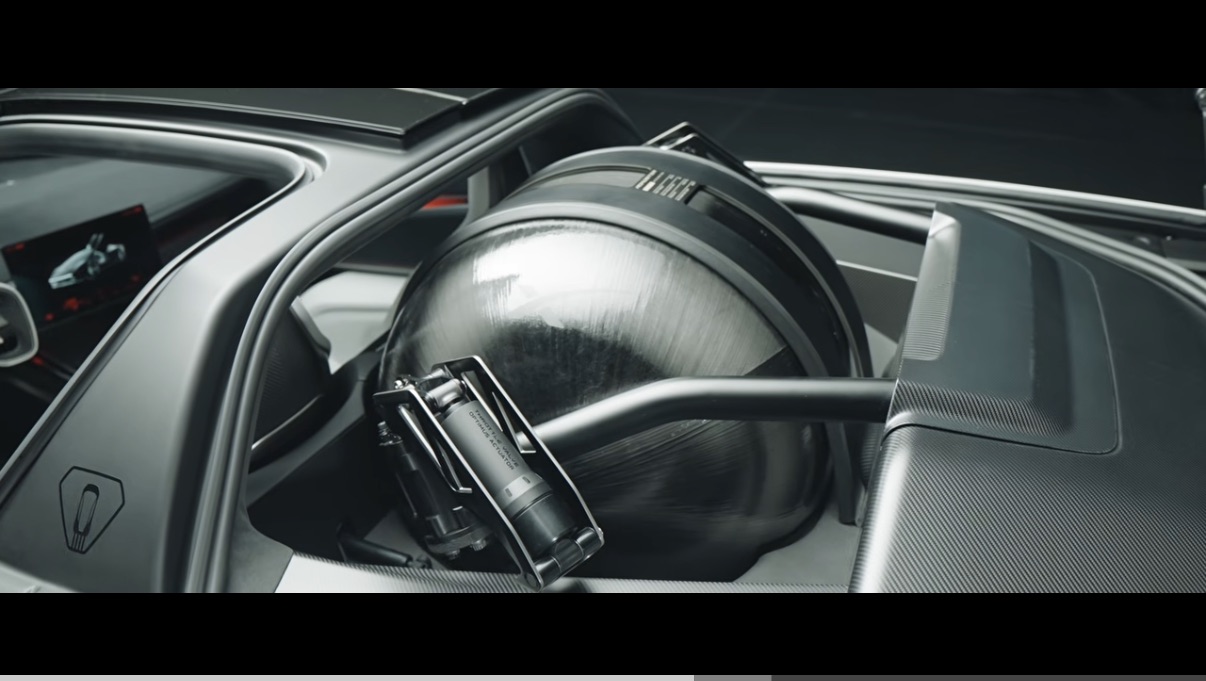
The one that thrusts downwards removes the front passenger seat for another 400 litre tank. I don't think there are any pictures of that though.
I personally would find it scary sitting next to a huge 10,000 PSI pressure vessel but there you go.
They will not attempt to make it legal to use on normal roads, but intend to try and certify it to be in a road legal car but only usable while not on the road.
It also takes like 6 hours to fill and can be used one time per fill for a single use. It's a party trick for sure.
The H70 standard for hydrogen cars is 10k psi and the tanks for it are usually ~140 liters (depending on the particular model), so very comparable in that aspect. They don't generate the pressure, something has to have pumped it into the tank as seen here, and keep in mind they are hydrogen rather than air.
LPG, no - the pressures are much lower (but also still pumped in and significantly reactive).
Dangle the shiney thing to get everyone’s attention and sell the hell out of the very normal thing. This is basic startup marketing and say what you want about Elon, but he owns this skill, it’s why he’s the worlds richest person.
Well... It's Musk. He's been known to fake stuff before. I don't think this was fake in the sense that the gppp thinks it is. But I do think this is fake in the sense that it can't be done practically or safely outside of a completely controlled environment and that makes this a nice demonstration on the order of a Cirque du Soleil or some magician's act but it has nothing to do with actual vehicles.
Minutes ago I had the idea to do a Google search for a situation I was trying to remember from about 15 years ago (an investment in Green Mountain coffee by a Fidelity fund) instead of using an LLM. The results were abysmal: Querying {Fidelity Green Mountain} not only uncovered 0 relevant information, but many of the results didn't contain either "fidelity", or "green mountain", both of which are obviously critical to the query. Claude easily answered it, albeit with a full prompt, but Google would have returned relevant results very recently and no longer does.
It is no longer a search engine in the traditional sense, it's just returning a bad AI guess at what a full LLM prompt would have been for this query, followed by I guess just the most popular links containing one of the words. Nothing about the results is recognizable as a result that would have been returned even a year ago. This is evident from the "Ask Google" branding rather than "Search Google". Google Search is dead as we knew it.
Google's search has been bad for a long time, esp. with older content. I had to use Bing to find a bug report from 2014 I was trying to find around 2 years ago.
It's a number of things like:
1. not searching for exact quotes/text, only words in the query;
2. including other lexical forms in the results (e.g. searching for things like "how do you open the run dialog" returns results for running (the sport/exercise) as well as run (an application));
3. including synonyms, typos, etc.
It seems like while each change makes sense and can improve results in some cases, over time the combined effect has made Google's search near unusable.
So the goalposts have moved to include continual learning.
In a sense I think no one will agree on a definition of AGI until it becomes impossible to construct any benchmark under which an AI underperforms "average" humans. That or it's defined retrospectively, after it's overwhelmingly obvious it met any such definition.
I hardly think it’s fair to label an objection so old that Turing included it (and discussed it at length) in the list of objections to thinking machines in 1950 “moving the goalposts.”
> These arguments take the form, “I grant you that you can make machines do all the things you have mentioned but you will never be able to make one to do X”. Numerous features X are suggested in this connexion. I offer a selection:
> Be kind, resourceful, beautiful, friendly (p. 448), have initiative, have a sense of humour, tell right from wrong, make mistakes (p. 448), fall in love, enjoy strawberries and cream (p. 448), make some one fall in love with it, learn from experience (pp. 456 f.), use words properly, be the subject of its own thought (p. 449), have as much diversity of behaviour as a man, do something really new (p. 450). (Some of these disabilities are given special consideration as indicated by the page numbers.)
Just because a condition is new to you doesn’t imply moving the goalpost. People have been putting forward continual learning and similar conditions like autonomy since 1950s.
I'm confused, is this a research device, hobby/tinker item, or consumer product?
I don't mean to be negative, but making a sustainable business on a hardware race to the bottom sounds challenging.
I'd be curious to to know from others here, what in-home tasks do people think they'll really be able to automate with any of the various bimanual or humanoid robot platforms that seem to be going around?
Nothing, none of these are good enough to do any home tasks reliably. These are all research/hobbyist devices that won't be interesting for another 5-10 years. Probably a bunch of fun to play around with though.
ASIC makes it sound like it's a single chip, but in reality serving trillion-param models on Cerebras requires a full cluster (as in multiple racks, MW of power).
Major tenants like OAI have near total control. These GW-class datacenters are built to spec for the tenant. Construction doesn't start until all the details are signed off.
If you are just paying the bills and leasing the space, is it really your fault a datacenter some other entity built is sucking the water table of Levelland dry?
If I just use and don't own the data center, then how can I be held accountable for it's impact others?
What I like about this, is that it significantly increases the probability of a sci-fi scenario where you're picking up a hot chip on the black market; rumor has it, Mythos 9 weights baked in...
Back in the kazaa and limewire days, you'd sometimes try to get a movie / episode from a series, wait hours / days for it to download, and when it was done you had a ~50/50 chance to actually watch what you wanted or an old german porn movie :/


reply