I live in Europe: My only “concern” about chinese cars (and I don’t mean chinese as in Volvo) that I am not sure you will get parts and service in 10 or 15 years. More than 500 unique models were released in
the first 6 months of 2026 alone [0]. It’s like the wild west of Android phones 10-15 years ago. Brands you never heared about, never updated Android versions etc
Thankfully, EVs don't need as many spare parts as ICEs. It is less complicated machinery, and the batteries are the biggest component that are actually fairly standardized (well, at the cell level, there is a lot that goes on around that that is custom).
Related: VW is turning part of its Zwickau EV plant into a site that takes back used VW Group cars and refurbishes them or strips them for parts to resell [0]. Target is 15,000 cars a year by 2030.
I live in the United States: My only "concern" about cars made here is that the parts are and will be exorbitantly high due to protectionism by our government and will be a lot more for a lot fewer features, efficiency and innovation and we'll have to win a class action lawsuit to even open the hoods of cars we "own" so we can repair them ourselves.
I don’t want to give a cent to European manufacturers because of the prices they want to subject us to, but I’m sure Europe will eventually do something about the Chinese allowing poor people to own cars.
I’m going to guess that parts for these 500 unique models are mostly coming out of the same handful of factories in China. While yes maintenance is definitely a concern I think as long as there is a steady supply of these EVs the market will figure out repair.
We're in the boom or bust years for the Chinese manufacturers. There's clearly a few fairly safe brands like BYD or anything Geely owned - they're not going away, but the smaller brands are a little bit of a gamble. I say this as someone with a hankering for an Xpeng X9. I saw a report [0] a couple of days ago that the profit margin across the Chinese car industry is at a record low 1.4% which would suggest to me that we're probably going to lose a few of the smaller brands pretty soon.
I mean the core feature here is a vastly simplified drivetrain and often modular parts borrowed or 'appropriated' from the best of existing marques. There's a lot less to go wrong versus any existing ICE platform, and the Chinese EVs that make the Western market are generally the budget/barebones models outside of the the high-end BYD stuff.
In comparison, the last two generations of ICE cars from Europe/US are the most mechanically complex in history in order to meet strict emissions laws.
The main point of contention is around support for the integrated cloud connectivity and continuous OTA software updates. Ultimately that will be clean-room decompiled or otherwise audited for PII/Security Compliance to the point where reverse-engineering for LTS is trivial.
Other than that, just as displayed with walled-garden Apple products, a robust, decentralized aftermarket will emerge from the legions of SEA hackers.
Slight nitpick - "the Chinese EVs that make the Western market are generally the budget/barebones models outside of the high-end BYD stuff" - what makes you say this? I follow the Chinese car market a fair bit and the high end marques are generally making it to western markets, even Voyah.
Given how often parts are unavailable for new and late model "western" brands this is more like a generic worry that comes with car ownership than anything brand-specific. If anything the proliferation of brands demonstrates robust use of off-the-shelf components, which in turn suggests replacement parts should be ubiquitous.
It's definitely an issue but typically not until you pass the ~20 year mark. I recently sold a very low volume car that is now 26 years old and there's definitely a secondary market now in hoarded parts as the originals become less and less available from the manufacturer.
You might want to take a closer look into the current state of play on new and late model vehicle parts availability and general serviceability, because your take here appears to be a couple decades out of date. Parts are frequently difficult or impossible to source for cars that are less than 5 years old.
I don't follow the car industry but I've worked on a project circa 2018 for all European manufacturers to help provide parts 15 years after the car was sold (I provided the Hadoop clusters and some of the predictive algorithms to try to predict which car parts will fail and how many will be needed over the car Lifetime.) BOOST4.0 or something. I don't know where it ended up going.
TBH the market demand will ensure a Toyota Camry/Honda Civic 'invincible' style runabout will emerge that basically anyone can run into the ground and still depend on. The real issue to me is the morality of the production of the parts, particularly things involving rare-earth metals.
Ish. Traditional car manufacturers had this figured out but intentionally dropped the plot over the last couple decades because make number go up. Net result: my wife had a mouse die in a vent duct in her 2 year old SUV. We drove a dealership loaner for 8 months waiting for parts. They ended up replacing the entire dash assembly (including gauge clusters, and infotainment unit). Many (most?) modern car transmissions aren't field-serviceable because no parts are available. Any issue with the transmission means the entire unit gets replaced.
that's fair argument and reason why to rely on long established concerns like BYD (BYD, Denza), Geely (Volvo, Lynk & Co, Geely, Polestar, Zeekr) and Chery (Jaecoo, Omoda, Chery), at least the brand shouldn't fold so early, though of course they can still ditch some specific brand, seems like BYD would be safest option judging by their market share in China, in Europe Jaecoo seems to be doing very well, but who knows how long they can last and from what I hear they are quite unreliable, so I would worry more about wait time for car par right now than 10 years down the line, even Korean/Japanese cars still have this issue if you crash the car and need to wait weeks for the spare part
> It’s like the wild west of Android phones 10-15 years ago
lifespan of the phone is much shorter than car (so is price), so not really a fair comparison and Xiaomi is still around and many other less known brands (actually that makes me realize I forgot Xiaomi cars, very nice design as well, nice Porsche copy), they just ditched export, but they are still present in China, even 10-15 years ago you had tier 1, tier 2 and other tiers of brands
Same concern I have with the Chinese golf carts/LSVs. They look very nice and have so many standard features even car play. I know a few people that bought Chinese brands that only existed for 3 years.
You guys must not have a lot of years of experience? My friends groups have a few hundred million dollars each (the junior developers are in the lower hundreds)
We're older. We missed out on the AI boom and the really juicy stock grants. Throw in toys that depreciate in value, tuition for the kids, a couple divorces/trophy wives, etc. and the money goes fast. It's amazing we have anything left at all!
Even hearing from others on this forum helps! Sounds like most people haven’t been nearly as lucky-heavy fortunate as folks in irl circles. Very eye opening, and I appreciate everyone’s anecdotes.
I still have my boxed copy of Encarta 2001. The interactive world atlas was the best feature! Miles ahead of everything at the time. Multiple layers of stats from population to weather to languages etc https://youtu.be/zsbShjlh6xk?si=4U47LILUmKPfXgPY&t=320
I kind of wish these fixed large encyclopedia were still going in 2019 to capture a pre AI corpus.
But I suppose that would pre-COVID too.
Still I'd quite have liked something like that.
Some have suggested a Wikipedia snapshot which can be browsed locally - not bad but not the same vibe as curated professionally written Encarta or Britannica.
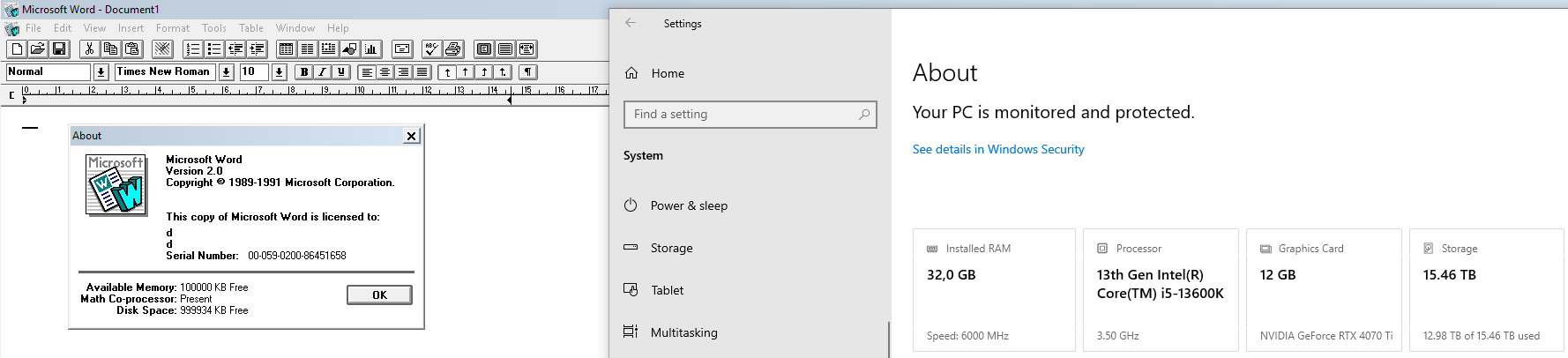
Installed MS Office 2.0 some months ago with it just for fun. It actually works pretty well apart from the dictionary files, for some reason those are not recognized
1, is it good enough for modern day to day word processing (mostly emails)? Yes it is
2, can the modern word processors (Office 365, LibreOffice, Google Docs) recognize and open the files created with it? (doc, rtf anything but plain text) Yes they can
For work, not due to other requirements, however for personal documents I fully agree with your first point, MS Office 2.0 is good enough to type in some snail letters, school reports or CVs.
Yes, however if you are only using them privately as a modern typewriter for stuff that is anyway going to be sent on paper, there is less of a concern.
Now sharing files with others is another matter, and I fully agree.
Most people prefer censored internet as long as it aligns with their political leaning. Maybe that wasn't the case 15 years ago but it's pretty much true nowadays. I myself consider this as a fact.
Not really. The past 10 years have seen huge masses of people mobilized worldwide for changing the status quo, and the status quo absolutely has changed as a result. Maybe not in the way you would have wanted, but it’s impossible to deny that the world in the past decade has changed dramatically.
Right - the only way we'll ever get a truly uncensored internet is if it's actually impossible to censor rather than some "gentlemen's agreement" that we'll censor this stuff for the Greater Good but not this other stuff.
I think it's more of a problem that the dividing lines in politics have shifted from left vs right within a liberal democratic framework, to liberal democracy vs populism. 15 years ago everyone was arguing within a democratic framework, partly by social norm and partly because before the internet became so ubiquitous there were many more gatekeepers to the spread of information making circulating disingenuous arguments harder. So if hardly anyone was breaking the rules you didn't need to debate who was breaking the rules of democracy or even what the rules were. E.g. JS Mill said 175 years ago that you couldn't have freedom of speech if you allowed harassment or bad faith arguments, but plenty of populists these days would define freedom of speech precisely in the terms of allowing harassment and by extension whatever the consequences of allowing harassment were are just what freedom looks like, and would then gaslight John Stuart Mill into believing he's the real authoritarian for not agreeing with them.
I agree. Interesting you’re being downvoted. I’ve been using Reddit for 16+ years and have watched it morph from a libertarian, centrist community dominated by developers and geeks, into a very left wing, violent, vehicle to export American political activism to the world. Redditors used to abhor censorship. People would practise debating all kinds of taboo topics because this is how we become wiser. Now just commenting on the wrong community will see you automatically banned from 30 of the largest subreddits.
They study this. [Gen Z is 10x more accepting of violence to suppress speech they object to compared to Boomers.](https://expression.fire.org/p/gen-z-is-10-times-more-accepti...) It seems history really does repeat. People are going to need to experience some authoritarianism to remember why we care so much about free speech.
A true test of one's desire for truly free and open society and speech is whether or not one's willing to stand up and fight for that "other" person's right to say something they hate.
I can't watch soccer highlights from X because all the mods on reddit are sure Elon's evil.
I expect there's no data to support this, but I really do think this is directly related to the age of the people responding, not their generation.
Boomers today would much rather squawk about threatening lawsuits or getting other people to do the work for them. The ones alive today feel confident in their command of the legal system to get what they want. During the 1960s, how many young Boomers and Silent Generation protested against the Civil Rights movement? Literal bombings and terrorism took place. One black family moving into Cicero, IL led to a violent mob of 4,000 people where it was also young Boomers that shouted and held up swastikas and eventually firebombed the building where the family was going to move in, leaving many other residents of the same building out on the street. -- https://allthatsinteresting.com/anti-civil-rights-movement
Yes, there were obviously not the same people protesting against the war in Vietnam. But, to their credit, Boomers used to turn out for protests back when they were 20.
If you asked Boomers this questions when they were 18-25, I expect their opinions would align pretty close to Gen Z in this survey.
Over 80% of real world politically motivated violence between 1990–2020 is from far-right actors. Left-wing violence has increased over the past 5 years, but is still completely dwarfed by right-wing violence.
As always, how you define the terms and conditions defines the outcome. If we take a broader view and include Mao, Stalin, Pot, Chavez etc this balance would come out very different.
The comment I replied to was a survey of internet users. So forgive me for thinking we might be talking about something closer to present day, where the right-wing is statistically more violent.
I’m well aware that Reddit doesn’t reflect reality. Most of society is not far left, chronically online, violent, and out of touch with reality.
The study you provide isn’t related to my comment but if you’d like to shoehorn it into future discussions you should at least read it first. That paper is widely criticised, and is, ironically, the kind of thing shared on Reddit. I’ll just copy and paste existing academic criticisms of the paper because I don’t really think you’re going to take the time to seek this out yourself.
1. Inconsistent data collection: The far-right data came from an established extremism database, while the far-left data had to be assembled separately because the database did not routinely track most far-left extremism. This creates a potential sampling bias, with no demonstrated guarantee that both sides received equally comprehensive coverage.
2. Serious numerical inconsistencies: The study counts 168 deaths from the Oklahoma City bombing but reports zero far-right bombing incidents. It also contains basic arithmetic errors, including percentages totalling 110%. These inconsistencies raise legitimate concerns about data quality and the reliability of the analysis.
3. Subjective ideological classifications: The study uses broad political definitions and includes homicides with weak evidence of ideological motivation. Without a fully accessible case-level audit trail, independent researchers cannot easily verify whether incidents were classified consistently or accurately.
4. Unsupported statistical conclusions: The author suggests far-left attacks are more likely to cause multiple fatalities, but the reported difference is not statistically significant (Fisher's exact test, p ≈ 0.22). Drawing substantive conclusions from this difference is therefore questionable.
5. Disproportionate influence of one attack: The Oklahoma City bombing accounts for approximately 32% of all far-right fatalities in the study. Removing that single incident reduces the far-right-to-far-left fatality ratio from 6.7:1 to 4.6:1. The overall disparity remains, but its magnitude is significantly influenced by one exceptional event.
6. Selective historical timeframe: The study begins in 1990, excluding the 1960s–1980s, when far-left revolutionary movements were especially prominent in American domestic terrorism. This timeframe may be appropriate for the research question, but it makes broad claims about political violence across modern history misleading.
7. Conclusions beyond the evidence: The study examines ideologically motivated homicides, not political violence generally. It excludes non-fatal assaults, riots, intimidation, arson without fatalities and other violent offences. Using its findings to claim that the far-right is responsible for most actual violence is therefore a substantial and unjustified extrapolation.
Notably, the time frame used doesn’t reflect reality today, so it cannot be used to make normative claims about which ideology is more violent right now.
Correct it's not the best study, but it's better than your survey. Mostly since it comes from things that have actually happened which other studies can look at too.
Your points about the data from this study are valid if there weren't multiple other studies that reach the same conclusions. The data still rings true.
You kinda undermined your own original argument by wanting to include non-fatal crimes and violence from the 60s-80s, when I thought we were talking about modern trends and as such is why I picked 1990 onwards.
RE: 5, as you said... when you remove the huge statistical outlier right-wing violence still outpaces left-wing almost 4.6:1. You took proved the point, the right wing is far more violent.
RE: 7, more people die at the hands right-wingers than left. I count death as a higher degree of violence; whereas I've seen you consider a survey response to be violent... so we might be at very different ends of the agreement there.
Anyway, this has been fun and I think we've both reached as far I'm willing to care about. Have a good day.
The last time I saw research on this, they found that the median age of Redditors had dropped significantly over time. I suspect they have a newer and younger user base now. I still talk with older users from time to time and we believe our views on free speech and censorship have not changed significantly over time. However Reddit policy and moderation and majority opinion have changed a lot. They are far more accepting and willing to use censorship to realise political goals.
I think questions like this are so leading as to be useless, because they are presented in a way that don't trigger people to inspect their actual beliefs but rather their advertised beliefs. I could imagine a dozen ways to phrase to really bump that boomer contingent:
- [circa 2020] Do you think that the Black Lives Matter protests should be stopped by force?
- Do you think that a police officer should be able to physically prevent burning of the American flag?
You can be libertarian or centrist, you can not be both. Also developers and geeks are left wing fairly commonly. You write as if all geeks and developers were right or something. They are not.
> Gen Z is 10x more accepting of violence to suppress speech they object to compared to Boomers.
That is direct result of practicing taboo topics like violence and normalizing them. A lot of effort was put into making them more aggressive, so success. Mostly on the right, contrary to what you are trying to imply. The violence aggression and censorship are much more common there.
Violence exists up and down the political compass. The real debate is who is allowed to commit violence. The people, or the state. The status quo in most of the developed world is a state monopoly on violence.
The libertarian view is generally that the people should have the monopoly on violence.
> The violence and censorship on the left is the fault of the right?
No, I said that right is more violent then left. Consistently so. That is result of right trying to make right more violent and aggressive.
> It adds an additional dimension to the incorrect belief that libertarians must be left or right wing. Of course even this is a gross oversimplification of how humans think and vote.
One thing libertarians are decisively not is a center. They are not middle of the road group.
> My Polish dev team is very right right, but very libertarian.
Yes, libertarians happily and frequently merge with right including far right. That does not mean geeks and developers are universally on the right or libertarians. Some are and they tend to think they represent everyone.
Seems like this is a direct result of being more exposed to the internet. I'm not sure it's their fault when they are raised with ipads in their lap and multi-billion dollar corporations are shoving propaganda (both sides) down everyone's throat 24/7. I wonder if boomers and gen x would feel the same if they grew up the same way.
> It seems history really does repeat. People are going to need to experience some authoritarianism to remember why we care so much about free speech.
Not sure making people experience authoritarianism is the best way to make people remember why free speech is important. That seems more extreme than anything I've read on Reddit lately. Surely there are better solutions.
Not just Internet, but the most abhorrent version of it, aka algorithmic rage-bait machine the Web 2.0 had become.
I can see why people don't value free speech anymore, when the speech had become mostly astroturfing curated by algorithms.
Censorship is the wrong direction, but I see where it coming from emotionally, mass Internet today is an abomination. It wasn't like that when I discovered it.
To be clear I’m not suggesting that that is my preferred outcome. I’m worried that that is what this new generation will vote for. Then when they get it, they’ll realise what they lost, and they’ll have to fight to get it back again.
People should really read the whole thing (well at least the last chapter) because it's not as simple as "vibe coders made meg go away".
The writer equally hates ZUN, vibe coders, and AI haters (Bluesky crowd)
And if not then the TLDR is basically: ZUN made the games for japanese people. Western people wanted to play the games. Reverse engineers came along but they relied on community funding. Now the community is taken apart by vibe coders but the same community is not willing to fund manual labor. Also the community is still paying for ZUN which enforces the status quo of not bothering with english releases.
To add some further context, all the Touhou games have been playable by Westerners for years due to fan translation patches. Even for the PC-98 games, the community has made preconfigured emulators packaged with all the games pre-patched to English so it's easy to play them without any technical knowledge. The reverse engineering project is orthogonal to this and is mainly intended to document the games' behavior as well as make them easier to mod. Having the source code available would make it possible to port the games to modern platforms, but they are pixel art 2D shooters so from a gameplay perspective there's not much of a benefit over playing them in an emulator.
Ah, that's sad. I miss the speed and intuitive UI/UX of the old Picasa. No image viewer has ever been able to handle massive photo libraries as well for me :(




0, https://www.carscoops.com/2026/08/chinese-automakers-lauchin...
reply