I know of several semiconductors that route their APAC revenue through Singapore. The point has been made by others here but it is the "standard" structure used for tax and law venue purposes. My guess is that 50% of revenue flowing through Singapore is par for the course.
In other words: there's nothing to see here, and it's just sensationalism by the FT.
For all intents and purposes Character.ai was acquired in August 2024, and this is just the mess leftover from their run around antitrust regulation.
The company filing for chapter 11 today is shell that was left after Google "hi-quired" (the opposite of acqui-hired) the founding team. The shareholders got paid ($2.7B from Google), the founding team moved on, and what's left is the corporate structure and whoever Google did not want.
It sucks for the people left over (but then again, it also sucks to be part of the team that's laid off in a merger). It's also a terrible practice that I hope the Justice department and the CFTC will put an end to soon.
Not clear that this is true financially. Of course, it sucks to be at a sinking ship, but in most of these the people left behind are compensated as both employees and shareholders.
Which to me implies that in that case, at least current employees were taken care of, and the court will likely force the former employees to also be taken care of because Delaware law doesn't like it when you discriminate in ways that were not spelled out ahead of time.
There was a Supreme Court case that essentially established that Common stockholders can be practically ignored as part of leadership’s fiduciary duty. It revolved around an ex-employee suing for compensation for Common stock after a merger that paid out the CEO and preferred shareholders, leaving stockholders zero.
This is also partially why your common stock options can be valued significantly less than the price the company value would imply: because it’s not an even share in the business.
Assuming you're talking about the Trados Inc litigation, the situation was:
* Raised 52m
* Acquired for 52m
* 8m paid to exec team to stay in place
* Common stock got zero
The lawsuit determined that the board did have a fiduciary duty to the common stock, but that the common stock had no economic value, so they were not actually being harmed here, aka this is basically the best deal the company could have gotten, but it didn't clear the pref stack.
In the Groq/Character deals, they very obviously cleared the pref stack, so common stock deserves to get a piece of the licensing deal at the rate of the stock they held. It's annoying because its a dividend and doesn't benefit from QSBS, etc, but common stock is getting paid there.
I swear this is what's so risky about AI startups, they've completely changed the risk/reward calculus that we all used to be okay with.
You join a company, are granted ISOs/RSUs/etc, and they matter at some point when a liquidity event happens.
Now the liquidity events are "acquihireasitions", the execs and senior AI/ML eng get buyouts to go to a new company -- everyone else: regular eng, designers, PMs, marketers, recruiting, etc. everyone else is just left with nothing.
I wouldn't join an AI startup unless I was on the ML side, and I'm not: I'm just a "regular ass product engineer" so screw me I guess.
Equity holders have a more junior claim than debt holders, but if there are enough dollars in the bankrupt company to make the debt holders whole, the equity holders get whatever is left over (obviously in order of seniority).
Mike Levine (a financial blogger for Bloomberg) says the industry is calling these sorts of transactions "reverse acqui-hires" to distinguish them from a normal (forward) acquihire where the acquirer buys the whole company even if all it wants is the people. He discusses some of the advantages and legalities here:
I think they mean rather than acqui-hire, acquiring in order to hire the team. They hired the team they wanted individually to specifically avoid acquiring this company.
Gutted. Poached is a bad word for it which already describes a different thing that is a component of this thing. If you can combine "poach" and acquire in a witty way, go for it.
"Hi-quired," although not sonorous, is at least a new word for a specific thing, instead of a word for a closely related thing that would just confuse anyone who heard it. I might've just gone for "Hire-quired" because it's obvious what it means and it seems a little bit easier to say.
Poaching is when one illegally hunts wildlife. People are not animals, and hiring them is not harming them. It is a terrible term to apply to human beings.
Most people know what poaching means without making that association. It’s a perfectly legitimate term across all forms of employment, in both negative and positive contexts.
Do we also need to retire ‘head hunting’, because it brings to mind cartoonishly outdated notions of savagery?
Within the employment context, is it ever a negative? Only from the perspective of the competitor? But to society as a whole, "poaching" (hiring) employees is clearly a massive win.
There are many thousands of words that mean more than one thing. If you go out of your way to deliberately misapply one meaning to another, in a way that's offensive, that's on you. Nobody's asking or forcing you to do that.
Do you object if someone says, "I adopted a new strategy"? After all, children are adopted, and one could say that using this phrase trivializes a deeply important human relationship.
Do you object if someone says, "She's a fan of my work"? After all, a fan is a machine that blows air. It could be said that referring to a person as a fan reduces them to an appliance whose purpose is to serve someone else.
Do you object if someone says, "I have a date tonight"? After all, a date is a fruit. Someone could say that calling a romantic partner a "date" is to objectify them and reduce them to something consumed for pleasure.
To clarify, what I am objecting to is taking a term for something with a massive negative societal impact, and trying to apply it to something that has a massive societal positive impact, in order to make the positive thing sound like a negative thing. I am all for the evolution of language, especially when it serves society.
> To clarify, what I am objecting to is taking a term for something with a massive negative societal impact, and trying to apply it to something...
No one is "taking a term" and "trying to apply" it to anything. The word has multiple meanings/uses, full stop.
What you are objecting to is one of its meanings (attracting employees from a competitor), because you don't like the negative connotation of another of its meanings (stealing game). And that's because you believe that the latter meaning's negative connotation will make the former also feel more negative. But I submit that that's just in your head, and the heads of a few others, and the vast majority of people are able to keep two definitions quite separate.
If you hire the core of a company that constitutes its competitive advantage and abandon the corporate shell and its looming legal liabilities, you might have just hi-quired a business.
I think the original meaning of hi-quired was hijacked-acquired, in the sense that the company was acquihired, all the critical talent transitioned to a more important G project and that's it.
I think the point is that it is an acquihire in purpose (want to team, not the assets) but would be blocked by the government so they did a thing that looks a LOT like an acquisition (paid off the shareholders, took the team) without technically being one specifically in order to avoid regulation. It's an "aquihire" in everything except name and the issue is that it was done in order to get around consumer protection laws. Google got what they wanted. The investors got what they wanted. The people got screwed.
it's people just trying to be smart here. You are either acquired (bought for mostly the product, whoever wants to leave is inconsequential), or acquihired (bought also to absorb the talent pool, so it is contingent on some personnel staying on).
All this other stuff people are trying to make up falls under those two when a company buys another.
Any such ban would be in direct conflict with California law (where I assume Character.ai, as a company founded by Xooglers living in Palo Alto is based), under the same logic that forbids non-competes. California has created one of the most prosperous countries in the world under a framework where you actually have to entice your employees not to leave, rather than shackling them to their workstations, and I would be extremely opposed to any attempt to change that.
I don't think this is necessarily true. This wasn't purely hiring. They also licensed the technology and paid off the shareholders, which is why it's basically an acquisition in everything but name.
The problem is each step individually is important to allow companies to do, and follows as a nigh-irrefusable consequence of the previous. You can't ban companies from "poaching" employees, or you end up as an economic hellhole of indentured servants, like Florida, or New York. You can't ban the licensing of a companies technology, since we want innovators who don't necessarily have the opportunity to directly execute on their new technology to still innovate. And you can't ban paying the company for doing so, since that's the whole point.
Meanwhile, the way that plays out is that Google hires all the talent by fairly paying more than the startup can, then can turn around and say "your company is a dead man walking, you can either sell us your tech, or crash and burn with nothing", and the only fiscally responsible decision is to sell.
The rules aren't that simple. The combination should be considered holistically against antitrust law. It's a judgement call that ultimately comes down to a judge or jury.
Antitrust is also federal and is probably generally supreme over state law. E.g. even if Google fairly acquires talent according to state law, it can still be determined to violate antitrust.
This poaching scenario (where Big Co pays above market to a large number of employees to drive a competitor out of business) is very similar to dumping (selling goods below market etc.), which has been illegal for a long time even though "selling goods" is generally legal.
However, since the government (DoJ, FTC, etc.) is the ideal litigant, you actually need someone who works there to not get fired for long enough to complete investigation and enforcement. In a lot of anti-trust cases, all the direct participants benefit: the employees get paid more, Big Co consolidates power, and Small Co gets paid off. The "losers" are most distant like their customers or uninvolved competitors who aren't in a good position to sue.
Which is why at the top end we are supposed to have complementary laws. Bans on non-compete increase competition at the low end. Antitrust and government regulation/licensing at the high end prevent monopiles and thereby increase competition. The problem today is that we are dropping the ball on the high end, letting the Googles stamp down competition when, in decades past, they would have been broken up.
There are rumors that the employees did not get paid out. Such a deal could be done by, for instance buying the equity from the investors at a current fair market value.
That the new "investor" choses to let their investment die may not matter, it would also be cheaper to selectively buy out investors than buy out all equity in the company.
I don't think banning these type of psuedo-acquisitions runs counter to non-competes. I posted the other day about Augment, which I believe did the same thing.
"if it walks like a duck and talks like a duck, it's probably a duck" should apply to acquisitions. These types of acquisitions leave employees (+ other shareholders) holding the bag. It should be illegal.
> where you actually have to entice your employees not to leave
Yes, by offering them things like equity in the company. This practice throws all that out the window though, in essence unilaterally renegotiating the terms of employment. When the leadership team can be acquired independently of the company then these employees can be left with nothing. Sometimes the corp doing the acquisition will throw a bone to the dregs left, but that does not appear to be legally required. It's exploitative and unjust.
> California has created one of the most prosperous countries in the world...
Along with the rest of the top 5 states where almost everyone lives in the USA?
Have you ever even lived for a significant amount of time outside of California? Ever try New York, Texas, or Florida? Nobody is "shackled to their workstation" there either. California leads in unaffordable living and wealth inequality, and it's not even because those on top in California are living any better than even the upper middle class elsewhere.
The economy is much more than tech and most of those businesses are not in California and don't want to be.
Yes, I have lived outside of California. It mostly made me more appreciative of this state, with the notably exceptions of last call and gun laws.
Noncompete "agreements" are evil and run counter to every redeeming quality that a free market economy has. If your state allows them, they are in favor of indentured servitude, plain and simple. In contrast, California stands as a beacon for those who refuse such chains. We don't just ban noncompetes in California, we actively liberate those who move here from their out-of-state noncompetes.
And contrary to what you'll read on here, California is not just tech. We've got a massive agriculture industry (more than 50% of the country's produce), several of the best universities in the world, the entire entertainment industry (to such a degree that we're killing everyone's accents), one of the top financial sectors, and the largest manufacturing industry in the country. Hell, our restaurants are better than anywhere else in the country: I can walk down the street walk past multiple restaurants that would be the best in the entire state in most of the rest of the country, to a point that I take it for granted until I walk into a random restaurant in the heartland somewhere and expect it to be good.
We treat our companies well and our residents better. Hell, we even treat our non-residents better than any other state, given that our taxes subsidize the existence of the parasitic 41.
When the worst thing about your state is a housing shortage due to everyone wanting to be there, that's glowing praise.
> Along with the rest of the top 5 states where almost everyone lives in the USA?
The other 5 states don’t even come close economically. If California were a country it would be the 4th largest economy in the world. Fourth. Largest. Economy.
The next closest state is Texas and it’s down around 9 or 10 at half the GDP…
Yes, California has pretty much all its eggs in one basket. That was my original point. I wouldn't be proud of numbers just for the sake of them, especially when they're not my numbers. Not even Texas is that blinded by their own pride.
At the flick of a wrist, any of those handful of businesses can follow Tesla and pull the rug out from under the state. The mind recoils in horror what will happen when the tide goes out.
As I mentioned in my other comment, California is far from just tech companies. You could wipe out the entire information sector and California would still be the most prosperous state in the US. California is practically the only US state to have a fully diversified economy.
I'm not very familiar with the US legal system, but doesn't Federal Law override any state law if there is conflict? Presumably any antitrust action taken by DOJ would be in accordance with federal law, so the state laws shouldn't matter?
When it comes to California, it's complicated. We have a looooong history of playing fast and loose with federal supremacy, and you can bet the defendants would be fighting tooth and nail to keep any court case in California. Which would be pretty defensible, since it would presumably be a California-based company hiring California-based workers.
In particular for the noncompete ban, I believe that trying to enforce a noncompete-adjacent action like this would open you up to being sued by the employees who would have been hired, and the hiring company, in California court.
was it a run around of anti-trust or character's liabilities? It will be interesting if there are creditor lawsuits / trustee clawbacks in the future around these deals.
It's silly or misleading to imply nothing has changed in this administration compared to the last one with regard to enforcement of laws and regulations. So many laws changed or ignored and regulatory agencies gutted, dropped, or silenced. The very next link on hn after this article for me is about the cftc being told not to investigate certain oil deals.
Please don't try to convince people to accept the current abuses of the system as inevitable or "both sides" when they clearly aren't.
> Please don't try to convince people to accept the current abuses of the system as inevitable or "both sides" when they clearly aren't.
Please stop only waking up under a Republican administration, or even worse just under the administration of a wrestling valet game show host.
> clearly aren't.
"Oh, please" and "it's just so obvious." If it's so clear, you should have less trouble explaining it than other things. And that doesn't mean explaining the bad things that your enemies do in power, but explaining how your friends weren't doing those things and actively ending them when they were in power.
Clinton did the massive deregulation that defined this century. Obama didn't prosecute anyone for 2008 financial crimes*, let Citigroup pick his cabinet, bailed out the banks, and flooded the stock market with free cash. Biden is literally the Delaware credit card prevent student loans from being discharged in bankruptcy guy, he had great people in Kanter, Khan and Chopra and undermined and ignored them consistently while breaking a railroad strike.
All absolute dirtbags who did what Republicans could have never gotten away with, because partisans who pretend to care fall asleep when Democrats are in power. A lot of consulting firms and nonprofits get flooded with state cash when Democrats are in power, and don't when Republicans are in power (and vice versa.) Patronage is more powerful than ethics when it comes to the middle class.
[*] Or for a worldwide torture network, or the people who admitted destroying evidence of the worldwide torture network. Or for the intentional lies that began two Middle East wars.
> Or for a worldwide torture network, or the people who admitted destroying evidence of the worldwide torture network. Or for the intentional lies that began two Middle East wars.
This form of laissez faire capitalism looks equally prominent in Europe at the moment. The problem seems not tied to any particular administration, but rather a culture of the Neo-liberal ideology which is pervasive across the entire capital and the governing classes of the western world (probably even wider).
And tech billionaires panicked and bankrolled the Republican Party. So, it was working. A shame that the USA has a democracy on sale. Less money in politics could have brought better lives for the average USA citizens.
But splitting big tech is unavoidable as otherwise they will sink the rest of the economy with them (and then it will be split anyway).
by using some inane term like "hi-quired" instead of using a few words to explain what happened, you left everyone confused and spawned a bunch of discussion about what "hi-quired" means.
very smart. very good terminology invented by someone who, i'm sure, has lots of blog followers.
Most valuable comment here. You can fine tune BERT to perform really well on classification tasks. What's exciting about Jev is that it generalizes. Laya does not!
I agree that from the perspective of a business owner this would seem very normal. "I need legal services for X, and I happen to know and trust a very good outside counsel for this" is very normal. Additionally, law firms have super robust conflict of interest policies so you can expect this would have been reviewed in details.
However, I think this story brings up two important topics:
1. It is important that high level government officials avoid not just actual conflicts of interest but also the APPEARANCE of a conflict of interest.
2. The Trump administration has taken a much more liberal approach to conflicts of interest than most admins, and this has undermined trust in government. The fact that this story got people so riled up is a great illustration of it. This is not good for the country!
This is just third world level of open corruption. If nothing is done against it, things will just get worse and not better.
First it will signal to all the lower level officials that corruption is ok. The next step isn't just corruption is ok, but it is expected. No corruption means you won't get far in your career.
The demand signals never allocated the resources, a small number of people always did. Those people react to the demand signals (and they still do).
IMO a more important question is: what happens when the market power of a segment of society grows much greater than the rest? In a "K-shaped" economy, the top 20% have so much spending power (and even more future spending power) than their demand signals can overwhelm the rest. Then IMO the market won't respond to the demand signals of the bottom 20% and capitalism stops working for all. Add to that the possibility of AI automating more and more work and you have a system that only works for folks at the tops.
This isn't a resource allocation problem! it's a purchasing power distribution problem.
This doesn’t strike me as a problem. There are sufficient entrepreneurs that market need common to a total 20% of the population will be met. In the USA that 70 million is a sufficiently large number. After all, that’s $700 million of MRR at $10/month.
The things limiting provision of services are physical limits like the audience being widely dispersed or just characteristics like not all sharing the same needs and therefore not actually being addressable.
You obviously are well aware that addressability does not track with income category automatically but it does for many businesses. E.g. payday loans, rent to own, check cashing, dollar stores.
Since a large section of this group is in use of government credits, at the least businesses will evolve to meet the use of those. EBT grocers, Medicaid-focused care, etc.
The majority of the effort will be spent where the greatest economic opportunity is, but entrepreneurs will match their ability to address the market to their audience. It’s not possible for a dollar store to sell GPUs to Baseten. They don’t have the capability to do something useful there.
Have you guys been having a good experience with OpenRouter? I tried it out recently with Claude, and it cached no tokens, charging me $200 for one conversation of 11 messages.
I tried using deepseek v4 flash with OpenRouter. It switches between providers too eagerly which resets the cache. Then, each provider begins to rate limit me for providing so many uncached tokens, so it just keeps on switching providers. I'm paying for every token... why rate limit me? It was unusable compared to just using the official Deepseek provider which has a much better cache rate.
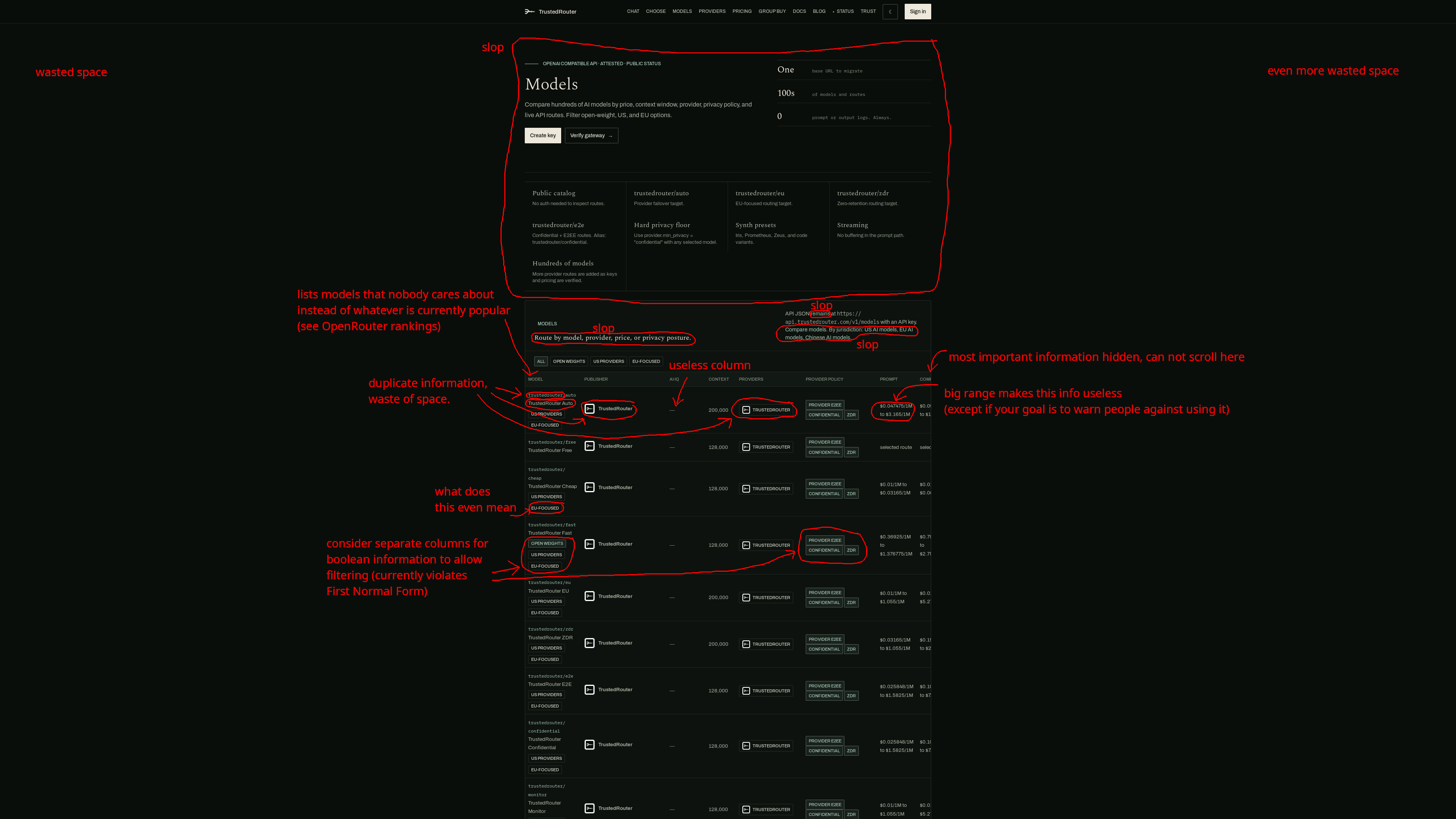
I have seen you advertise your website a few times. I like the idea of not having to trust the router, so I took some time out of my day to critique your website: https://files.catbox.moe/v68cf7.png
My visit to your website went like this:
1. Visit models page
2. Try to find GLM-5.3-Flash (which is among the ~5 models that 90% of people currently care about)
3. Give up scrolling (which would have taken OVER 50 SCROLLS!!!) and use Ctrl + F
4. Try to find input/output/cached price
5. Scroll all the way up to find out which column is what
6. Notice that output price is cut off
7. Notice that the scroll bar is over 100 scrolls further down the page
8. Use Shift + Wheel to scroll horizontally (most visitors probably won't know this trick)
9. Notice that cached price is missing
10. Conclude that this is probably not a serious offering and bounce
There are probably more issues later on, but this is how far I got.
I would suggest you to:
- Deslopify all pages that a user may visit before conversion
- List important models first (see OpenRouter rankings)
- Move the most important information (model name/input/output/cached price) to the left
- Disaggregate the prices per provider (maybe subtables per model? not sure)
- Measure cache hit rate and compute effective price per provider (see OpenRouter)
(- Optional: Fix the broken link on your HN profile page. Currently, the only way to get from this comment to your website is a search engine.)
How am I supposed to navigate around there? For example the pricing page is empty or is that how it was supposed to look? On models and providers pages there are lists but no way to filter or get any kind of meaningful info. Or is this a WIP/POC?
I think most business will decline to do any further business with you after you threaten to sue them. There are even patent licenses that automatically get voided in the event you sue your counterparty for any reason.


In other words: there's nothing to see here, and it's just sensationalism by the FT.
reply