Remember when Elon announced a humanoid robot by using a dancer in a robot costume? Seems reasonable that he would have some "technical assistance" to make his stage show look great. No idea if it was cables or not, but reasonable people can doubt the veracity of the theatrics.
A dancer dressed in a robot costume was not being played off as a robot, and is not evidence of cables, nor is it evidence of a tendency to fake demos.
It’s strange that people need to convince themselves that this is fake.
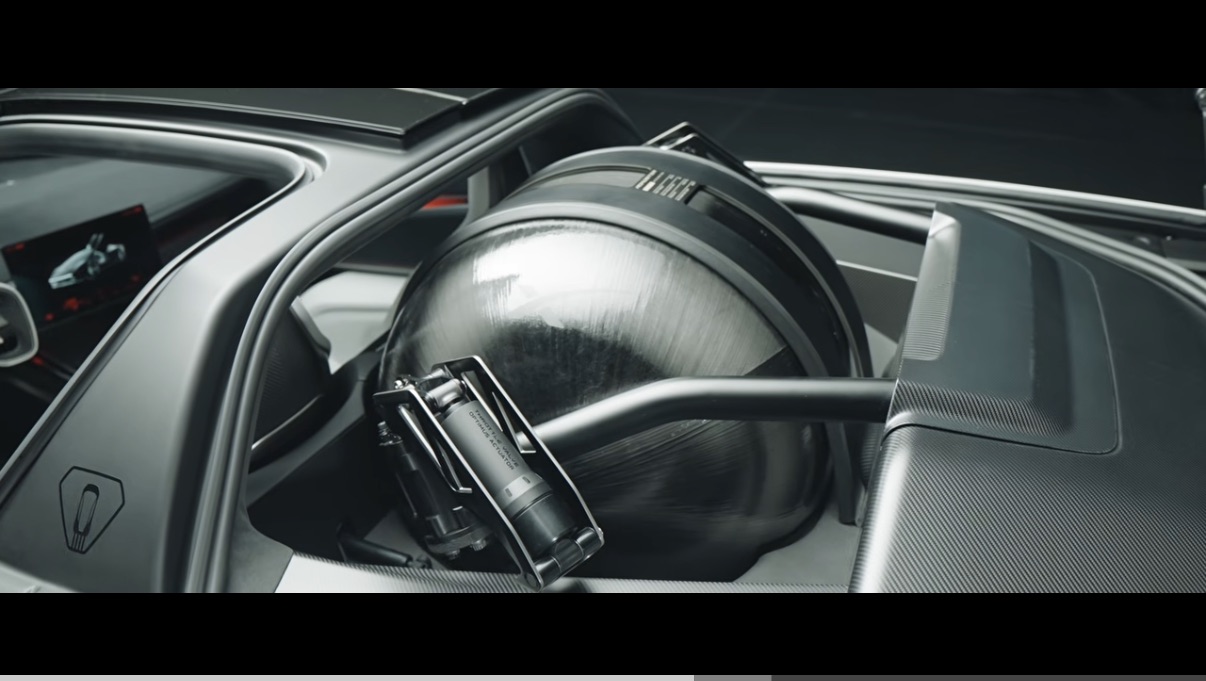
I think it was a real demo, but I share in the skepticism that this is something that could reach the market. How big is this cold gas container? What happens to it when it gets in an accident? If the car has dirt and debris under it, what is the risk to people/property around it when the trusters turn on?
10 years from their initial offering of the roadster, I'd like to see them release a well functioning, cool looking car. Why are they spending time/energy trying to make it fly?
The one that thrusts downwards removes the front passenger seat for another 400 litre tank. I don't think there are any pictures of that though.
I personally would find it scary sitting next to a huge 10,000 PSI pressure vessel but there you go.
They will not attempt to make it legal to use on normal roads, but intend to try and certify it to be in a road legal car but only usable while not on the road.
It also takes like 6 hours to fill and can be used one time per fill for a single use. It's a party trick for sure.
The H70 standard for hydrogen cars is 10k psi and the tanks for it are usually ~140 liters (depending on the particular model), so very comparable in that aspect. They don't generate the pressure, something has to have pumped it into the tank as seen here, and keep in mind they are hydrogen rather than air.
LPG, no - the pressures are much lower (but also still pumped in and significantly reactive).
Dangle the shiney thing to get everyone’s attention and sell the hell out of the very normal thing. This is basic startup marketing and say what you want about Elon, but he owns this skill, it’s why he’s the worlds richest person.
Well... It's Musk. He's been known to fake stuff before. I don't think this was fake in the sense that the gppp thinks it is. But I do think this is fake in the sense that it can't be done practically or safely outside of a completely controlled environment and that makes this a nice demonstration on the order of a Cirque du Soleil or some magician's act but it has nothing to do with actual vehicles.
Honest question: What is preventing you from understanding any part of the stack now?
You could potentially ask an LLM to explain it, but I would venture a guess that wouldn't feel like the right source to help you. You could use the LLM to help you identify source material written by humans in order to learn anything new. It doesn't have to "do all the work for you".
Modern AI systems are powerful. They are not omnipotent or omniscient. Understanding the details is still valuable, especially if you want to push the frontier of any known field.
In any event, the situation isn't hopeless. At least not yet. :)
You can ask frontier models with all the bells, whistles, language servers etc to give you every example of X. And it gives you 12 examples and says that's all of them. When you know damn well there are at least 40 (but not exactly how many). So you say no, you know it has missed some, such as X23, and X27. So it goes away and comes back again and says yes, there are 41 X, here they are. How much digging should you do to see if its right?
I have many times gone looking myself to find that it has still missed some. Asked it to go check for those, to look harder it goes oopsie and says now im sure ive gotten all of them (has it?)
All this to say, I have been burned, repeatedly, multiple times a day, for the last year+. I still use these tools, but I truly cannot understand how some people treat them as oracles that know everything about our codebases
Excellent points. I agree that frontier models get things wrong all the time. They are NOT oracles. I believe that we need to encourage our peers to become sophisticated operators of these systems, instead of treating the output like Moses and the 10 Commandments. Perhaps we need more specialists, because the major AI labs lack the incentives to venture down the long tail of knowledge. Agents can be a piece of the learning puzzle, despite their imperfections. Again, thanks for your reply. It gave me lots to think about.
You need to define the goal in a way that you will trust the completion. If you are not sure how you yourself would verify that there are 41, then you are in trouble. Verification must be deterministic, or it's worthless.
What the large models do really well nowadays, is that they won't lie to you if your deterministic verification fails. If you tell an OpenAI or Anthropic model that they need to run a certain `grep` or search or whatever command to verify, then they will do it. I haven’t seen them lie about this for a year, and trust them in this.
Surely you can see that for basically every example of this sort of problem, fully defining a deterministic check is the same as finding them all?
Like you're telling me if I had a script that printed all X, and it's my responsibility to ensure it has no bugs, then the agent could tell me all X and I could trust it?
This is not helpful at all? I am capable of running scripts myself and using the output directly.
No? It's like saying "why bother doing maths, a calculator can figure out the solution to any question you have if you just put the right equation in" there might be more to maths, it turns out. Most of it lying inside of finding "the right equation"
I can't intuit, it would take me an hour or two to figure out the right "deterministic script". Hence why i'd like a robot to do it, while also being able to ya know, actually do it
> You could potentially ask an LLM to explain it, but I would venture a guess that wouldn't feel like the right source to help you.
I don’t think this works, at least for me. Even on the 5.5 versions of Claude it’s still arduous to read at this point.
> You could use the LLM to help you identify source material written by humans in order to learn anything new. It doesn't have to "do all the work for you".
This probably depends on the shop, but humans aren’t writing docs anymore. That was the first thing to go, sadly.
I hear what you're saying. I often tweak the CLAUDE.md file to improve the quality of its output. It's an ongoing experiment.
As for "humans writing the docs", you raise a good point although it's not quite what I imagined when I wrote that line. I was thinking more about having the LLM/Agent create a list of verified output by humans with reputations as experts in whatever field interests you. This is important when pushing the boundaries of research, although it's overkill for wanting to know whether or not a new technology could be useful in your existing project (or the next one).
What use case did you have in mind when you brought up the docs situation? Sounds like you had some direct experience with that one.
I think a distinction is clearly emerging between docs intended for humans, and docs intended for agents. The latter is where all the Markdown-ridden slop should go; I'm not insulting humans with that.
In many case it is the sheer accidental complexity. I tried to get into Linux codebase and gosh it's so much harder than FreeBSD. And Chromium, LLVM... I don't believe it has to be that way. I use Common Lisp software (besides Emacs) written by human for anything I can and these have always been a joy to use or work with.
It seems the way industry is heading towards wrt LLM will make this even much, much worse.
It's the Mad Hatter's tea party, you sit down, you figure out how it works, and then poof a third of its gets overwritten and your past investment is significantly washed away by someone who absolutely didn't put the same amount of thought into what is replacing it.
If only it were so simple. Many of CBP's policies are clearly defined by U.S. Congress (most recent example, which actually establishes CBP: https://www.congress.gov/bill/114th-congress/house-bill/644/...). That said, Congress appears to have ceded their oversight role by allowing these rules to change without comment.
I have 20/20 vision and this presentation hurt my eyes. I'm glad my browser has "reader mode" to normalize things like this. I'm not trying to yuck someone else's yum. I simply appreciate the technical ability to read someone else's post in a way that doesn't cause discomfort.
Politicians are lazy, sure. I also believe that hearing sustained and prolonged resistance to X as a communication platform will make a difference. It's real grassroots effort.
Which social network has larger reach than X?
Which social network has stronger influence on humans who make policy decisions than X?
Which internet provider can deliver reliable access to remote regions than Starlink?
Which internet provider has manipulated access in contested regions than Starlink?
Maybe you're right, maybe you're wrong. I don't know.
What I do know is that your baseless assertions are meaningless to me.
Show the facts and figures that support your claims.
That's the only way to avoid being a garden-variety internet troll.
Excellent question. My definition is admittedly qualitative. I spend a fair bit of time listening to commentary by people who are connected to policy decisions at the state and federal level (in the USA). An unusual amount of people admit to relying upon X as their barometer of public sentiment, despite their intellectual understanding that Elon Musk has his thumb on the scale. Most of them have admitted they understand the "water has been poisoned" but they also claim that all alternatives are inferior. This might not apply to YouTube as much as the others, but I haven't seen evidence that disproves this theory. I'm open to the possibility, for sure. This said, I believe that Facebook, Instagram, Snapchat, and TikTok have a profound affect on large swaths of the population. The evidence I observe suggests that X is doing more work among the people who can text someone who makes decisions. Curious to know more about your POV. What am I missing?
(edit: I genuinely don't understand how your replies are anything other than ad hominem attacks. Your responses are about as effective as a toddler asking "why?" over and over and over again. Either deliver a substantive counter argument or stop replying.)
(edit 2: I assume you are the one who downvoted this reply. That only adds to the factual evidence that you are struggling to defend your position via legitimate means. This isn't a personal attack. I hoped you would engage in legitimate discourse. Please do better in the future.)
Ad hominem would be if the GP was making a personal attack on you. Saying a question is "silly" is not that.
Downvoting can also mean that the downvoter doesn't think it's worth the time to engage with prose. It's a bit arrogant to assume that a downvote means someone can't come up with a cogent argument against you; the fact that you make that assumption points even more strongly at the idea that it's not worth arguing with you.
I would say that classifying an argument as "silly" without any supporting evidence is borderline ad hominem because it doesn't make a substantive critique of the assertion, and instead colors the character of the opposition. But that shouldn't take away from your position.
As for your suggestion that I am being arrogant, I can see where you're coming from but I also feel as though I'm within the bounds of fairness to push for a reasoned response (instead of an emotional appeal).
All that said, thanks for replying in a way that advances the discourse. Much appreciated.
You assume incorrectly. I flagged your comment for breaking site guidelines, not downvoted. Perhaps you're unfamiliar with how the site works but it's not possible to downvote a reply to one's own comment. The button isn't there.
No, I did not claim "a massive percentage of the population accessed the internet (via starlink)". Try again.
I said that people in REMOTE regions, by which I mean those who are underserved by traditional internet access such as fiber or coax or twisted-pair, are served by Starlink in significant numbers.
Please give demonstrable facts that dispute this claim if you disagree.
> X and Starlink don't even remotely have a "firm grip" over the social media or Internet access markets. They have many active competitors.
Starlink's market isn't "Internet access" in general. Anywhere you can get fibre, fibre will be faster and cheaper. For many use cases a cell tower works better too, if you are in its coverage area.
Starlink's market is "high bandwidth / low latency Internet access no matter where you are on Earth". And for that it is by far the market leader. Its closest competitors are way behind – second place Amazon's Kuiper has under 400 satellites in orbit, Starlink has over 11,000. So Starlink is over an order of magnitude in front.
If you define a market narrowly enough then pretty much any company has a "firm grip" on some market. That doesn't mean much in terms of overall market dynamics or broader power. My local neighborhood taqueria has a firm grip on the burrito market for a radius of at least 3 miles.
> My local neighborhood taqueria has a firm grip on the burrito market for a radius of at least 3 miles.
This is a bit of a silly comparison though – the market of providing high-speed low-latency Internet access (a highly general-purpose service) anywhere on the planet, versus the market of providing one particular type of food in a small localised area.
I agree that SV's regressive culture is a problem. I've seen it up close.
I don't have a solution, but I am concerned about where this trend might lead us.
You're very correct. It's much, much easier to amplify sentiment that already exists, as opposed to attempting to manufacture sentiment from nothing at all. That's been true for as long as propaganda has existed, afaik.
I disagree. It seems just as easy to plant a seed for people to latch onto. In my experience, people are unlikely to express any kind of opinion that they haven’t seen someone (anyone) else express first.
Why do you believe it's "just as easy to plant a seed for people to latch on to"? Please provide some basis, whether it's first hand experience or published research. I'm open to the possibility that I'm misinformed. I just need more information to work with.
Brexit was the flagship of combining this approach with the cheap leverage available on social media at a time when people were more innocent/ignorant about it. Russia clearly influenced the UK vote, then applied those lessons elsewhere in the West.
(The Brits themselves seem to consider this subject somewhat taboo, even though Putin continued to mock them with operations like murdering people in broad daylight in Salisbury in 2018.)
The issue is that "whoever" isn't a single homogeneous entity. I would presume that someone in the organization spotted the discrepancy. Having worked closely with (and sometimes for) large corporations, I cannot presume that C-Suite decision makers were sufficiently aware of the issue. Or perhaps they didn't weigh the issue properly. Or maybe they were consumed by a desire to complete the merger, no matter what. There are quite a few ways this could have gone, internally, and still arrived at this place.
Anecdotally, I've worked at places where the due diligence process wasn't so much about determining if a course of action is good, but justifying a decision that was already made. If the subscriber count and income don't mesh, just use whichever number makes the merger look better.


reply