Microsoft did not want to invest in Apple. In US v Microsoft, testimony revealed that the investment was forced upon them by the decision against San Francisco Canyon Co and Microsoft/Intel as co-defendants. There is some speculation that this was a first installment of several payments as part of the settlement.
A K Dewdney did a quick sketch of the early chapters of Braitenberg’s book in his Computer Recreations column in _Scientific American_ in the late 1980s.
> Inadequate or broken safeguards do not fall under my definition of reasonable.
I see no such assumption there. In my reading, the implicit assumption is that adequate safeguards are necessary and that anyone who doesn’t build them is irresponsible. And I feel that that is correct.
I don’t understand how to connect this to the facts at hand. Building adequate safeguards requires studying safeguards to understand whether they’re adequate. But the source article is dunking on one of AISI’s attempts to study such safeguards; we should, the author argues, consider whatever behavior the model exhibits to be an explicit decision by whoever provided the model. It seems impossible to build or study safeguards against model misbehavior without accepting that the models can make decisions.
You start with least privilege. A shared instance of an artifact host is very far from least privilege (I'm comfortable in accepting that OpenAI did not wilfully create this situation, but they were certainly negligent).
And yes, it does indeed seem that a UK government agency ran a controlled experiment where they allowed an agent to instigate phishing attacks against members of the public. Attributing this to Anthropic is wrong. I'm not sure how I feel about my government conducting such attacks on non-consenting individuals, but I'm not comfortable about it in the slightest.
Yes, the cut/copy/paste system and its shortcuts were developed at the Xerox PARC LRG as part of Smalltalk-76. They used a Control key.
>and adopted by DOS
DOS inherited it from CP/M by way of the 86-DOS clone that Gates purchased. Kildall used the TOPS-10 while developing PL/M and CP/M and adopted some of its conventions, including control-break.
Ah yes, computing luminary Larry Tesler, what an idiot, working at Xerox PARC. Whoof.
Decades is an exaggeration. It was less than a decade after Digital started using Control-C as a process interrupt in their PDP-10 operating systems (1967) to when Mr Tesler devised his mapping to a copy operation (1974-1976) for Smalltalk-76, and only four years after C was born. CP/M is the much more likely source of widespread usage of control-C as an interrupt, and it was contemporaneous (1974) with Tesler’s mapping.
But they weren’t combined on the same system until decades later, after Windows became nearly ubiquitous and Linux systems started copying things from it.
A researcher submitted a paper to the medical journal _Diabetes care_ in the nineties that basically redescribed integral calculus as a novel finding. How’s that for a silo?
This is really funny. A less extreme example is how much domain-specific terminology in Reinforcement Learning and Control Theory/Model Predictive Control refer to the same underlying phenomena, but we must translate between the two. I understand there are many unique concepts as well, but it would be so helpful if the overlap here used the same terminology and notation.
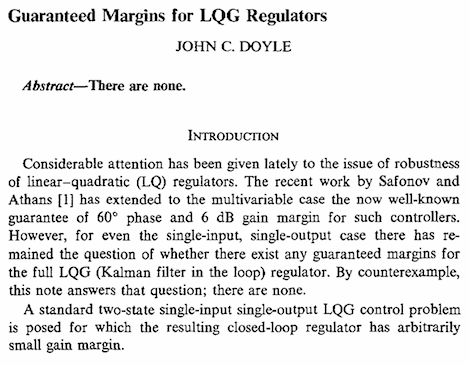
I still get IEEE Trans. on Control Theory, and it's all machine learning now. Except that the controls people are desperately trying to solidify the underpinnings of machine learning, so that control systems don't suddenly misbehave for some sets of inputs. Controls people want a guarantee that if it does something reasonable for inputs of 5.1 and 5.2, it doesn't do something completely unexpected for an input of 5.15.


reply