Maybe it's worthwhile to remember that money and paying for things arose from the necessity of trade. Different humans created different value and traded with each other to all benefit. To not have to trade goods, money came to be.
If your AI can give you the benefit without having to trade, you no longer need money. But even if your AI can do everything a human can, unless it can create something out of nothing, you still need land. Both to grow food and to extract resources. And you still need to defend your land.
> Maybe it's worthwhile to remember that money and paying for things arose from the necessity of trade.
Initially, yes. But that was in a situation where (broadly speaking) people had roughly equal levels of resources, and they developed money to have a consistent way to value those resources.
Here and now, the money the super-wealthy have now represents control of those resources. You and I don't have much to offer in that context.
And if (as CodesInChaos alludes to) we are positing a future where the super-wealthy controllers of AI also have sufficient robot-power to replace human manual labor, why would they not also have sufficient robot-power to kill anyone trying to take those resources back from them? Certainly, this is the calculation many of them are already making.
It is abundantly clear that if they are allowed to continue down this road, beyond a certain point the only way back will be by overwhelming force. And if they are able to continue farther, then beyond a certain point assembling that level of force that may no longer be practical even in the rosiest of scenarios.
The way I came to understand the speed of light, it is not so much that it is finite, but more so that time slows down the nearer you get and stops at light speed.
This means that going faster than light entails time travel into the past. While going just at the speed of light means you can travel any distance in exactly zero seconds. It's just that time passes for your surroundings.
This is a subtle misunderstanding. As you approach the speed of light, physical processes including clocks or other time measuring devices appear to slow down relative to an observer. Exceeding the speed of light, at least as a conceptual generalization, doesn't mean that you end up going back in time and experiencing past events like Back to the Future, rather it would allow for future events to influence the outcome of past events, what is called retrocausality [1].
Retrocausality is not the same as time travel. With time travel it's as if you get to go back in time and reexperience things that happened in the past, which is not what faster than light travel implies. Retrocausality is more about things happening in the present that are influenced by future events, as opposed to causality where only past events can influence the outcome of future events.
I had a mobile phone around 1998. It was a brick. Wouldn't even want to carry that around with me. Ditched it after a few months. Next time I had a phone was 2008. By around 2004 most classmates had a phone, but I didn't. Wouldn't even have known what to use it for. Call my parents? What for. Talk to classmates? I can do that in person.
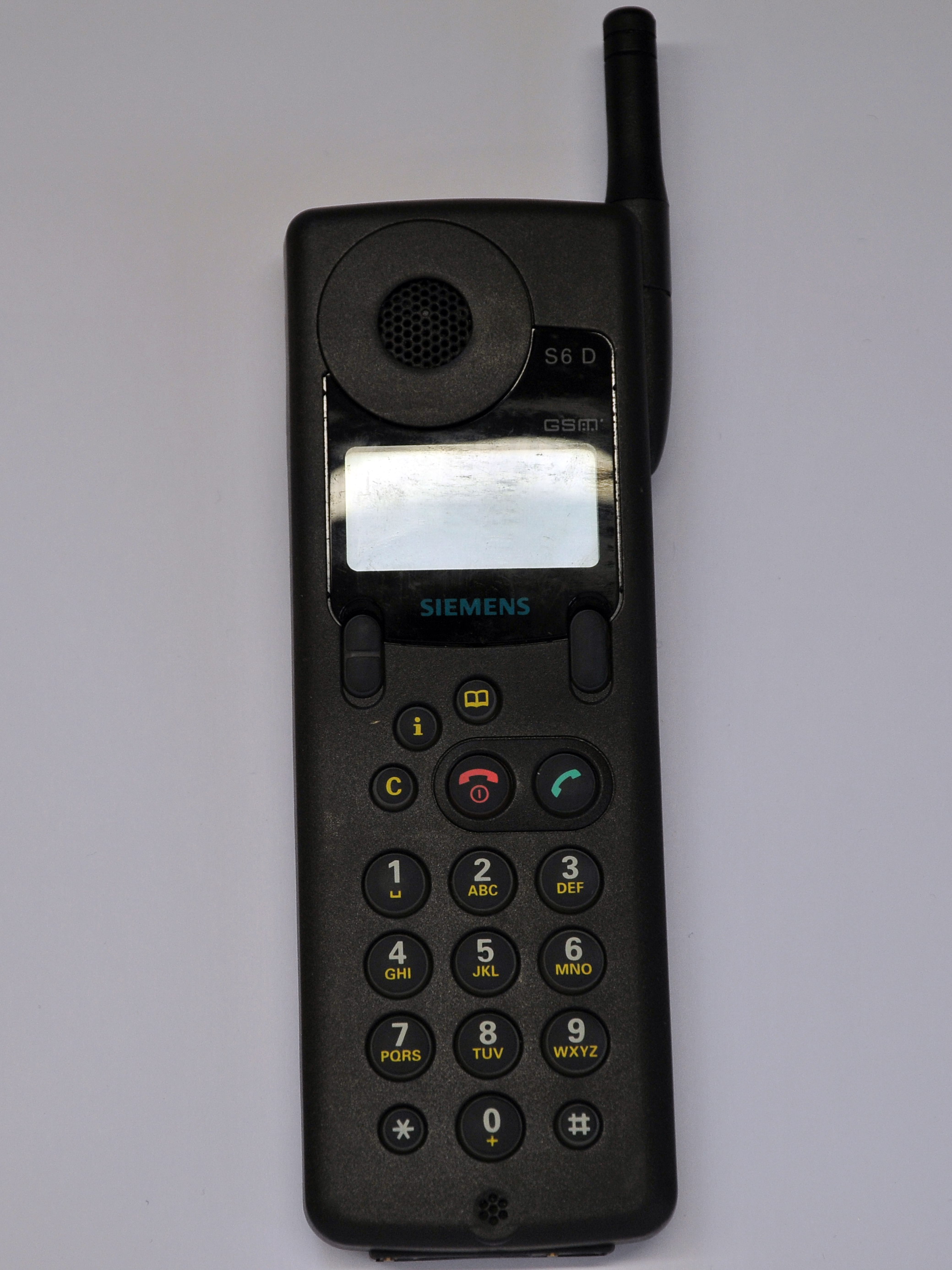
This is the phone AIB bank were giving away in 1999 in Ireland. Far from a brick, pretty compact actually. We texted after class of course, all evening. Where everyone was going, who'd 'gotten off with who'. Gossip, just like today.
All the kids I know have a healthier relationship with their phone than some of the adults I know. Some adults can't even bear to not look into their phone while watching a movie.
I mean, no, pretty much every service lets you download stuff for offline access (including YouTube if you have premium), which I was doing anyway to preserve battery.
I'll admit that part of me wants to try a dumbphone primarily as a curiosity, since I am curious how well I could survive in 2026 without all the smartphone conveniences. Also the battery that can last upwards of a week.
Before the phone era, you wouldn't have to make those calls, because your parents didn't care what you were up to. You could even stay over with friends for a few days without telling your parents and it wouldn't have mattered a whole lot.
Then, of course, the media was full of scary murderers during the late 1960s and 1970s and things changed. Laws also changed to get parents on the hook.
Without any sort of phone, I might have been less inclined to do an unplanned activity that would keep me at school after the school bus left, because getting home by public transit was obnoxiously slow, it was too far to credibly walk, a safe bike route basically didn’t exist, and none of my friends were old enough to have a car. But I was lucky that my parents’ commutes were such that one of them could come and get me after work if I managed to arrange it. Which I sometimes did by using the aforementioned pay phone to call their office.
I don’t know about any relevant laws, but this was a big city, well after the 1970s. I semi-regularly walked myself a mile or so after elementary school to a parent’s office and no one batted an eye, but this may have been partially a result of the fact that the route was quite safe and largely car-free. Hmm, maybe the problem with kids’ freedom these days has as much to do with busy roads dividing up the world as with fear of school shootings.
I think that public transit in the particular area where my middle school was would have been, if anything, worse in the pre-phone era.
Having the cable alone isn't enough. You also need these weird plastic things that raise it a few inches up from the ground. Audiophile scams are hilarious.
And productivity would be reduced why? Because rational faculties are impeded.
In any case, if that were the only concern, then I claim you would likely not see the legalizing or loosening of restrictions. On the contrary, I claim that this growing laxity is at least subconsciously if not explicitly motivated by a fear of growing discontent over our oligarchic political order, and the desire to “neutralize” the nasty effects of the disordered lifestyles it encourages and to render people docile.


If your AI can give you the benefit without having to trade, you no longer need money. But even if your AI can do everything a human can, unless it can create something out of nothing, you still need land. Both to grow food and to extract resources. And you still need to defend your land.
reply