First, ChatGPT has been the most downloaded app for two years straight, the idea that AI is loathed by the general public is pure delusion, propped up by manipulated surveys and people living in a bluesky bubble.
Second, Big tech wasn't well liked by the early 2020s, that ended in the early 2010s when the NYT editorial board took a top down decision to cover big tech negatively.
Third, the idea that they were innovating before but aren't now is insane. AI is the biggest innovation in tech since the transistor and possibly the only true innovation since the GUI.
Respectfully, download numbers are not an adequate proxy for opinion. The number of companies mandating AI use plays in significantly. There are highly ploarized bubbles of opinion fwiw. In the end, it requires actual controlled polling of opinion to have a satisfactory understanding.
Additionally, I'm not sure how you square NYT coverage being more critical of generally worse behavior as "top down" without a citation, care to point at anything to substantiate that statement?
Innovative, in some part sure. But lately the running jokes have become "Uber, but for $X", which hints at imaginative stagnation. AI has been the largest shake up in a decade (or more), but it is hard for Average Joe to grasp what is changing.
The way you would do that generally is to make it backwards compatible, then adding warning to legacy tools, then turning SHA-1 off by default, then removing it entirely.
Doing it in a backwards incompatible way creates a chicken and egg problem, can't convert repo to sha-256 because some tool doesn't support it, tools don't have an incentive to be updated because no repositories.
The point I'm making is that "backwards compatibility" cannot rely on SHA-1 support being around forever. At some point, all uses of SHA-1 must go. This includes not only the interfaces between Git and external tools, but also Git's internal data structures. Past a certain point in the near future, there cannot be a two-tier Merkle tree system anymore; the SHA-1 tier has to be removed before long.
Didn't you know? Once you heat up water that's it, you can't use that water ever again. It's even worse if you make it evaporate, not just useless but GONE.
Now try again with local and short term impacts on the whole ecosystem instead of saying "Ackchyually water never leave the atmosphere so it's unlimited"
Imagine fretting about water and electricity usage in europe, where we'll never ever have a datacenter build-up because electricity prices are too high anyway.
Yemen, one of the poorest countries on earth, closed an important EU trade route for over a year and we couldn't fix it. Defending your land vs protecting your trade interests are different things.
Brussels too. There's some US cities that seem to be exceptionally bad, in a league of their own, but that's probably still a small fraction of all the homeless.
If we did mind a world were global trade was unreliable we have a military to match that concern, but we don't. The Houthi close the red sea for years and we can't do anything about it. Iran, attacked by the US, retaliates against us by closing the strait of Hormutz and we sit in the monitoring chair.
Don’t buy too much into the propaganda. Back when the US was a reliable partner that still understood how much it was gaining from global trade, it would have been idiotic to focus on building European military capability.
The thing that seems to have changed is that both the US and Russia are determined to destroy their own future.
How many years ago was this? Because over the past 20 years things have gotten better
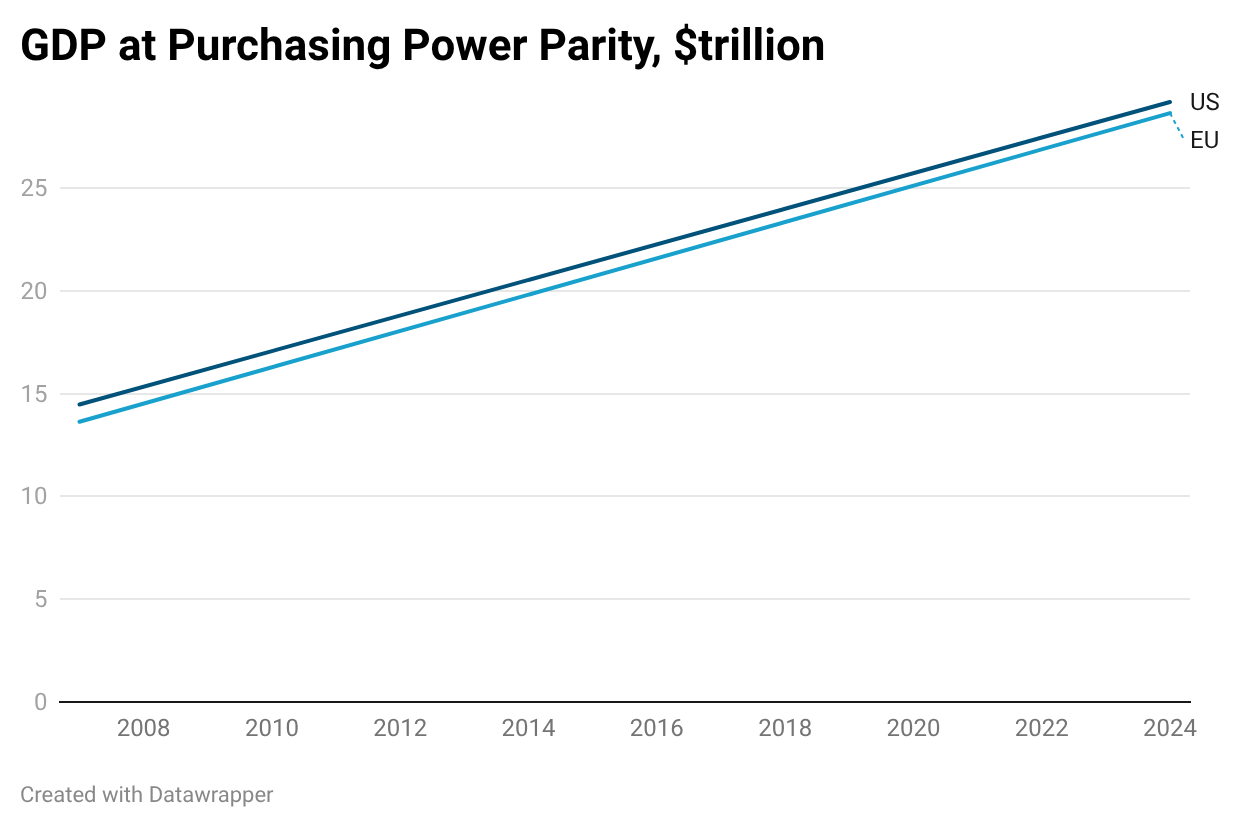
Last time was 15 years ago, though family has been as recent as a few years ago and havent's seen a much of a change change. Also, in many ways, the last 20 years is quite a bad example to pick, since wealth of everyone under the 90th percentile was the same in ~2017-2018 as in ~2007:


reply