From the comic: "Over the course of a year, Io's orbital time varied by 22 minutes".
This sentence implies that at some point in the year the time it takes for Io to do one single orbit, as viewed from earth is 22 minutes longer. That's not true. This is not a good explanation comic.
What happens is that if you have a clock that is very accurate and has a drift of less than a minute for a whole year, and you measure the exact moment that Io's eclipse happens (every 42.5 hours) over a full year, you might expect that it's every 42.5 hours all the way through the year. But what you actually see is that this moment varies over the course of a year by 22 minutes - it's later if Jupiter is far away.
Now you might ask how can somebody create such an accurate clock - in the 17th century? He used a pendulum clock which had a drift of like a second in 6 hours, and at the beginning of each night, he corrected that clock based on some other daily occurring measurement of the night sky, like when a certain star crosses a fixed point when viewed from his observatory.
I think it is still a good explanation because the context makes it clear, although on its own the statement is wrong. Perhaps you could have written "Over the course of a year, its orbit period was late by up to 22min". Phase is too technical and you would have lost a loot of readers already.
I believe the universe sets the standard for constants science is attempting to articulate.
With that said, the observation of an orbit being late is an observation that our tracking of the orbits is not accounted for accurately.
Time is vague. If our use of base-12 is to account for 60x60x24 seconds in earths rotation and our calendar systems are based around earths orbit. They fail to align with our solar systems constants.
Likely just another counting and dating system approaching
Oof, "not a good explanation comic" is a bit harsh. I deliberately skipped the synodic-period / cumulative-delay framing because I worried it would add a layer of complexity that might bog down a comic aimed at people with zero physics background.
Didn't intend to make you feel bad. I'm sorry if I offended you.
I think it's interesting that readers often believe "in the medium of comic, things are easier to understand". But it's not so by default. As a writer, it's all about first getting a good intuitive understanding yourself. And then breaking things down into easy to understand chunks that build on top of each other. Which can work in text just as well as a in sequential art.
If I used the form of comic to explain this, I would have shown a graph of time and when eclipses happened, that a scientist might make of this on earth. The graph would have expected eclipses as regular black dots, and there would be red dots with the time of the actual eclipses. And the actual eclipses sometimes line up with the expected time, and sometimes the actual eclipses are a bit late. That would have used the medium to make things clearer.
I'm not sure if it is "comics are easier to understand", but rather that for many, "comics are more inviting to consume than books".
I have 3 (now adult) children -- one was a bookworm and the other two were not, despite doing all the supposedly right things in their rearing (reading to them every night, a large collection of books tailored to them and lining the bookcases in their bedroom, etc.)
They just don't like to read. But Manga and other assorted graphic novels will catch their attention.
I didn't write the original comment but perhaps a suggestion that may satisfy both of you would be to say the "apparent orbital time"? You don't need to get into the details but this way no one will think that you claim that the actual orbital period varied, only its measurement from earth.
Edit: re-reading the comic I think it was pretty clear already but still maybe this helps.
Piano playing is not like using a typewriter. It matters how you sit, the position of your body, arms and hands, and how you touch the keys. How to not become cramped.
I'd recommend taking lessons with an experienced piano teacher instead of looking for a software solution.
This has already been going on for years. Google Flights and Kayak already have fare histories, fare forecasts, fare monitors with automated notifications. So now anybody can get the cheapest price with a low effort.
The industry responded with aggressive unbundling - basic eco now has no carry-on, no seat selection, no changes. All can then be bought as extras.
This is a scenario across many industries - hotels, car rental, cruise, concerts, online retail etc.
Basically - yes that trend is bad for Bob, but it makes things more transparent, fair, and increases competition. It's the way the world goes - hard to stop that.
Yes, but this type of stuff compounds. Moreover, the fact that agents are now the lowest friction interface for this stuff makes it a potential double-whammy.
A similar example discussed recently on the podcast ”The Real Eisman Playbook”[0] illustrates the point: Many retail investors have trading accounts with some cash sitting idle. The brokers earn a healthy margin by investing that cash into short-term money market funds (MMF).
Now obviously, the diligent investors could easily buy the MMFs and pocket the profit themselves. However, many of them are lazy or don’t care. But now with agentic access, even the laziest user can optimize their short-term cash holdings, which might cost the brokers relying on this income dearly.
"multiple providers disclose sensitive conversation-derived artifacts — including titles, prompts, and screenshots — to third parties, often alongside persistent user identifiers that enable user attribution. We also find that some providers publicly expose conversation permalinks without access controls, allowing trackers to read the entire conversation."
I'm shocked... SHOCKED! that these companies would sell this data to advertisers and violate the privacy of their users. Who could have seen this coming??
Author claims the system setting "Privacy & Security > Apple Intelligence Report > Report Duration" with its 3 options [Off | 15 minutes | 7 days] sends that data to Apple with that frequency. This is wrong - this is a transparency report so that you as a user can see everything that is getting sent to Apple as a part of Apple Intelligence. Nothing additionally is getting sent to apple if you switch this away from "Off".
It's placed right next to a similar report for the user to see which apps generally connect to the internet and to which domains.
Basically, the main point of the article, "I discovered that macOS 15.3 had enabled a feature that was phoning home every 15 minutes with personal data" is not true.
that refers to a post from 2025 that he links to. this is clear from the first sentence of the article. I suspect maybe you didn't actually read the article and spent more time writing this erroneous comment than you might have reading the article.
This is literally the main point of the article:
"The nice thing about keeping a blog is that I can say at precisely 9:51am, Wednesday 5th February 2025, I discovered that macOS 15.3 had enabled a feature that was phoning home every 15 minutes with personal data. And that I said “no” and turned it off."
Disappointing that we have multiple 10-deep reply chains pearl-clutching Apple's disrespect for the user, and no one actually bothered to verify the premise of the article. They just want to be mad.
When I updated, I had to actively sign up for new Siri and even make space for it. Until update, my phone had the "old" Siri. Not sure what the issue is
Snowden got into action because he believed that the US was fundamentally good and needed to get back on track. Over the past 12 years, in the US and around the world, this belief completely vanished. Whatever remains in the archive no longer holds any valuable news.
That doesn't equate. Something can have no value as news but incredible value as security. Your passwords, for example.
The big question is whether Snowden's original thesis - that these newsagencies would find the right balance - was correct. In some ways, I hope there is a complete leak of the archive in decades' time when the relative risk is minimised so that the public can, in turn, evaluate the press of the day as to their ability to do this assessment. It may inform future similar whistleblowers whether Snowden made the right choice.
Example being the gross irresponsibility of Wikileaks releasing unredacted documents that detailed source identities (although all I know about this is anecdata).
The problem here is an information imbalance between seller and buyer.
This could be solved via regulation (unlikely to happen in the US).
Another solution would be independent testing labs / publications. To stay independent, they can't finance themselves using ads. Would people be ok to pay for information, on the internet? For $1000 lawn mower maybe, what about for a $50 kitchen appliance?
This is the same position of Yuval Noah Harari in his recent Economist interview: The ones in power (Musk etc.) try to frame the bad AI future as inevitable, instead of shouldering responsibility. https://www.youtube.com/watch?v=FNZhxTtOL-I
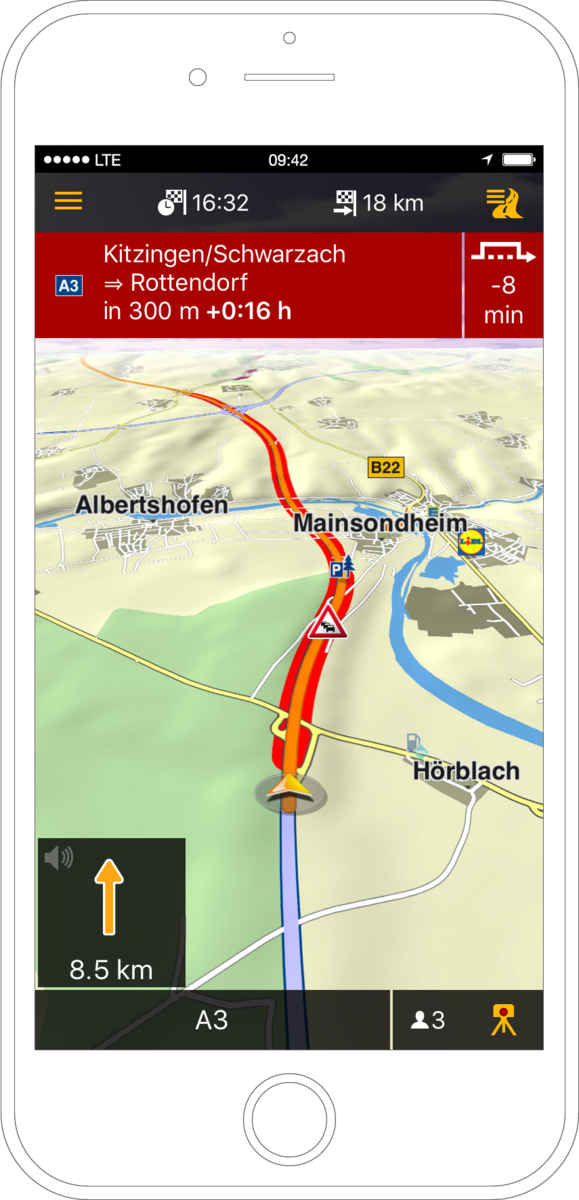
Beautiful perspective if you need to take a left in 500 meters. Not so great if you have to take a left in 3 kilometers because that would just not be visible.
Now of course you could change the parameters so that the upper screen border is 3 kilometers. But normal standard perspective is even better, because it can show you up to infinity. The inherent concept here is that there is a cut-off at the top, and that there is always a lot of unnecessary stuff near you whizzing by to look at / dopamine kicks. So you would have to constantly look at the screen - instead of at the road.
Navigon (among others) back in 2009 showed a perspective that balanced between showing the next junction and the next few kilometers. And leaving out anything unnecessary. I like that better. Example: https://www.notebookcheck.com/fileadmin/_processed_/csm_Garm...
The trick would be adapting relatively, which a lot of apps already do... zoom/flatten out if it's a long stretch of nothing, back in when you start approaching more complicated sections.


This sentence implies that at some point in the year the time it takes for Io to do one single orbit, as viewed from earth is 22 minutes longer. That's not true. This is not a good explanation comic.
What happens is that if you have a clock that is very accurate and has a drift of less than a minute for a whole year, and you measure the exact moment that Io's eclipse happens (every 42.5 hours) over a full year, you might expect that it's every 42.5 hours all the way through the year. But what you actually see is that this moment varies over the course of a year by 22 minutes - it's later if Jupiter is far away.
Now you might ask how can somebody create such an accurate clock - in the 17th century? He used a pendulum clock which had a drift of like a second in 6 hours, and at the beginning of each night, he corrected that clock based on some other daily occurring measurement of the night sky, like when a certain star crosses a fixed point when viewed from his observatory.
reply