Notice that LLMs are increasingly generating dense jargon difficult to read for humans. Training on difficult problems and targeting perplexity would cause the language it uses to converge towards something better at reasoning about these complex problems than what humans might be used to, in some way, that's superhuman reasoning emerging.
The fact that LLMs explicitly target this measure is one reason they are getting good at engineering and architecture, sometimes better than humans who think they know better but lean on engineering fads instead of more mathematically supported (but more nuanced and probabilistic) principles like entropy/perplexity.
It's nice that this article goes beyond the "context too long" scapegoat diagnostic.
There is more to it than just reducing content in context. LLMs attention mechanism works by finding graphs of related words and concepts and it works best when the relevant relationships are close together in the text. Length matters but how well the information is organized matters as well.
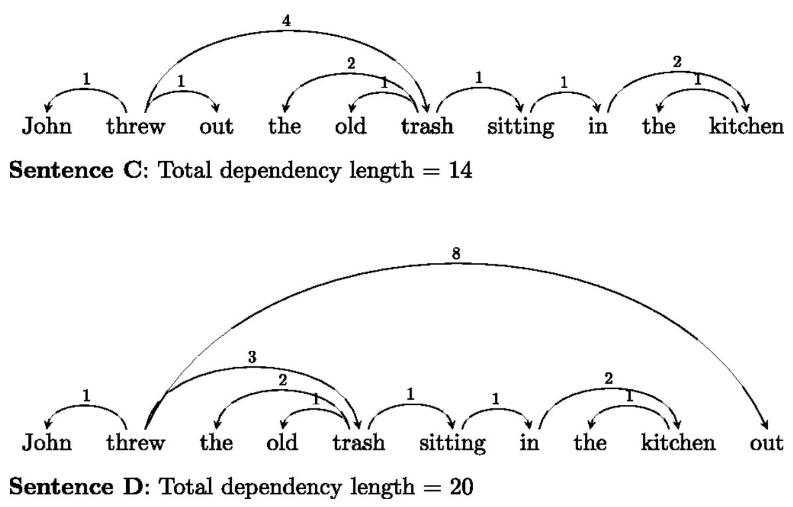
It's useful to be familiar with the concept of dependency length. The two sentences in this image ( https://benoitessiambre.com/img/dependencylength.png ) have the same words and same meaning but sentence C is organised to minimize the distance between related words.
This can also apply to paragraphs and sections. Ordering them so that related information is recursively closer together, helps AIs think better (also helps humans, Dependency Length Minimization, DLM is an idea from psycho-linguistics).
This is one reason progressive disclosure and sub agents are important. Including unnecessary information spreads apart surrounding information and makes it more difficult for AIs to figure things out.
For eg. optimizing skills, it can help to put more important information at the bottom of a skill. Usually after a skill is loaded, the AI will start “thinking”, talking to itself to try to reason through a problem. The thinking block will have an easier time considering the text closest to it, the last part of the skill, than information farther up.
Thinking blocks can produce a lot of text (a lot of it often hidden from users) that also spreads information apart. Sometimes, when an early instruction is still relevant but there’s been a lot of thinking and discussion added to the context since, it’s worth repeating a summary the early information ( keeping in mind that too many reminders can also spread other information apart ). I think however, LLMs are tuned to overweight very early information so that they don't disregard system prompts. You might be able to exploit this by placing some important facts near the very beginning of a conversation.
If you've ever written compression algorithms where repeated blocks are referenced instead of encoded, you'll be familiar with how related information being clustered allows for better compression. It's another example of the parallels between intelligence and compression and it hints at the information theoretic aspect of DLM.
  For eg. optimizing skills, it can help to put more important information at the bottom of a skill.

  LLMs are tuned to overweight very early information so that they don't disregard system prompts. You might be able to exploit this by placing some important facts near the very beginning of a conversation.
My impression is that there's only a small area at the beginning of the context window that is artificially boosted, after that DLM becomes important.
Full disclosure: this is info I got from Claude. I was discussing DLM ideas with it a while back and while it mostly confirmed (maybe sycophantically) my ideas, it also said that rather than a pure decaying distribution effect with distance, it was U shaped because of the small boost at the beginning of the context window.
1) This would make stocks worth a lot more and produce more dividends so everyone owning stock would get money to spend.
2) Governments effectively indirectly own ~40% of all business profits via corporate taxes, capital gains taxes, dividend taxes, sales taxes. So governments would also have more revenues to spend/redistribute (this depends on governments not wasting it, spending it on wars etc.)
#1 is still mostly just moving money from the poor to the rich. Most people working for a wage are going to be in the bottom 80%, yet the top 20% own over 80% of the stocks.
It doesn't have to be arbitrary. The Kolmogorov/Solomonoff definition, that the simpler models are the shortest programs that can generate what we know about a domain, measured in bits, have a solid mathematical foundation, based on information entropy and even thermodynamic entropy if you cross over into computer hardware.
Entropy is a metric targeted in LLM training which is likely why LLMs are overfitting less and less as they improve and why they subjectively seem to obey Occam's razor.
Reducing entropy or cross entropy fits intuition and theory and it's what LLMs target during training in order to model languages, to model the world and to enable calibrated reasoning across uncertainty and gray areas. I think you can use entropy reduction as a good definition of simplicity even though it's not always "simple" to understand what that entails.
The benefits go beyond reducing token consumption. Compact contexts also foster better reasoning, enable intelligence across more layers if you can load them in a single context, and writing software to enable this, results in more correct software, software that _generalizes_, that has higher probability of being correct not just for tested cases, but for the interpolations and extrapolations of these cases.
Refactoring towards good abstractions is more powerful than people realize. There's information theoretic bayesian math to back this up.
It's a bit of a divine coincidence that software that is more economically and energy efficient to process and run tends to also be more correct.
Imagine what happens when human readability is discarded as a goal. LLMs are already very good at inferring meaning with little context. If the objective function is reduction of token consumption, it's hard to know where we will end up.


reply