"Current status: We're continuing to pursue all available pathways to restore service, as our actions taken thus far have not provided the anticipated relief. Our investigation has found that a core process on the affected servers is becoming overwhelmed, which causes the servers to stop responding and contributes to the capacity loss."
I mean, either roll back your update or there is a malicious actor involved.
The 4:11 AM UTC update claims no indications of malicious activity (obviously I have no way to judge that, just copying it here):
Current status: As part of our investigation into the sustained traffic management imbalances, we’re reviewing traffic flows and affected infrastructure to identify opportunities to optimize routing. This includes verifying the reasons for service failures so we can develop specific actions to improve stability.
We will continue to share more information as soon as we have it, and for now we can confirm that there is no indication this is the result of malicious activity. We’ll continue to apply learnings towards remediation actions as we confirm effectiveness mitigation actions.
According to patent prosecution records, the independent claims for GB2484736 originally lacked any network transport limitations and were deemed entirely unpatentable against the prior art listed above.
To get the patent granted, DisplayLink’s attorneys amended the claims to specifically add delivery of the display data over a "general-purpose data network." The validity challenge relies on proving that adding a general-purpose transport layer (like USB or Ethernet) to existing image-compression methodologies was an obvious step and completely unoriginal in 2010, given the widespread existence of USB monitors and network-attached graphics at the time.
> I predict a high chance that they lose this patent. Mark my words.
After how many dollars spent? I mean, it is good that eventually bad patents get killed, but it still costs too much to do it, one at a time. We need a more streamlined process, maybe? Maybe an academic-review-like process at filing? Send the claims anonymously to a few experts in the field, randomly selected. If they all say it is obvious, kill it immediately and fine the company for wasting the patent office's time?
My only concern is, what if some well-meaning person puts in a poorly constructed claim, and then that creates a counterproductive precedent.
I think ideally, someone like Software Freedom Conservancy or the Linux Foundation or the FSF or whoever would take charge of doing it, taking advice from patent attorneys in the process.
Maybe there is some UK patent attorney reading this who is willing to take it on pro bono?
A bit pedantic (since my wife is in IP), but you don't need a patent attorney for most patent things, you just need a patent agent. (Who may also be an attorney.) Non-attorney patent agents can handle basically everything related to patents other than litigation.
“patent attorney” vs “patent agent” is a US distinction. In the UK, “patent attorney” is the standard term for what is called “patent agent” in the US - someone who can appear before the patent office, but cannot (in general) practice law. [0] Now, unlike US patent agents, UK patent attorneys can actually appear in court for patent litigation (they all get some limited rights to do so, and can gain additional rights by undertaking advanced training) - however, in practice, you’d use an IP solicitor/barrister for any high value patent litigation, it is mainly at the low end that UK patent attorneys handle litigation independently of a solicitor or barrister. A solicitor or barrister who specialises in patent law doesn’t have to be qualified as a patent attorney, and although it is technically possible to do so, few actually are.
[0] Technically, the UK classifies patent attorneys as legal professionals-in popular parlance, “lawyers”-but unlike solicitors and barristers, who are generalist legal professionals permitted (in principle) to practice in any legal area, a patent attorney is a specialist legal profession whose scope of legal practice is officially restricted to intellectual property (they are allowed to advise on non-patent IP law matters such as copyrights, and also related commercial law matters such as IP contracts, but not on legal matters which have no connection with IP)
Yes, it's quite jurisdiction dependant - I'm actually in Canada, not the US, and while my wife works with various foreign associates and I expect is familiar with that UK distinction, that's not a point I was clear on. :)
THis may be the case or may not be the case. I prefer to hit where it hurts. And it will hurt more in the US and I know US Patent law better and I see the opportunity in the US. If Synaptic wants desert, we can take care of the UK patent afterwards.
I think I may be able to hammer something out. Maybe this can be a group effort.
But this is not how you approach Synaptic. You write the counter and tell them they have 2 weeks to give you a free license or you file. Tick tock tick tock tick tock.
Is this a potential use case for having a gen AI agent grind to put a prior art claim together? Feels like scanning and building prior art to challenge existing patents is a great use of AI agents, but I might be mistaken.
You assume there is some logic to software patents. It looks like an extortion racket to me. If you don’t pay enough fire insurance the mob lets your competition burn your business down.
I wouldn't pin that on patents specifically, it seems you can shut down a free software project by suing them for literally anything, even something they obviously didn't do because they can't afford a lawyer and can't afford a loss so their only option is to give in to everything you want.
If software patents are slop, you fight slop with slop.
It would take much human time to search for prior art across all of human knowledge for existing patents and new patents being proposed. But GPUs are tireless, and can continually grind towards success. They build their case for dismantling all existing active patents as long as they are kept fed.
If I were a frontier lab, I would be finding the most valuable patents, starting the research agents up, and then shorting companies that would see enterprise value decline if subject patents were invalidated (think Hindenburg or Culper Research activist investors). Just one way of monetizing the fancy search engine and token dispenser.
The patent generally covers methods and architectures for transmitting compressed screen updates over a general-purpose data network, such as USB or Ethernet, the patent specifically claims Haar-transform decoding.
So only the combination may be new. But this reminds me of a USPTO thing from my past.
The landmark ruling you are referring to is the U.S. Supreme Court case KSR International Co. v. Teleflex Inc. (2007), which led directly to the USPTO publishing its highly influential 2010 Examination Guidelines for Determining Obviousness.
Under this framework, if element A is known and element B is known, combining them is not patentable if the combination yields nothing more than predictable results.
So, general-purpose data network, such as USB or Ethernet was known (A), claims Haar-transform decoding was known (B) [DE69909880T2 / EP0955609]. Even if we don't find this combination in prior art, it is dubious that this is patent worthy based on USPTO guidelines (combine A with B).
But I see a lot of stuff that suggests prior art:
1. Noriaki Yamazaki and Tetsuo Tanaka (2007). “ZYWRLE: Enhanced VNC Codec for Motion Picture.” IEICE Transactions, J90-D(7), pp. 1790–1798.
Brief summary: Adds wavelet compression to VNC’s ZRLE codec for transmitting moving images, reducing network traffic to 20–50% of standard ZRLE.
https://search.ieice.org/bin/summary.php?abst=j&category=D&i...
2. Joshua G. Senecal, Peter Lindstrom, Mark A. Duchaineau and Kenneth I. Joy (2004). “An Improved N-Bit to N-Bit Reversible Haar-Like Transform.” Proceedings of Pacific Graphics 2004, pp. 371–380. DOI: 10.1109/PCCGA.2004.1348368.
Brief summary: Introduces PLHaar, a reversible Haar-like transform supporting lossy and lossless image compression without increasing coefficient bit width, suitable for bandwidth-limited video and graphics hardware.
https://www.osti.gov/servlets/purl/15014239
3. Joshua G. Senecal, Mark A. Duchaineau and Kenneth I. Joy (2004). “Reversible n-Bit to n-Bit Integer Haar-Like Transforms.” Proceedings of the Data Compression Conference 2004, p. 564.
Brief summary: Introduces lookup-table Haar-like transforms that preserve bit width and reversibility, with applications to fast image compression and streaming hardware such as DVI channels.
https://www.osti.gov/servlets/purl/15013668
Deutsche Telekom is a regional monopoly that abuses its position in every possible way. It's like Comcast but even worse. Best thing you can do is forget they exist and if someone really wants to contact you they'll find another way.
Is it just a default theme difference, or is the current version actually less themable?
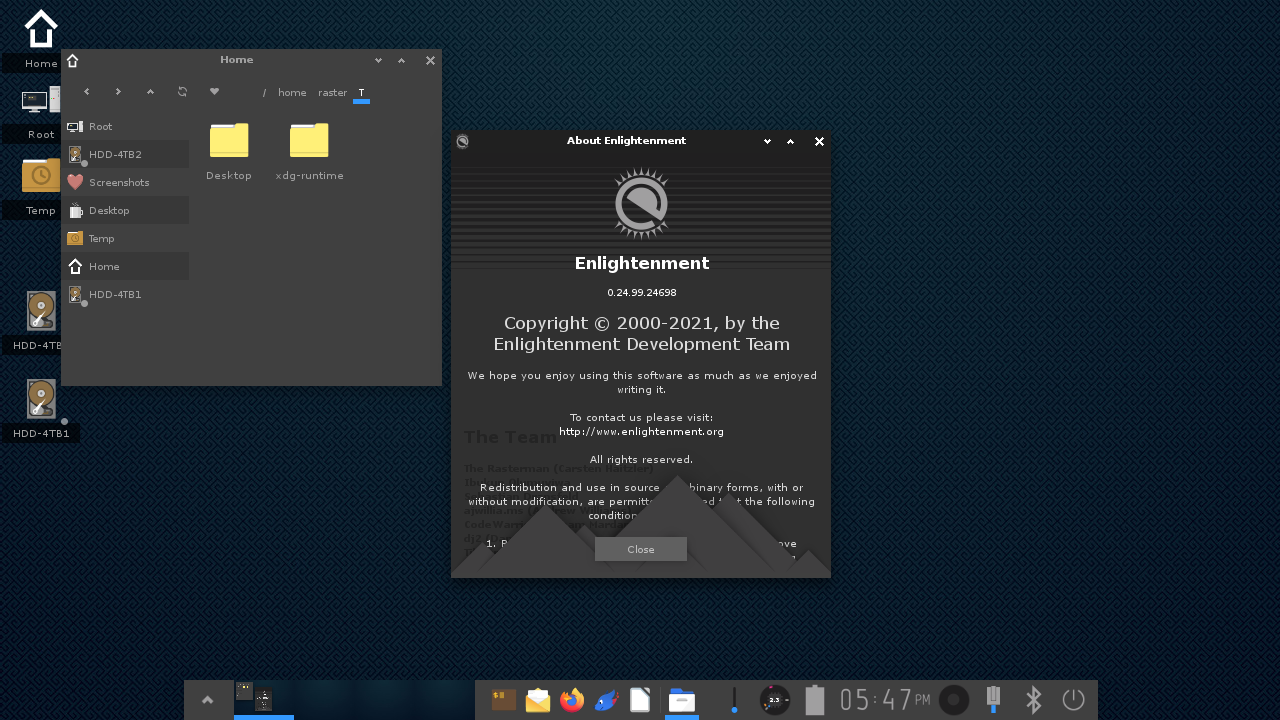
Also, the person you replied to mentioned Moksha; that's a fork of Enlightenment 17 (which is what at least two of your cool-looking example screenshots appear to be from).
Same with AI. It is becoming much more efficient and cheaper. This will result in a much, much higher demand. Expect Netflix to render a movie based on your wishes in real time.
That the energy demand is sinking is based on the fact that most industries got outsourced to China.
No, it is not. For example, gasoline use per capita in the US peaked in 1978 and the economy went up around a gazillion percent since then. There are now millions of EVs in Europe and electricity use has declined in the last twenty years and this has nothing to do with the hand wavy "deindustrialization". Why would it not? The light bulbs I have today use 10x less electricity, the induction stove I have uses significantly less energy, I bought a fridge last year that uses 3x less electricity than the previous one, the TV died three years ago, the new one uses an estimated 50kwh per year of normal use, and the old one used 200. The EU has new standards where the devices on stand by are not allowed to draw more than 3kwh (I think) etc. And obviously manufacturers will not make efficient stand by devices for the EU and then make inefficient ones for the rest of the world in purpose. The same is true for other forms. My building replaced the gas boiler used for heating and warm water in general. The winter was tougher than the one before, I switched to working from home and heated a lot more. My gas use stayed flat.
When your logic collides with hard numbers I would stick to the numbers and reconsider the logic. Here is an idea: will I run my dishwasher 3x more often just because it is now 3x more efficient? Will I run my fridge more often because it is more efficient? Difficult, it already runs 24/7. Will I keep the lights on when I sleep because they are 10x more efficient?
So as you see although there is obviously some validity in the OBSERVATION that is Jevons Paradox, it is not a hard rule. There comes a point where it stops being true.
„Economic Growth Is Closely Tied to Energy Consumption“, Slide 3:
“This rather strange situation arises because the standard calculation misses energy embodied in imported goods.”
"Will I keep the lights on when I sleep because they are 10x more efficient?"
Nope. But now you have a computer, maybe two, a cell phone, an ebook reader, a tablet, take international flights and use Bitcoin and AI.
Your anegdotal evidence falls on its face as well: I have two TVs now instead of one, and my electricity consumption went down. This includes moving mid year from an office to work from home. So one laptop charging every day, and one monitor. I even bought a printer which I did not have previously. That's because the two TVs combined, made 2023 and 2025, use less electricity than the one I had before, made 2011. The addition of a laptop, monitor and printer were negligent compared to the savings I made with my new fridge.
Your argument was Jevons Paradox, that consumption goes up as use gets more efficient. My counter argument was that my fridge got more efficient, but it will be difficult to use it more often since it by design runs all the time. Your counter argument was that I will now have more computers and whatnot and will still use more electricity. I replied to you that even this anecdotal evidence falls on its face because I actually have the data and that my electricity use went down despite moving to full time work from home. I think this sums it up nicely.
I also stated previously that we have the data even on a large scale. Electricity use in the EU went down in the last 20 years and this even with millions of EVs now compared to then. Even Norway which now for years sells almost exclusively EVs has had just a mild bump in electricity use compared to a decade before. This implies that The efficiency savings made elsewhere held. My hypothesis would be it's because at a certain point it's impossible to use something more than you already are (see fridge, dishwasher, induction stove, computers, TVs etc) and thus efficiency gains there will hold. The same pattern is observed with American gasoline use -- as the gas guzzlers of the 70s died off during the oil crisis, per capita gas use fell and practically never recovered. This despite the fact that this use case is quite comparable to coal and you could easily argue that with better mileage people will drive more. And they probably do, but still the gasoline use fell.
You argued further that developed countries need to account for energy use of products they offshored, but I offered data that says otherwise. Additionally the argument can't be used for gasoline use which as stated did not follow Jevons Paradox.
So obviously, Jevons Paradox did not hold in these substantial cases and should not be viewed as law of nature. It's an interesting observation that makes sense, but obviously has its limits.




I mean, either roll back your update or there is a malicious actor involved.
reply