Different angle on the same model: the full GLM-5.3 (744B MoE, 4-bit experts, 434 GB on disk) runs on a single MacBook Pro M5 Max with 128 GB
by streaming the experts from NVMe SSDs instead of keeping them in memory.
One drive gives about 2 tok/s; striped across four drives it reaches 3.5 tok/s with byte-identical output, and our best internal build with a not-yet-published patch does 4.2.
Given these numbers it has some potential to become quite usable for unattended workloads, especially if decode can be batched across multiple sessions (ideally enough of them to get some reuse of the sparsely streamed weights). (Of course this ultimately makes prefill times explode as you try and increase the workload even further. But that's arguably the natural bottleneck on any interesting local LLM inference, being a compute bound step.)
We stream DeepSeek-V4.1-Flash (518 GB, 4-bit) from NVMe on a 128 GB M5 Max, because it doesn't fit in RAM.
                        prompt processing      steady decode
    upstream, internal       16.23                 10.59
    ours, internal only      28.04  1.73x          14.38  1.36x
    ours, +1 external        36.88  2.27x          16.05  1.52x
    ours, +2 external        43.62  2.69x          17.38  1.64x

  The first fork row is the one that matters: same single internal SSD, no replicas, no enclosures.
Just so you know, you are getting automatically flagged in HN (your comments are automatically removed). I think it's because you are using LLM to write them. You should not copy paste LLM output directly to comments in this website.
(I'm not talking about using LLM to generate the README.md of your project, that's also distasteful but not nearly as bad)
In either case your repository is interesting, and might be useful for people that own a M5 Max
Put a five-line TL;DR at the top of the README — what it is, the number, the honest limit, the two findings, credits — with the detail below for anyone who wants it.
What was the decision to leave the LLM to write the detail section rather than author it yourself? There's a growing resentment about asking people to read LLM-produced words, especially if it's a large amount to read. Not sure if you were aware of that or not (I think there's been links to surveys / polls just recently on H.N)
Decode was flat from 128 to 512 generated tokens (0.926 → 0.923 tok/s drafter-off), but that's a 6-token prompt plus the output — total context under a thousand.
The current configuration admits about 4.4k tokens of context at all, and at anything like 200k the killer wouldn't be decode, it would be prefill: today it reads each layer's experts once per 64-row pass,
so 200k tokens of prompt would be measured in days, not minutes, until the scheduling fix.
The KV cache on this engine grows about 2.8 MiB per token of context, and the machine's 128 GB is already holding the 50.7 GiB resident trunk plus reserves the speculative-verify path needs
(we found the hard way that squeezing those makes the verifier reject wide batches and decode falls to single-token steps).
With the current reserves the engine admits ~4.4k tokens; that's a configuration ceiling you can raise by giving the cache more of the 128 GB and accepting less headroom elsewhere.
K3 itself supports far longer contexts — but see the prefill caveat above: on this setup long prompts cost minutes per 512 tokens until the scheduling fix lands.
That's the one workload this setup is worst at today, unfortunately: output tokens are cheap at 1/s but input isn't — a 512-token prompt takes ~6 minutes before the first token,
because prefill currently reads each layer's experts once per 64-row pass (~9 TB of reads for a 1.4 TB model).
Fix is scheduling and it's the next thing being built; once prefill reads each expert once per layer, the one-token-out classifier pattern becomes the sweet spot rather than the worst case.
Probably not. Each read here is a whole 17.5 MB expert file, so the time per read is set by the drive's throughput, not its access latency — 17.5 MB at 7 GB/s is ~2.5 ms, which is what we measure at queue depth 1 on the SN8100s.
What actually moves the barrier is how fast the slowest of 16 concurrent whole-file reads completes: more drives on direct ports, stable tail behaviour under load, and scheduling. Our ladder shows even that with diminishing returns (one drive ≈52% of four, three ≈90%).
When you have heterogeneous SSDs, e.g. you mix PCIe 5.0, PCIe 4.0 and Thunderbolt interfaces, you can obtain a greater throughput by managing in software the distribution of data, than by using RAID0.
RAID0 works fine only when all the interfaces have the same speed.
If one SSD is twice faster than the other, in order to achieve maximal throughput, you must take care to place the data in such a way so that you will need to read twice more data from the twice faster SSD.
In general, you must distribute the data so that the amounts read from each SSD are proportional with the throughputs of the SSDs.
One could write a modified RAID0 device driver, which would use unequal stripes, with widths proportional with the SSD throughputs, but I am not aware of any such already existing RAID0 driver.
This would not work with HDDs, because the time to seek between 2 partitions of the same device would cause abysmal performance, but on SSDs this should work fine, even if some SSD controllers might still have a lower throughput when reading non-sequential pages.
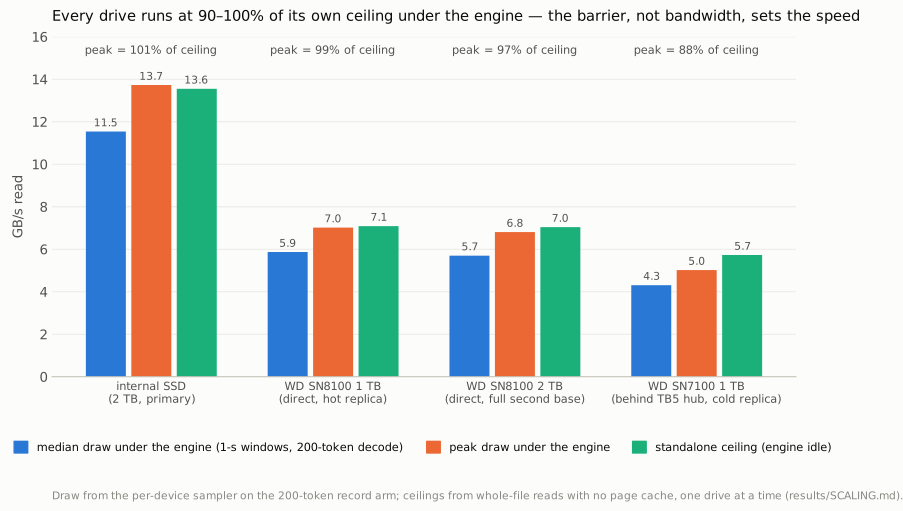
Bandwidth doesn't multiply like that here, and we measured it rather than assumed it. A MoE layer needs 16 expert reads and can't proceed until the slowest one lands, so a layer costs the max over its reads, not the sum.
Going from one drive to four (13.6 → ~33 GB/s of combined ceilings) took decode from ~52% to 100% of our number — not 4× — with
Every drive already at 90–100% of its own ceiling. RAID-0 was one of the first things tried and it lost: striping makes every read touch every drive, so the slowest drive sets every barrier.
What moves this is per-read latency and read scheduling, and for long prompts not re-reading each layer's experts eight times.
Numbers in results/SCALING.md and results/PREFILL.md.
No matter how many external drives you gather, the data coming from them must be squeezed through the peripheral interfaces of the Apple SoC.
So your CPU, made by Apple, Intel, AMD etc., has a number of PCIe lanes and a number of USB/Thunderbolt ports for connecting peripherals.
Those have an aggregated throughput, which sets an upper limit for the amount of data that can be read per second from all the peripheral devices.
In a given computer, usually not all the lanes and ports of the CPU are actually connected, so the limit may be even lower.
In desktop PCs and mini-PCs, usually only 4 + 4 = 8 PCIe lanes are available for SSDs, and when there are more SSD sockets they share some of those lanes.
A much higher SSD throughput could be achieved in a desktop PC by using the GPU connector with an SSD adapter for M.2 SSDs, which has 16 PCIe 5.0 lanes, with a 64 GByte/s throughput.
Taking out the GPU might actually be OK for doing AI inference, because a beefy CPU like a Ryzen 9950X should be able to keep up with a reading throughput of 88 GB/s from 6 SSDs (2 on the motherboard and 4 on the add-on PCIe card), while computing inference in the INT8 or BF16 formats, so the absence of the GPU would not reduce the inference speed when it is limited by the speed of reading the weights.
OWC Express 1M2 (Thunderbolt 5, single M.2 NVMe) — three of them, two on the Mac's own ports and one behind an OWC Thunderbolt 5 hub since the machine has three ports.
Each enclosure tops out at about 7.1 GB/s on whole-file reads regardless of the drive inside (a 2 TB SN8100 measures the same as the 1 TB);
the drive behind the hub reads 5.7 GB/s and falls with queue depth.
It actully does the job. Example: every morning it takes 30-40 minutes to generate reports automatically and these reports are being sent as a pdf to read to Telegram.
Often Deep Seek V4 flash or Qwen should be enough.
I wanted to see whether Kimi runs at all on one machine with the full record published, and for long multi-table finance reasoning I wanted the strongest model I could keep on the machine.
I did some tests against Deep Seek v4 flash results on my reports and Kimi definitely has some advantages.


reply