Impressive vision benchmarking. If the vision model is truly as good as astra, that would make it best in the world.
Also strong on cyber benchmarks (better than all chinese models), so this is a good defender model.
Lots of people shitting of Mistral for no reason imo. These are pretty good numbers across the board. Definitely good enough to use as a daily driver over other llms, if you have moral qualms with the others. For certain use cases, like cyber security, this may be the go to model.
I like to make fun of europe, but there's lots for mistral to be proud about in this release imo.
I'm still embedded in the OpenAI ecosystem, but man, when I try out Mistral, it is snappy! Like basically instant responses that seem faster and better in quality than ChatGPT on instant mode. I'm impressed.
> Impressive vision benchmarking. If the vision model is truly as good as astra, that would make it best in the world.
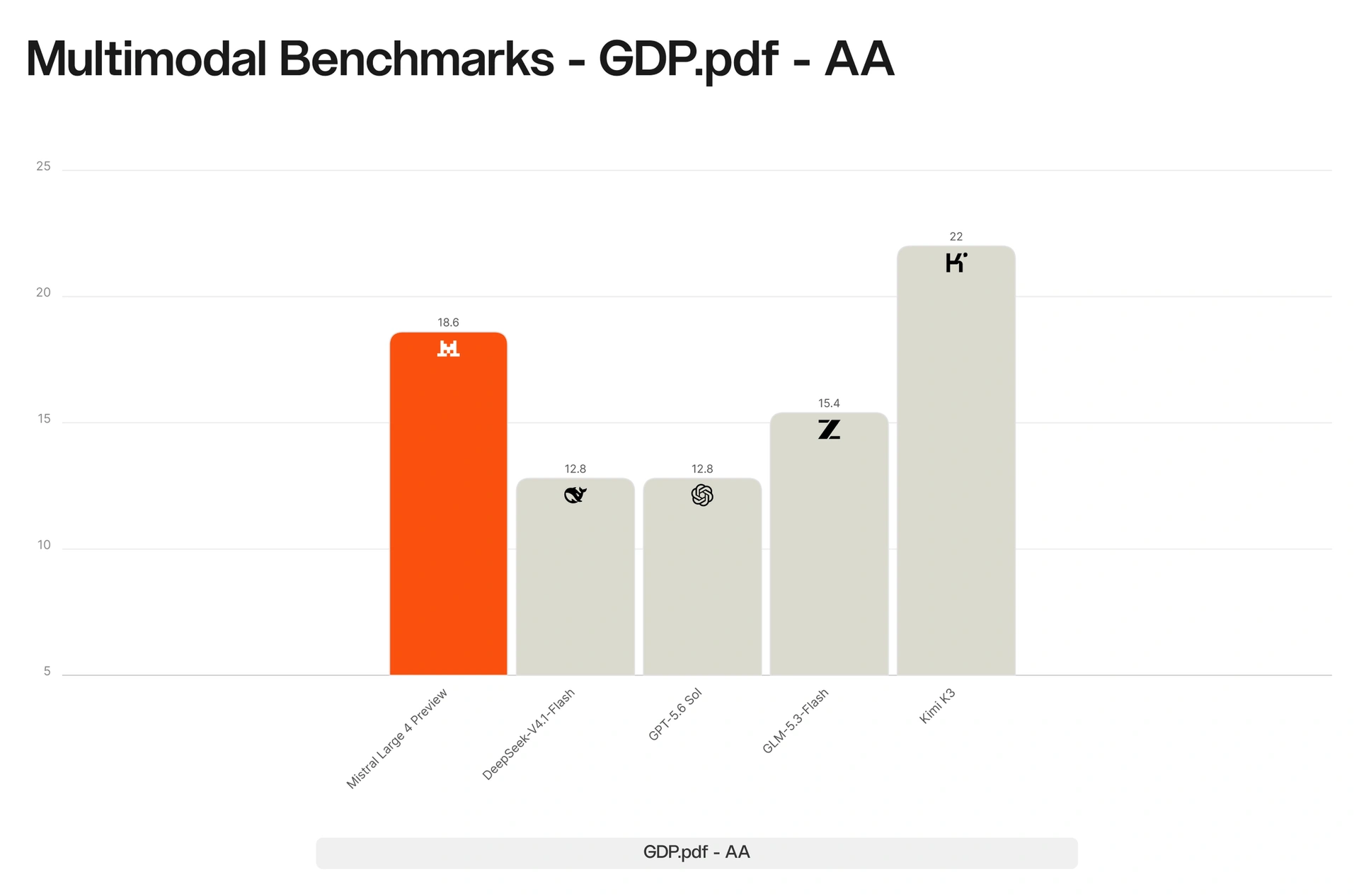
Sure, it leads in one unpopular benchmark with internal numbers.
But look at the third benchmark. It only has Sol 5.6 from OpenAI and it shows a 12.8. I don't know this benchmark but AA's GDP.pdf listing has Sol 5.6 Max at a 27, even non-reasoning beats the 12.8. It's extremely weird to cherry pick Sol 5.6 and then also lie about the published third party benchmark score. I'd love AI companies to stop lying about this stuff.
The paradox between supporting consumer rights with actions like universal usb-c adoption, but also complete elimination of any privacy rights at all. Like the surveillance state is insane. No e2ee chats, backdoors in everything.
There are e2ee chats. There are some parties/politicians who want to get rid of them, but so far they are proposals. If/when these things go beyond committee stage, politics and democracy need to do their job and be sensible.
PATRIOT, FISA and Bush's surveillance programme imho give more powers to certain agencies today already than are codified in EU law.
E2EE are are alive for maybe a few more years tops, until Chat Control 2.0 is voted in. ADDW enables mandatory spying camera in every new car. EU AI act allows AI surveillance without any court order (the only tiny useless hurdle is to record video first and then observer can use AI on the records at will). eIDAS2 allows legal MITM browser certificate attacks. Media Freedom Act (duh) allows deploying spyware against journalists in cases of "national security", as usual vague and undefined. And the list goes on.
Modern day EU, over the past 5 years or so is just as bad anti-privacy as USA, for no clear benefit too. Just surveillance for surveillance sake.
> PATRIOT, FISA and Bush's surveillance programme imho give more powers to certain agencies today already than are codified in EU law.
This is not true. Whether you believe that FISA courts have teeth, or whether 3 letter agencies abide by the law, in most of Europe you do not even have the pretense of this. UK/FR and to a lesser extent DE are all much worse.
The worst parts of Patriot Act were undone in 2015, and the "F" in FISA stands for "Foreign". Europe continues to push policies like Chat Control and attempt to backdoor/ban E2E encryption for domestic surveillance.
The present day and trajectory in Europe is far far more grim than in the US.
> Europe continues to push policies like Chat Control and attempt to backdoor/ban E2E encryption for domestic surveillance.
Let's not forget that Chat Control is pushed by US non-profit Thorn, and implemented by software that this non-profit develops! Furthermore, if you look at how this software actually works (even in "self-hosted" setup it sends hash values to Thorn's servers [1]), it's pretty clear that this tech could easily be abused to perform surveillance on the EU from within the US.
> Europe continues to push policies like Chat Control and attempt to backdoor/ban E2E encryption
Some politicians in Europe push for that, until now it has been refused by the others. Unlike in the US, there are many different parties in European countries. And Europe is made of politicians from many parties from many countries.
> The worst parts of Patriot Act were undone in 2015
So the NSA doesn't do any kind of domestic surveillance anymore, is that what you believe?
> the "F" in FISA stands for "Foreign". [...] Europe continues to push policies [...] for domestic surveillance.
So if it's surveilling allies, it's all good in your opinion?
> The present day and trajectory in Europe is far far more grim than in the US.
"Far far"? Do you even realise that Europe is not one single country? The US elected Trump, twice.
>> Some politicians in Europe push for that, until now it has been refused by the others. Unlike in the US, there are many different parties in European countries. And Europe is made of politicians from many parties from many countries.
> And yet neither party in the US is pushing for it...
This is a bad retort. The U.S. has 2 relevant parties. Most countries in the EU have at least twice as many relevant parties and there are over 25 countries in Europe, so you’re looking at close to 100 relevant parties.
Yes, I am an American living in Europe. I have pretty good insight into all of this.
> Some politicians in Europe push for that, until now it has been refused by the others. Unlike in the US, there are many different parties in European countries. And Europe is made of politicians from many parties from many countries.
And yet neither party in the US is pushing for it...
> So the NSA doesn't do any kind of domestic surveillance anymore, is that what you believe?
Do you have any evidence to the contrary? Or if you believe this without evidence, do you have any evidence this is not occurring in Europe?
> So if it's surveilling allies, it's all good in your opinion?
Lol, lmao even. Yes, of course it is. Allies spy on each other. The Europeans do it to each other massively and have done since the dawn of Europe. Good lord, go read some history.
> "Far far"? Do you even realise that Europe is not one single country? The US elected Trump, twice.
Again, I live in Europe. I am well aware, but thanks for the classic European condescension. I don't like Trump. But how has he weakened privacy rights? And yes, beacause I don't want to write dozens of caveats for each teeny tiny member state, I consider Europe to be dominated by happenings in DE + FR + UK. I don't care what Latvia does.
This is such a strange statement about a massively culturally diverse part of the world.
Many European countries speak such poor English that it'd be a miracle if they developed some sort of unified condescension.
I'd argue a big part of Europe not performing as well as other parts of the world economically is the LACK of any defined culture, it's really more like a hodgepodge of countries that have a thin layer of cooperation
I have no clue what English comprehension, monolith culture, and condescension have to do with one another? Or even the presumption that I only speak English?
It's not a strange statement in the slightest if you live here or spend any appreciable time here. I take it you do not.
I think you misunderstand their point. I think their point is that it's difficult to talk about a "typical European condescension" given that "Europe" is not one culture. It's made of many very different countries.
If you randomly take two Europeans, they probably speak a different language and have completely different opinions, but chances are that they can't even understand each other. If you randomly take two US citizen, they most certainly have a shared identity.
Oh given current affairs I don't even think two US neighbors have shared identity. Plus the whole thing about intersectionalism.. basically cut everyone into a million little groups and identifiers, nobody is left the same as anyone else.
I didn't say "they are the same". I said they share some part of their identity. It starts by saying "I am an American". Or thinking that 9/11 was an attack on their country. Or having the same government. Or having the same army. Or the same schooling system.
If you take two random Europeans, they most likely don't have the same school system. The bank of the first probably does not exist in the country of the second. One may be in the EU, the other may not. They have a different army, they possibly have a long history of being at war against each other in the past. They don't have the same architecture. They have a vastly different public transport system.
Sure, there is an identity at every level. Europeans do recognise themselves as Europeans, like South Americans do recognise themselves as South Americans. But the shared identity between a Chilean and a Brazilian is much smaller than the shared identity between two Brazilians.
I think that is not nearly as certain as you say. Some identities are very very outside the norms of local culture. (For example, I identify non-human, which is quite rare in any part of the world)
Well no two identities are exactly the same. But there is a shared part. It's an intersection.
When the USA hockey team played against Canada after Trump threatened to annex Canada, the Canadians booed the US team. Not because they hated the players, but because they wanted to show that they were pissed. As a response, the US supporters booed the Canadian players. Why? Because they felt attacked "as Americans", not because they supported Trump's idea of militarily invading Canada.
That is a shared identity. And surely in this crowd, not everybody identified as a white heterosexual male.
I believe that there is a bit of an asymmetry between US people and... well the rest of the world, in that the WHOLE world has some level of insights into the US. Whether they want it or not, for many different reasons.
However, the US don't typically have a good insights into... the rest of the world. Which does make sense: the rest of the world is pretty big.
Of course the US is more complicated than "they elected Trump". Sure, there are 50 states. But everybody knows that (be it just because your president repeatedly threatens to annex Canada as the 51st state ;-) ). People in the rest of the world do not need to "live in the US" to have that level of insights, because the US makes sure they do, by force if necessary.
The mere fact that you don't seem to be aware of this asymmetry at all suggests that you over-estimate your "pretty good insight into all of Europe".
As counterpoint, though, I've heard some absolutely bonkers impressions of the US made by some Europeans. And that's not isolated; there seem to be lots of Europeans who have some very strange ideas about what it's like in the US.
I do agree with your general point, though: I would expect your average European to have a better understanding of the politics of the US than your average American would have of even a prominent European country like Germany.
Totally, it happens everywhere. And there are stereotypical traits in every country. It's just that everybody tends to recognise the US ones, but nobody knows them for all the other countries. A random European cannot say "this is soooo typical of Latvia".
But a random European can easily say that the parent is sooo stereotypical of the USA :-).
Note that I believe there is some level of European identity. But "European condescension" is not really part of it, I would say. What the OP may have felt was maybe some "non-US condescension"? I think it could be a thing. The OP said "believe me I know Europe better than you, because I live in Europe AND I am an American" (which somehow implies that being an American made them more knowledgeable? Not sure). The answer was something like "dude, it's so American to believe and proudly say that you must know better because you are American", I felt. Sure, it's condescending. But I don't think that whatever the European shared identity is contains a "they are condescending against anyone non-European".
This comment could not have been more stereotypically American. I stress "stereotypical", I'm obviously not saying Americans in general are like this.
> I don't like Trump. But how has he weakened privacy rights?
Attacks on rule of law and civil liberties have increased, and the right to privacy is one of those liberties. It's of course not limited to Trump, he wasn't in office when Snowden showed the world the scale of American mass surveillance on domestic and foreign citizens.
> Do you have any evidence to the contrary?
I'm totally unsure what you are attempting to imply. That mass surveillance by the American state stopped at some point in the last 10 years?
> Allies spy on each other. The Europeans do it to each other massively and have done since the dawn of Europe. Good lord, go read some history.
What does that even mean "read history" ahaha. Espionage != mass surveillance. You do understand the difference, do you not?
> thanks for the classic European condescension
> I consider Europe to be dominated by happenings in DE + FR + UK. I don't care what Latvia does.
> This comment could not have been more stereotypically American.
Of course. As I noted before, dripping in European condescension. Nothing you can actually point to, just condescension from a region that has been left behind over the past century.
> Attacks on rule of law and civil liberties have increased, and the right to privacy is one of those liberties. It's of course not limited to Trump, he wasn't in office when Snowden showed the world the scale of American mass surveillance on domestic and foreign citizens.
Which right or in what way has the right to privacy been attacked? Fully agree with you on attacks on rule of law. And I find Trump incredibly dangerous. But I do not think privacy in the US today has suffered. Please educate me.
> I'm totally unsure what you are attempting to imply. That mass surveillance by the American state stopped at some point in the last 10 years?
I am not implying anything. The Freedom Act curtailed a bunch of activities. You are implying nothing has changed. All of the Snowden revelations implicated many European countries: intelligence agencies spying on each others populations. I am asking you if you believe nothing has changed in the US do you 1) have any evidence of this and/or 2) believe that anything has changed in Europe? You've answered neither.
> What does that even mean "read history" ahaha. Espionage != mass surveillance. You do understand the difference, do you not?
Do you understand that the mass surveillance of European people was done at the behest of the intelligence agencies of those countries? And ditto for the NSA. The agreement was "you spy on mine and I'll spy on yours and we'll swap the intel". I am not talking about espionage. Foreign intelligence agencies spying on foreigners...what did you think they did?
> l m a o. Oh say can you see...
God, it's so painful. Yes in the same way that you talk about the US as a monolith and not 50 individual states. You don't care what Rhode Island does any more than I care what Latvia does.
Christ you guys are insufferable. It's no wonder everyone is leaving in droves.
> Of course. As I noted before, dripping in European condescension. Nothing you can actually point to, just condescension from a region that has been left behind over the past century.
Let's see about that; Just me, some small guy with no knowledge on the topic.
> Which right or in what way has the right to privacy been attacked?
The US scans your device if you enter their land, e.g.
Oh; I heard ICE uses cameras to spy on their own citizen?
What about the raising Flock Cameras?
> But I do not think privacy in the US today has suffered. Please educate me.
A giant corporation just attacked another one. There were no repercussions.
If you think that isn't privacy: How about leaking civilian data to outsiders of the government? DOGE, anybody?
> I am not implying anything. The Freedom Act curtailed a bunch of activities. You are implying nothing has changed. All of the Snowden revelations implicated many European countries: intelligence agencies spying on each others populations. I am asking you if you believe nothing has changed in the US do you 1) have any evidence of this and/or 2) believe that anything has changed in Europe? You've answered neither.
Why does he has to provide evidence but you don't?
Also, I have never heard that an European Country spied on civilians from another country. That's an US and Chinese business model.
Things changed in the US. It is now a lawless country. A war mongering state which dumps its allies for their own benefit. They are actively hostile.
Your second question is so unspecific I have to require elaboration: "believe that anything has changed in Europe?" - I assume you are referring to Privacy Laws? We had plenty of new laws _protecting_ consumers in this regards. Handling data responsible.
Wait; What are you guys doing over there? Ah, right: You are pushing Age Verification and demand information on our criminal record systems. You are pushing biometric tracking. You are telling buys of your weapons that you have the right to disable them. Honestly: The US sucks right now. You guys have elected the stupidest idiot, twice. And now without any regulation you are actively supporting a technology which will undermine _all_ citizen in the world.
> Do you understand that the mass surveillance of European people was done at the behest of the intelligence agencies of those countries? And ditto for the NSA. The agreement was "you spy on mine and I'll spy on yours and we'll swap the intel". I am not talking about espionage. Foreign intelligence agencies spying on foreigners...what did you think they did?
Again: You are accusing all twenty five member states in one statement. To me you are just yelling polemic nonsense. EUROPOL is _cooperating_ with the US. They are hunting people breaking our laws. If any individual is lawless within our boundaries of justice, European states have the rights to try to prosecute them.
> God, it's so painful. Yes in the same way that you talk about the US as a monolith and not 50 individual states. You don't care what Rhode Island does any more than I care what Latvia does.
You are implying your behaviour. The US has _one_ president in order to bundle the power. Your states have their national rights. If you compare the US to the EU you are not informed.
> Christ you guys are insufferable. It's no wonder everyone is leaving in droves.
By appearing with such statements on the Internet as an European Civilian you are undermining our values. Maybe if you can not align with them you should proceed your journey.
You don’t care about Latvia and I don’t care about some dickhead who "lives in Europe" and knows it all. And I’m not even from Latvia, you’re just pathetic.
That is false. They are not proposals, they are being actively discussed in trilogues which is way way past proposal stage.
Chat control V2 trilogue negotiation was last week and it included mass scanning of messages and private data. Thankfully the EU parliament rejected the idea but every 6 months like clockwork it comes back. The next trilogue is in November.
If this was passed, it would force every single cloud provider and e2e chat provider to keep, filter and pass on your private information to Europol and other security agencies.
The trilogues are the standard informal step when the Commission submits a proposal. It remains a proposal until it is rejected or approved. The formal next step after submitting a proposal is the Parliament’s first reading [0], which hasn’t concluded yet (the Parliament hasn’t adopted a position yet). So it’s still in the proposal stage.
The US, at least in spirit is all about individual freedom, including freedom of being an asshole, and also the freedom of punching that asshole in the face, metaphorically speaking.
Europe values freedom too, but not as much as making sure people are not assholes. So, freedom of being an asshole is not a thing in Europe, and the government does the punching in the face so that you don't have to.
Which is best is honestly debatable. It is the usual question about the individual vs the collective. The US is on the individualist side, East Asia is on the collective side, Europe is somewhere in the middle.
> the freedom of punching that asshole in the face, metaphorically speaking.
This is not at all a freedom
in the US. “The right to swing your fist ends at someone else’s nose.” You don’t get to harm someone else just for being “an asshole”. You can be an asshole back but you don’t get to violate their rights.
An example where it involves actual harm, related to freedom of speech.
In the US, defamation laws are particularly narrow, insulting people is generally legal, and "hate speech" is mostly legal too. And even though it is not physical harm, it is definitely harmful. But Americans accept the compromise because they value free speech a lot.
In most of Europe, it is different. Defamation laws are broader, sometimes including telling the truth if it is done in a misleading way. Insulting people, public servants in particular may also be illegal, even though it is rarely applied on a day to day basis, it can be in some contexts. And what constitutes punishable hate speech is much broader, Germany is notorious for this when it comes to Nazism.
As for actual bloody harm. In the US not only you are allowed to defend yourself in case of an agression, you are supposed to, and you are given the tools to do so (i.e. guns). In several state, you can shoot people trespassing, something that is seen as barbaric in most of Europe. Europe also has self defense laws, but they tend to be narrower, and you are generally not allowed to carry weapons.
What meets the legal definition of harm for speech has no bearing on whether you can inflict harm on someone else in response to something that does not meet that legal threshold of harm. For example there is no scenario in which you can defame someone because they said something mean, whether or not what they said meets the legal definition of harm. You can’t libel someone back for libeling you.
> As for actual bloody harm. In the US not only you are allowed to defend yourself in case of an agression, you are supposed to, and you are given the tools to do so (i.e. guns). In several state, you can shoot people trespassing
None of this is true for the US. You do not have a duty to defend yourself, in fact it is the opposite. You have a duty to retreat, and only if there is no reasonable avenue of escape without putting yourself more at risk do you have the right to strike back in self defense. The Castle doctrine you are referring to re: trespassing is a merely an exception to the rule, in which you do not have a duty to retreat within your own home. You still must meet the other requirements for self defense and can only respond with a level of force proportionate to the perceived threat.
Isn't that just the recent highly controversial Chat Control push? Generally speaking, the EU has some quite strong privacy protections relative to the US.
Let's just say you won't find my name, address, my yearbook pictures, history of where I lived, anywhere on the internet. I can quite easily get this information for all distant cousins in the US. And that has been the case long before GDPR was a thing. The culture around privacy is simply different.
Except that the government has all of this information and much more.
And you have no protections from the "much more" bits, unlike in the US.
It's incredible that Europeans today think the culture of privacy is different. American privacy protections (from the government) were born out of European flaws.
The difference is that Europeans love the nanny state regulating private enterprise (GDPR) but never pointing that same effort against itself.
Insane compared to what? I don't know where you get your (wrong) information from, but there are no backdoors, of course there are e2ee chats. There are some parties who try to push for changing both. That's fine in a democracy, people can try to change things (and fail).
I will say that the EU has to do something about the practice of just retrying the same failed policy over and over again, hoping that at some point people won't pay attention anymore, that is in fact a huge issue.
As an American living in Europe, it's generally Europeans who have a distorted perception. Most Americans know the bill of rights and the 1st/4th/5th amendments. Many Americans will know of the Patriot Act/NSA/Snowden revelations.
The same is not true of Europeans and they generally believe their rights are much stronger than they are. Most Brits are not aware of the true nature of the Investigatory Powers Act. Most Frenchmen are not aware of Article L851-3.
I don't think we're talking about perception though. Europeans can certainly perceive their privacy rights to be greater than they actually are, but that doesn't mean those rights are inferior to that of Americans. Outside of things like the GDPR (which is more about data held by corporations and not the government), I don't know all that much about privacy laws in various European countries (and I expect they vary quite a lot country to country), so I don't know either way.
As for the US, 1A doesn't guarantee any form of privacy. 5A does, but in the very narrow sense of not requiring you to incriminate yourself. 4A is indeed about privacy, but it feels like those protections are constantly under fire, and SCOTUS regularly rules against private citizens who believe the government has run roughshod over their 4A protections.
Beyond that, judges seem to rubber-stamp surveillance warrants all the time, and it's currently very legal for law enforcement agencies to purchase private data on citizens from private businesses that have managed to collect it through whatever means. What's the point of the need to get a warrant before tracking someone's movements if the police can just pay Google or T-Mobile for location data? And don't get me started on Flock... they're a government surveillance agency without the "government" part.
Then there's the border search exemption, which is just nuts. Fortunately it seems some federal judges are sane and think the government shouldn't be allowed to trawl through our phones at the airport, but those rulings are not universal across the US at this point. And if and when that sort of case ends up in SCOTUS's lap, I don't trust them to do the right thing.
Frankly I think the US's privacy posture (when it comes to people keeping things private from the government) is pretty bad. Maybe it's still better then Europe, but that's still nothing to celebrate.
Not to forget the European Human Rights Convention as interpreted by the European Court of Human Rights (ECHR), although it's not an institution of the EU but the Council of Europe, spanning all EU states and then some.
The Court's case law is recognized as is by EU, and includes some landmark privacy rulings, e.g., against access to contents and metadata of electronic comms without a court order (or comparable legal safeguards), or any forms of bulk surveillance.
Yes, the court can overturn laws that are deemed to infringe on privacy rights but this path takes years. The last time a privacy invasive law was enacted it took something like 8 years to be overturned.
Are you willing to live in the EU knowing that for the next 8 years the EU agencies will have access to every single message, email and picture you send your loved ones just in case one of those could be CSAM?
Even if that was overturned, how will one know if he data they intercepted and illegally obtained will be destroyed or if the text messages you sent to your wife/husband are not going to end up sold to the highest bidder on the darkweb?
To add some practical results to that: the Data Retention Directive[1] was struck down by a bunch of national constitutional courts before being completely annulled by the EU Court of Justice.
There are forces pushing for chat control again and again and again, until one day people are not vigilant enough to prevent this BS from happening. Then it will take ages to repeal and repair the damage done. Once there is some chance to vacuum up some personal data, businesses, government, and security forces will be very quick to grab that chance, and very slow to give that data up again, should it turn out, that the whole damn thing was illegal all along, due to some constitution. The malpractices might continue for years even after things have been declared illegal.
Yea, they only need one successful attempt. I'm still quite not sure about the motivation, the fact that politicians have an exempt from this law is scandalous at least.
Yeah. Fortunately Germany has a quite firm stance against surveilance, for well known reasons ;), and with Germany against it will be extremely difficult to pass this.
Not so sure about that. We have enough politicians here, who don't know shit about technology, or want to seem like they don't and will gladly hold the hand open to be bought by forces, who would like nothing more than get their hands on all that data.
In practice it _might_ still save you, if the country is willing to pay annual fines to the EU for not implementing some law or policy. But communication tools are always at least a 2 way thing, where you communicate with someone else. If that someone else has their chats leaked due to living in another EU country, where chat control is implemented, then even your constitution will not protect you.
Scenarios like these make me consider, whether one day I need to vote for my country to also leave the EU, as it might become a surveillance nightmare. The moment chat control impacts me and my chats on my devices, I think I will have had enough of this. But the economic consequences are scary of course. So damned if you leave and damned if you don't. Sucks.
The constitution of Italy says that we can't use war to solve international controversies. And yet we were in iraq… constitutions are somewhat meaningless if you have authoritarian governments that can ignore them.
European countries detain and deport immigrants who are illegally present all the time. The level of it can be discussed, but what's happening in the US is that they've detained hundreds of citizens and deported immigrants who are present legally because they said something the people in charge didn't like. I'll skip that part, thanks.
These are not people obstructing or harboring fugitives. They're people who ICE believed "looked foreign" (aka weren't white) and ignored them when they said they were US citizens. They spent days locked up simply because their skin is too brown and they speak with an accent.
It's absolutely disgusting. Educate yourself about what's actually happening out there.
on the other hand europe doesnt have roving gangs of masked gunmen violently abducting people based on ethnicity (at least not not in the last 80 years....)
Those two examples are not opposite. They're both examples of governments crippling freedom.
The main reason that governments forcing USB-C is widely seen as good is because it limits the freedom of big corporations, which don't elicit much sympathy, but the principle is the same.
dude, yes some countries in the EU are "trying" to include backdoors, and e2ee chats are not going away. Meanwhile in the US, you have literally cameras watching everywhere you move, snitching to the police and Palantir and probably all the other 3 letter institutions, and you complain about privacy rights in the EU? With so many other stuff you could have pointed out? lol, rofl even
What? I I’m in Europe and I use e2ee daily. The reason you hear about this imho is that we have strong protections and you hear when someone tries to break them.
Dude you need to talk to real people and not just get all your information from right wing internet sites. You sound ridiculous. You think signal and PGP don't exist in Europe? You actually believe Europe is a surveillance state? Fucking hell dude, quit you job and go travel. Meet some real people from outside of America.
I'm sorry, but you should really read up about the laws in the US and in Europe. U laws are a lot more easy on spying agencies and spyware companies like Google and Facebook than European laws. Backdoors: ask the CIA about random number generators. Surveillance: heard of the cloud act?
In EU, it's politician > industrialist >>> EU citizen > outsiders.
It's almost never only about consumers. Via tech regulations, they protect European incumbents first in effect. They see US is ahead and make laws to destroy their moats. If Apple was in EU, you wouldn't have saw universal usb-c, because it would have hurt an EU company. But the more you look at how tedious is for a non-EU company to sell to EU customers, the exemptions they don't get, the specialists fees they got to put on the table, you'll see EU is more coherently described as protectionist than pro-consumer.
They handicap our little companies more than the incumbents. The Commission itself acknowledged that regulatory costs affect SMEs proportionally more than bigger competitors [0] and the OECD explicitly found that policy failures and regulatory barriers tend to hurt startups more than incumbents [1][2]. The way I see the broader pattern is: more regulation -> larger bureaucracy -> larger bureaucracy has more scope and more incentive to regulate -> incumbent absorb growing compliance burden easily -> entrants get hit harder + ad-hoc regulations to hurt established outsiders even harder.
[2] OECD, about Germany 2025, e.g.: 'Industrial and labour market policies have tended to favour incumbents and hampered the reallocation of resources to young and innovative
firms, weighing on allocative efficiency and slowing down structural change' (https://www.oecd.org/content/dam/oecd/en/publications/report...)
At least in Poland the requirements before GDPR was the same for small startups and for large enterprises. If you wanted to set up a newsletter for a bunch of friends you had to do, technically, the same requirements and reports as the large telcos.
The only way to manage it was to effectively ignore it. I’ve met people who were afraid of setting up a landing page because you technically had to fill in paperwork and whatnot.
Ditto managing VAT across the borders and a bunch of other stuff.
It is better now in some ways - I think some newer regulations had it written down that they apply above a certain turnover threshold. We also we have saas-es to deal with a lot of beauricratic bs, and now also agents.
But I imagine for more human/real-world stuff the issues can’t be overcome with tech. E.g. if you hire a 4th team member and that person immediately goes into months-long health/birth timeout, it can derail a whole project. We barely avoided that once - didn’t hire a person due to culture fit, but we later suspected they planned to take a leave shortly after getting hired. It’s a common thing in bigger corps but they can afford it.
As a side note, in Poland used to have a lot of such BS, but our general culture is about hacking around it.
For example it’s common for smaller companies to have employees „self employed” to avoid most of regulatory burden of hiring, whereas the bigger companies need to have employees actually employed with all the legal consequences. Technically anyone can get audited but below 20-50 people the government won’t bother, so it balances itself out.
Germany is another animal altogether - the last time I was doing business there you couldn’t even theoretically open a new company at all because they had a catch 22. To open a company you had to have a bank account to pay the notary, and to open an account you had to have a company. And either the notary or the bank had to blink.
I don't think it's a hostility to tech but different values that value consumer rights more than it values 'move fast and break things'. We have good things here and we don't like someone breaking them.
Problem is that we thought the US was 'cool', with US movies, music, digital services, cooler than our own and thus we helped give the US the lead. The US has lost it's coolness though, now we just think it's creepy.
Europe has spent the last twenty years in stagnation - generating about half as much wealth and technology as you'd expect for its size and advanced economy. Simultaneously, Europeans are notoriously arrogant. It's a mockable combination.
Edit: unfortunately, it's a question that voting does not really permit you to answer on this website.
The US is biased to favor the top half of society. Hence why there is a lot of vocal poorer people and a lot of low profile wealthier people (I'm not including the 1% or even the 5% in this).
When you are in the 75%ish of the US, it's very easy to make a case that life in the US is better. But we don't really talk about that because it's pretty taboo when poorer people are struggling much more than they would in Europe.
Almost half of US households earn $100k+ now. The median American is affluent by European standards. The "middle class" of Europe and America has become less comparable over time because median incomes have significantly diverged. You see it in many aspects of lifestyle and the kinds of things they can afford to buy.
20 years ago this was not the case. The minimum wage in some parts of the US is now higher than the average wage in most of Europe.
The US has a population that will always struggle to survive without government assistance. Per multiple US statistical agencies that is about 10-15% of households.
But federal minimum wage is lower in US then in Poland (real value not even PPP) - 31.4PLN/h with ~3.9USD/PLN exchange giving ~8USD/h). Freaking Poland.
And when one comperes wages - PPP should be used. US is really expensive compared to the most of UE. But even then it is not whole picture. For example I can live comfortably with one car in my household. In US I would need 3.
The minimum legal salary where I live will be >€80k in a couple months. The minimum hourly wage is equivalent to about €40k annualized. Does the average person in Western Europe earn €80k?
These types of minimum wages used to be limited to expensive locales but it is spreading across the US pretty rapidly. Now you see minimum wages rapidly approaching $20/hr in places far enough from a major city that houses still cost $250k.
Your numbers are just wrong, then. The US federal minimum wage is $7.25/hr, and 19 US states are at or below that number. That's a hair above $15k/yr. That's quite a lot less than €40k/yr (~$45k/yr).
Let's talk about that $45k/yr. That's an hourly wage of $21.63. No state in the entirety of the US has a minimum wage that high. The current max is Washington, DC (not a state, but they also set their own) at $18.40, which comes out to under $39k.
That's all for hourly work. In the US, there is no minimum for salaried work. If you agree to be paid $1/yr for your work, that's what you get.
So, the minimum hourly wage where you live is absolutely higher than the US, nearly triple that of much of it.
All of which is useless if one trip to the hospital for something regular can still put you in serious debt.
If the financials of people in the US are so great, why do the stats of healthcare, student, and general consumer debt look so bleak? Either you all suck a being high income, or it is not the only interesting factor.
>Either you all suck a being high income, or it is not the only interesting factor.
This is actually what I think of all of you guys. Americans completely suck at being high income. They have so much money and yet they waste it. Zero care for efficiency whatsoever.
Edit: Making housing and healthcare expensive is a policy choice and can easily be averted in so many ways.
"$100k" means nothing without knowing the cost of living in the particular place a person lives. As an extreme example, $100k is not "affluent" if you live in a US city like San Francisco or New York. If you want to keep your housing expenses to a reasonable percentage of your income in those places, you're going to be living with several roommates in a small apartment in an old building in an undesirable neighborhood.
Even outside the most expensive cities, we have lots of affluent suburbs throughout the US, and I guarantee you those households have to earn quite a bit more than $100k/yr in order to live there.
Good luck if you're a family of four making $100k in one of these places. Well, you aren't in one of those places; you live somewhere much cheaper.
In the US people don't say "has money" as meaning net worth, they are generally talking about spendable money ie a paycheck unless you're talking about someone super rich who "has money" or "comes from money."
Does 28k-30k in the US get you the same (or better) quality of life than 24k-26k gets you in Europe?
I doubt that; I expect a European on 24k is living better than an American on 30k. But that also depends on where: I'm sure 24k will get you farther in, say, Sofia, Bulgaria, than in Paris or Berlin. Same is true of different places in the US.
It's a shrinking issue once you get out of the bottom ~50%, and a non-issue once you get above ~75%.
Again, the deal with the US is that the rich live better and the poor live worse. Or put another way; people who make money get to keep more, and people who don't make money are given less.
Because there are so many more people who have money, and because those people like living comfortably, available healthcare and education is world class. Make sure not to read that as "All healthcare and education", it's "available healthcare and education".
Generally people who are earning a lot don't care as much about vacation, but every white collar job will generally give at least a standard 15 days off and 10 holidays. Ironically as you move up you are generally given more vacation while actually using less.
Poor people in the US have fully subsidized healthcare and education.
Americans don't have vacation in the same way Scandinavian countries don't have a minimum wage. Even the most left-leaning States in the US have not written it into law because it is effectively addressed by custom. Americans are sufficiently happy with it that vacation isn't a political topic.
I think we are seeing the decline of even this. The European debt crisis, the United States security umbrella being disinterested in Europe, austerity, increasing retirement age, an inability to defend Ukraine without the United States. The running gag they don't have AC...
Even poor populations worldwide have access to the 3 things you described, but the quality is lower.
European decline has been mentioned since the 1930s.
And yet the poorest 25th percentile of Americans are not enjoying a better quality of life than the European middle class. If those numbers are accurate, all they tell us is that personal wealth is an even worse indicator of having a life worth living than we would have thought 20 years ago.
I'm biased as well, being American. I think I'd much rather be middle class in Europe than the USA as well. Middle class in the US is a constant feeling of the ladder dissolving just beneath you.
I haven't been on Facebook in 15 years. I spend every night on Wikipedia, following random links. I worked for a Parisian company for a decade and have been around western EU more than most Americans.
Probably dial back your assumptions a little bit. I've earned my opinions just as much as you have.
I moved to Europe a couple of years ago from the US. I paid 100 euro for an mri the other day. I absolutely feel richer in the EU and am shocked at the prices in the US whenever I go back for work.
But I’m fortunate to make a US salary living in the EU.
People always make this case, if you're not satisfied then move. As someone who has changed countries twice and continents once, I can attest it's not an easy or convenient thing to do. Money or lifestyle is one thing, but you're also leaving behind family and culture. Statements like these are so dismissive to that struggle that it's almost offensive to me.
The point is that middle class Americans can become middle class Europeans, but middle class Europeans can't become middle class Americans, because they can't afford it.
I didn't say it'd be easy. I'm just pointing out that only one of the two groups being discussed has a real choice in the matter.
Why do you think that middle class Europeans can't become middle class Americans? I know more than one example where that was no problem at all.
It's not like a middle class American or European could just move and then not work and just live off of their savings. They move and get a job (ideally the other way around), jobs tend to pay relative to the living cost of where you live.
That's why people compare spending power instead of how much money you earn, because that comparison is meaningless.
Because if a middle class American sells their middle class home and buys a European middle class home, they have an extra half million left over. And if a middle class European sells their middle class home and tries to buy an American middle class home, they're half a million short.
Neither the US nor Europe has such a unified housing market that this could be a reliable statement. In Europe it differs greatly within countries, and there are many countries. In the US it also varies greatly within each state and there are many states.
Also at this point both have seen such negative upward trends in housing prices that the assumption that someone placed in the middle class owns a home at all (without any debt attached) is questionable. (But that's just a comment and besides the point)
That is the entire point I'm trying to make. You can win the argument by being pedantic about the precise thing you were saying, or we can recognize the broader implication of what you are suggesting people to do. Only economically viable means nothing when it comes to life decisions.
I have no idea why you're being downvoted, because you're absolutely right. I have circumstances that make moving abroad something like a nuclear option. I could take my job with me, but that's the least of it.
The point is about economic mobility - of course, people get tied down as they get older.
Middle class people from wealthy nations who move to poor countries are relatively rich by the standards of their new country. Middle class people from poor countries who move to rich countries are relatively poor by the standards of their new country.
Depends. If you are middle class in US with little savings, moving to Europe will probably make your life worse as relative wages are lower for many professions (e.g software eng).
If you are middle class in EU and have little savings, moving to US will do the opposite and you would be better off.
Your comparison holds for the inverse: getting most of your quality of life from static wealth.
I don't think you realize the situation of the US middle class.
High education costs. High healthcare costs. One serious disease or accident can bankrupt you. Buying a house usually means a 30 years loans at 7% so after 10 years you still have 85% of capital left to pay off.
Salaries are higher but everything is more expensive, so in purchasing power parity it's basically the same.
Europeans are crazy arrogant and racist but it is the soft kind lacking self awareness.
Every person I have ever spoken to who is not white has told me they experienced more prejudice and racism in Europe than America. (at least the ones who have actual been somewhere in Europe)
America still has areas of hard bigotry but most places are wildly diverse and accepting. The favored EU countries everyone holds up are so white and homogeneous it is comical.
This is not dunking on Europe or any specific country but comparing America to some Scandinavia country rich in oil is an apple to oj situation just like comparing America to China or Saudi would be.
Yet Europeans are healthier, happier, and have a better quality of life than Americans. They also have so much better transport infrastructure it's embarrassing for Americans. Like all the money America generates, where does it go?
> Yet Europeans are healthier, happier, and have a better quality of life than Americans.
I wonder if this is actually true. I see very few Americans taking every possible opportunity to make bombastic statements about how their lives are better than everyone else's (at least on HN). This conversation seems quite asymmetric from my perspective.
Gemini says: Around 28% to 32% of Americans have visited Europe in their lifetime, while roughly 15% to 20% of Europeans overall have visited the United States.
Gemini is shit, just like other LLMs. Tourists don't have any idea how life is in a visiting country. How many US citizens have eve emigrated to Europe, vs European citizens that have emigrated to the US and have an idea of how day-to-day life is there ?
Gemini says: Over the past 20 years, approximately 1.8 million to 1.9 million Europeans have emigrated permanently to the United States (measured by lawful permanent resident status/green cards), while an estimated 1.6 million to 2.0 million Americans have moved to Europe on long-term residence permits and visas
I'll just say that I don't think the reason is a lack of knowledge and leave it here.
UK doesn't count, becausd it suffers of many of the problems that affect the US. And especially here on HN, there are almost no US citizens that have moved to Europe, and many European citizens that moved to the US, and can talk out of experience.
I think there’s more nuance than that is the issue. The average European likely has a better QoL than the average American. If you go above average in wealth/salary, the US can be great.
Trends become the future. If European stagnation continues, those advantages will vanish by the time we're old.
I'm frustrated, not bitter. Americans are acutely aware of falling behind China, and rightly concerned about it. Europe is falling behind Alabama, Mexico, and Brazil, and arrogant about it.
Edit: y'all are supposed to be our moral allies in creating a utopian future with prosperity and world peace. Instead the most likely outcomes seem to be that you'll fade to irrelevancy and rather than compromising between America's vision and Europe's vision, we'll compromise between China's vision and America's vision. We liked your vision more than China's.
I see you are making a lot of similar comments. I am not sure where you get this perceived 'arrogance', I'm sure some of its there, but I'm similarly sure it can be found for Americans or Chinese. People being people, what's new.
> y'all are supposed to be our moral allies
This all comes across as rather black and white. I don't know why you take this stance. I'm sure you understand that it would be very hard for you to understand Europe as a whole, and judge it, just like it would be hard for me to do this with America.
Regardless, when talking morals, I'm also sure you agree there are numerous examples where America has not held up its end of the moral utopian future of prosperity and world peace.
We used to be a duo where America was pragmatic and European conscientious. In the new duo, China is pragmatic and America conscientious. If you think america wasn't holding up its end of the moral utopian future before, don't watch the news for the next fifty years.
HDI is indeed a better metric than the various alternatives based on dollars.
But still. The six US states that score less than 0.9 (i.e. Kentucky, Mississippi et al) are supposedly peers of EU countries like Portugal, Estonia and Croatia, i.e. exactly the places that well-off footloose Americans are choosing to move to (Portugal is packed with well-heeled US refugees).
So apparently HDI does not fully measure quality of life, either.
Well, the Scandinavian and Sicilian do share one currency and one immigration policy and one set of regulations - which are the things that we generally look at when we analyze economies.
Norwegians, Danes, Swedes and Finns all use a different currency. Finns and Sicilians do share a currency though, but all these countries have different immigration policies and regulations. I don't think you really know how the EU works.
> Simultaneously, Europeans are notoriously arrogant. It's a mockable combination.
Funnily enough, you can just change European to American here and that's how many Europeans view Americans. Mostly in terms of the wealth distribution though instead of the overall wealth, and the fact that Americans just blindly claim they're the best in everything without hesitation.
Maybe we should focus on huge, exploitative companies that suck out the wealth from everyday Europeans and Americans instead.
A 'bubble bursting', if that happens, doesn't make the tech sector go to zero. Apple doesn't suddenly stop making iPhones. It would take a hell of a lot more than that for the US economy to fall to European levels.
read Varoufakis for the story on how this happened. European surplus capital gets recycled as VC money into Silicon Valley. So it's not like there's some big choice to be made, its potentially a systemic part of the global monetary flows.
You say that on a site with a strong contingent of Europeans who take literally any opportunity to crap all over the US, no matter how trivial or untrue. It is what it is.
Honestly the sentiment on the streets was WAY different when you guys had Obama, like not even close. Sure some grumblings about your guys love for starting wars in the middle east. But it's not even close now. People really don't like the way the US is behaving right now. The complaining is way more out there, even influencing business decisions and political choices...
That they think their politicians are better than the United States but have populist demagogues, right wingers winning, corruption scandals, freedom of speech restrictions, and unbelievably bad spending problems.
Still waiting for France to send troops to Ukraine or ask the United States to get rid of their European military bases.
You understand that all the problems you listed are extremely present in the US right now, so this doesn't really work as a comparison, right? There are still more elected leaders and govs in the EU that aren't terrible, compared to the US.
> Still waiting for France to send troops to Ukraine or ask the United States to get rid of their European military bases.
That’s such a bizarre take. No NATO country is officially sending troops to limit risks of escalation. The US do not, either. And it’s not up to France to decide whether there are US bases in Germany or Spain.
You mean, about the bases? He cannot do it (and I am doubtful he’d actually say that; it’d be a diplomatic faux pas at a time when he needs consensus). What he said repeatedly is that Europe should be less reliant on the US.
Since when do we measure based on what some politicians say they'll do. I mean just look at what Trump says all day long.
I recently saw some stats (unfortunately can't find it) about the percentage of election promises that are actually being tackled at all by the winning party for many different countries and it was real depressing across the board.
I think you picked the cutoff (70) so that the numbers look worse than they are.
If you look at the top 100 it’s 16 (EU) vs 4 (Switzerland).
16 is still not good enough. That being said none of the 4 companies from Switzerland are in software and hardware. ABB is maybe the closest (data center electricity).
Also Switzerland is a very very rich country. Neutral.
Also other countries like Germany has a lot of small companies that are world leaders in their field. That’s part of Germanys resilience.
> I think you picked the cutoff (70) so that the numbers look worse than they are.
Reminds me of a point I heard about sports statistics. If a given team is reported as having "won 4 out of their last 7 matches", there are good odds that they also won 4 out of their last 8 matches. Also pretty good odds that their seventh-last match was a win, otherwise the stat would be 4 out of 6. (It could also go the reverse direction if the goal is to make it look worse than it is.)
It's not like those are independent variables though. The idea is that if Europe were more competitive and did a better job fostering innovation then both its percentage of global GDP and top companies by market cap would be higher.
Judging by rank is a bad metric anyway. Why should ST, Infineon, NXP, Arm (UK, not EU), Airbus, Safran, etc. be considered irrelevant because they are not in the top 70 or 100?
> And let's not forget: there were promises made to Russia to never grow the EU to the east. Then the EU started exciting Russia by saying they'd incorporate Ukraine into the EU: I'm not against that but doing that did trigger a war.
Simply not true. The EU is a democratically elected body and nobody can give any promises what their successors will or will not do, because that will be decided by the electorate and not by any current official.
Not to mention that the initiative for joining the EU has always been on the side of new members, against the opposition of many existing members who fear displacement and disruption to their positions inside the union. All the narratives about how the West has been "encroaching" upon Russia depend on denying the obvious fact that the initiative has come from Eastern European capitals, not Brussels or Washington.
>We could also maybe make a bit fun of how the EU destroyed it's car industry (the main industry in Germany, which is the biggest economy of the union) by handing it all to chinese EVs?
How to get causality backwards 101.
Observation 1: China does something (invest into solar panels, batteries, electric vehciles).
Observation 2: EU Politicians made a far away promise to do it too by 2035.
Observation 3: German car manufacturers do absolutely nothing.
Observation 4: EU politicians softened their targets in 2026.
Wrong Conclusion: EU is to blame for the destruction of the German car industry. The industry should have stayed with ICEs until it disappears and no longer exists.
Correct Conclusion: EU should have beaten and forced the car industry to adapt and beat the Chinese at their own game. This would lose some jobs, but the car industry would remain in Europe.
You live in a small scared country with the same kind of people all around you, with very little diversity.
Your taxation was the only thing your otherwise poor country could come up with. And now you only have this little enclave which silently melts away while you get stuck there, scared of the rest of the world.
The Swiss are a special breed. Too small to bark, too small to make an impact, but just small enough for the rest of us to laugh at when some rich dude can't understand why the rest of the world doesn't want to be like that.
You're scared of the world, not one bit interested in making it a better place for all mankind. Wanker
I once read, UK was the first in the industrial revolution and the first to get out of it. Maybe Europe has just gone post-hardware. Not sure it will work though...
If the UK is in europe, you should make fun of the following: they don't have a first amendment. So to me, it's an authoritarian state preaching freedom.
The order of amendments is just the order in which the constitution has been amended. It's meaningless to talk about "first amendments" in other countries. Talk about the actual laws and rights described therein.
And as you can probably tell by now, the first amendment in the US is not actually preventing the US government from promoting a specific religion or silencing speech. It's just words on a paper at this point. Look at the actual practice.
Several European countries do a much better job at protecting the rights described in the first amendment to the US constitution.
> The order of amendments is just the order in which the constitution has been amended. It's meaningless to talk about "first amendments" in other countries.
Also, at least here in Brazil, the way the constitution is amended is by patching it. For instance, our constitutional amendment number 115 (https://www.planalto.gov.br/ccivil_03/constituicao/emendas/e...) patches article 5 of the constitution to add protection of personal data as a right. But we wouldn't talk about "amendment 115", we would instead talk about "article 5 item LXXIX of the constitution"; that is, what matters is the patched text, not the law that patched it.
I don't know about other countries, but it wouldn't surprise me if they take a similar approach.
The UK does not have what? Book bans? Science censorship by the government? The government pushing TV shows off the air for criticising the government? The president banning certain news media for asking questions he doesn't like?
The UK is not the world's biggest champion of free speech, but I think it's still doing better than the US right now.
The US doesn't have book bans. Some public libraries not stocking some books isn't a ban. You can still buy Mein Kampf (or whatever you like) on Amazon.
The president also didn't ban the media - he just didn't allow them in the Whitehouse. This is something we're rightly concerned about and pushing back on.
The UK on the other hand, does ban ordinary speech by ordinary people in their homes. It's orders of magnitude worse than the United States, as any cursory examination would show.
American public schools are notorious for banning books. Much more so than in many European countries. And the issue is not that fascist literature is getting banned, but quite the opposite.
> The president also didn't ban the media - he just didn't allow them in the Whitehouse. This is something we're rightly concerned about and pushing back on.
That's still a ban. It's interfering with the media's ability to report on the government. It's great that you're concerned, but it's still happening.
> The UK on the other hand, does ban ordinary speech by ordinary people in their homes.
In their homes? Do you have examples?
I've never heard of anyone in the UK getting in trouble for criticising the government; it seems to be a time honoured tradition there. Whereas in the US, they now check your social media at the border and might not let you into the country if you've said anything critical of the president.
And there's also the censorship on science, which is every bit as serious as the crackdown on government criticism.
The UK arrests 12,000 people a year for their social media post. This tabloid has some examples https://nypost.com/2025/08/19/world-news/uk-free-speech-stru... . There is less example-focused reporting in more serious international media outlets (British state media avoids this topic).
NYPost is not the most reliable source, but I can see several other sources reporting similar numbers. I also see criticism, including from the former PM, so it seems the UK police is indeed overly broad in its interpretation and enforcement of the law.
But note that there can also be legitimate reasons why certain social media posts could be illegal: threats, blackmail, cyberbullying, hate speech, etc. Free speech is never absolute; there are always limits to it; also in the US.
The most important (though not the only) reason why free speech is so important, is that it must always be possible to criticise the government, or powerful people in general. That is the big area where the US is attacking free speech: Trump's fragile ego can't handle criticism, so he leverages his power to deny critics, or even just journalists who ask serious questions, access to the White House. Or to remove them from TV (see Stephen Colbert).
I don't know if anything like that is happening in the UK. Some of the reasons mentioned for arrests sound absolutely ludicrous, it definitely sounds like the police is far overstepping its mandate there. But the figure also seems to include threats and harassment, which I would say make absolute sense to prosecute. I haven't seen any evidence of government criticism getting punished in any way, but it's absolutely possible I've missed it; this was a very brief survey. If so, the UK might well be as bad or worse than the US in this.
Do you literally think that elementary school libraries should stock any book ever published, regardless of content? Nobody actually believes that. There will always be a line somewhere, the disagreement is just over where the line should be drawn. That's why all the talk of "book banning" is disingenuous.
They don't have to stock everything. But it's not about stocking regardless of content - it's about refusing to stock specific content. They're not removing the least interesting N% - it's very targeted.
Of course it's targeted--do you think elementary school libraries should be stocking books with, say, violent sexual content? That is my point: everyone agrees a line must be drawn somewhere, the argument is just where to draw the line. Everyone is in favor of "banning books" from school libraries, they just differ on which books should be banned.
Why must the line be drawn anywhere in relation to the sexual orientation of the characters? I mean, violence, sure. But we know this is not the targeting that's happening. And neither is sexual violence banned - you can easily find the bible in schools.
Sure, but where they draw the line is to exclude a lot of widely lauded literary cornerstones. People aren't complaining about banning porn, they're complaining about banning literature.
No, it doesn't have a first amendment, but it does have ECHR articles 9 (Freedom of thought, conscience and religion), 10 (Freedom of expression) and 11 (Freedom of assembly and association)
I mean laws and rights are only useful if enforced. If the arm of government responsible for enforcement just doesn't and the people allow it, then what good is that purported freedom?


Also strong on cyber benchmarks (better than all chinese models), so this is a good defender model.
Lots of people shitting of Mistral for no reason imo. These are pretty good numbers across the board. Definitely good enough to use as a daily driver over other llms, if you have moral qualms with the others. For certain use cases, like cyber security, this may be the go to model.
I like to make fun of europe, but there's lots for mistral to be proud about in this release imo.