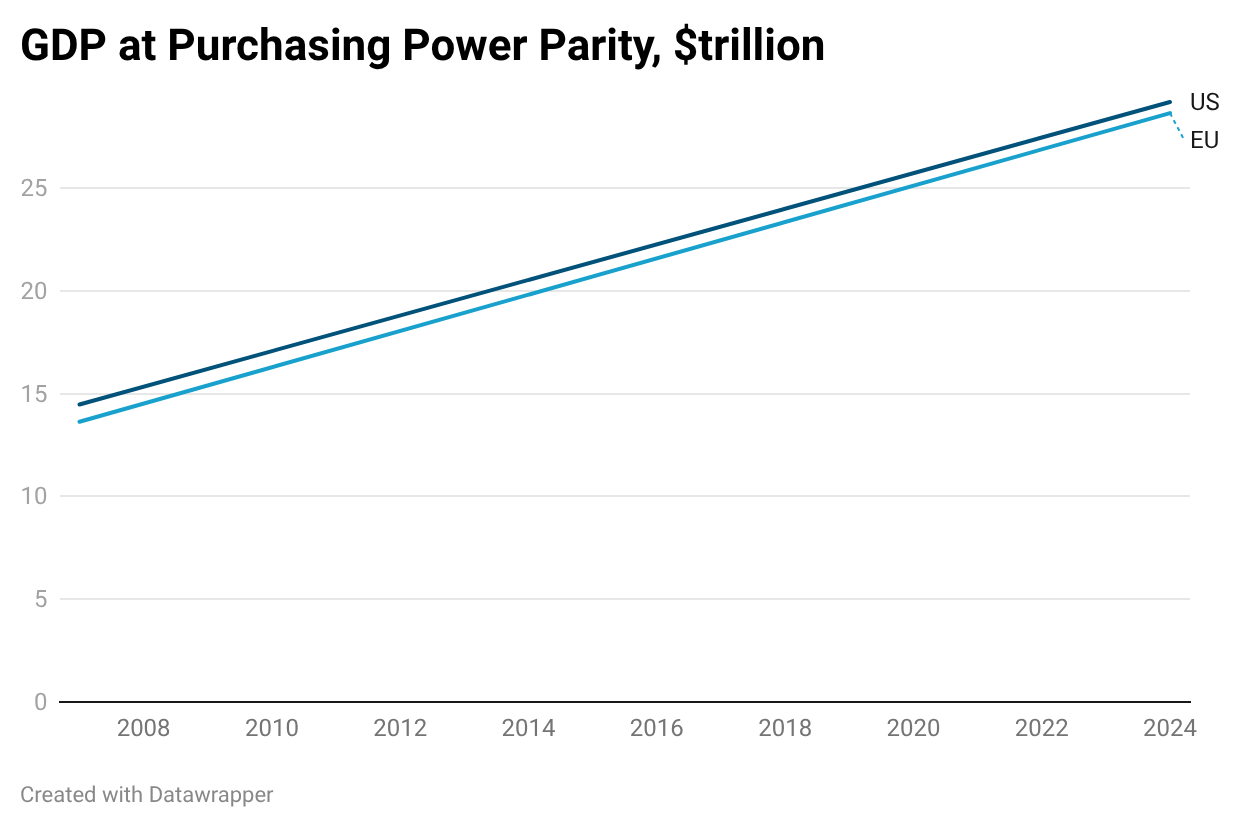
What do Europeans think of the European economy? From my American perspective it looks like they are trying to lose, trying to fall backwards, trying to become a less prosperous society. No one seems to be building anything, and the governments seem to be preventing anyone who tries to advance from doing so. What am I missing?
Europe has been anti-innovation for a long time, completely missing the tech wave in the 2000s. I was hopeful that Europe would learn from its past mistakes, but now it is also completely missing the AI wave and falling behind.
The politics are bad, way too user-centric (see Arthur Mensch complaining about AI regulation), and the European mentality does not help. The social safety net is strong, which is good, but perhaps too generous given the state of the economy. Without sufficient economic growth, it becomes unsustainable, leading to a lower and lower quality of social benefits.
People complain, rightly so, that things were better before, but nobody does anything or even seems to understand that innovation and economic growth are what fuel everything.
I am very bearish on the state of Europe, which, as a European, makes me sad.
It's just the takeover of the continent by an ossified bureaucratic class. Their opinions and actions do not represent the European people's but quite the opposite of it.
Fair point, ASML is a linchpin in the global economy, and very much a European company. But Europe has a population larger than USA, shouldn't they at least be close to us in leading edge companies? They invented the Industrial Revolution.
You sound like someone who is enjoying the retirement benefits and full social safety net. One which does not have the funding to continue on for the youth of today. You have a certain smugness about your current situation but maybe you should look at how things are actually coming along today for young people staring down the barrel of higher inflation and lower wages.
> An economy is there for the people. If that larger number of people have a higher quality of life than in the US, aren't they wealthier?
It's a little unclear how it shakes out there.
I've met a number of young western Europeans while traveling there who are jealous of the ability of Americans to afford cross-ocean/different-continent multi-week trips to tier-1-hotel-cost cities, while feeling like it's more out of reach to them to find a job that would let them. (Phrasing edited here because, as a reply pointed out, "international" travel in Europe is easy and common due to proximity.)
On the flip side, those people also enjoy having much more time off. But hey, at least American isn't as 996'd as China yet?
There's no single linear "better" scale.
(There are, of course, many Americans without the means to travel to Europe or Asia themselves, who could give two shits about an "innovative" company being based in the US vs anywhere else since it doesn't seem to be helping them personally, but the overall mobility is still higher for now. But that's more due to the age of the country than anything else. History suggests that as low-hanging-fruit continues to close the US will also get more and more of that social stagnation too. It's easier to become upper class when you go to a place without an upper class yet.)
> I've met a number of young western Europeans while traveling there who are jealous of the ability of Americans to afford cross-ocean/different-continent multi-week trips to tier-1-hotel-cost cities, while feeling like it's more out of reach to them to find a job that would let them.
Anecdotally, I think it’s out of reach for many young Americans in my cohort (26) but we’re insulated from that in tech
> I've met a number of young western Europeans while traveling there who are jealous of the ability of Americans to afford that travel, while feeling like it's more out of reach to them to find a job that would let them.
The statistics tell a story different from those anecdotes: young Europeans are considerably more internationally traveled than young Americans, probably by something approaching a factor of ~2 in the likelihood of crossing national borders in a given year. But they're not necessarily twice as geographically well-traveled. Much of the difference is due to Europe's small countries, open borders, dense transportation network, and cheap short-haul international travel.
Look up what percentage of Americans between 25 - 34 have never traveled outside their own country, vs. Europeans in western or Northern European countries.
I had this exact conversation with a barber on the UPC campus in Barcelona in 2005 (if my memory is right). My reply to his assertion was to ask if he ever considered how large US states are compared to EU countries. People do travel within the USA alone and with their families all the time. Just this week mine crossed three states for a beach vacation and the returned home. International travel is not unheard of but not the same distance scale. If I recall he said something like he had not thought of it that way. I do not recall if we were talking in Spanish or English anymore after 21 years.
> The statistics tell a story different from those anecdotes: young Europeans are considerably more internationally traveled than young Americans, probably by something approaching a factor of ~2 in the likelihood of crossing national borders in a given year. But they're not necessarily twice as geographically well-traveled. Much of the difference is due to Europe's small countries, open borders, dense transportation network, and cheap short-haul international travel.
Means and using those means for any given particular end are entirely different things. It's hardly surprising that Americans are generally insular and uninterested in non-American things. (This is not a good thing IMO. But it's a thing.)
But more importantly, like you say, "interntional travel" in Europe includes, say, "going to the UK from France" vs the overseas 5-to-10hr+ flights that are required to cross the Atlantic to have these conversations in my anecdotes.
That's my bad for saying "international" instead of "cross-ocean" or such. So let me clarify that the jealousy here is being able to pay for flights and hotels to spend 2+ weeks across an ocean in cities with $100-or-equiv-per-night-to-$300+-per-night hotel costs. They didn't think they'd ever be able to afford a similar trip to SF or NY.
---
The non-anecodotal version of this story would likely be the rise in social-acceptance and popularity of the more right-wing parties in Europe. A lot of people, younger especially, feel like they're getting left behind and aren't interested in mostly-older or born-into-more-money people's generic remarks about how it's still great overall for them.
K-shaped economies + "stay in your lane" are how you get Trumps :(
Well, those Europeans are only encountering the Americans who can afford to travel. There are millions of Americans who have never even left their own state. Tens of millions more who have never left the US.
It's true that most of us in Europe get more time off but we don't really get more to spend on expensive holidays. We don't have the culture of spending thousands upon thousands on holidays. Most of us think it's crazy to spend that much on travel and do it much more frugally which means we get more but at a lower level of luxury.
while there are a lot of people in the US who also can't afford to leave the continent, even if we assume what you say is true (it isn't), I'd still prefer having the time
Missing out on every Revolution after the Industrial Revolution isn't a recipe for long-term success. I think you might be missing the point of the article.
It appears to me that in most of Europe there is an unspoken bargain: society provides you with a reasonably comfortable and secure life where your basic needs are guaranteed at least to some level, and in exchange you are supposed to stay in your lane, make sure your ambitions match and follow one of the approved tracks, and leave things like starting businesses to a hidden aristocracy with family money, who for their part generally accept higher demands on their contributions and avoid "vulgar" displays of their wealth in exchange.
I'm not trying to be inflammatory but just thought it was kind of funny that one could say the same about your own comment but just swap the placement of the words Europe and American. I think unless someone pulls up actual stats on quality of life and all that just saying what people feel is kind of meaningless.
> one could say the same about your own comment but just swap the placement of the words Europe and American
Maybe. I have citizenship in Switzerland and America. I aim politically active in both. That doesn’t give me authority—but it does afford me perspective.
And no. Europe is poorer than America. Comparable measures show the effect one would expect.
> unless someone pulls up actual stats on quality of life
These exist. Individual numbers slope as one would expect.
If you’re poor, Europe is better. If you’re middle class, it’s debatably, but probably Europe. If you’re rich, by which I mean you make a few hundred thousand a year or more, America. Obviously.
This depends entirely on which USA state is being compared. Many USA states have healthcare, education, and social safety nets that rival or exceed typical European benefits. Massachusetts, Connecticut, New York, Vermont, for example.
This may be a better way to slice it. If you’re in New York, regardless of income, you have a higher standard of living than someone comparable in the EU. If you’re in Missouri, a median European lives a better life than you do.
> If you’re poor, Europe is better. If you’re middle class, it’s debatably, but probably Europe. If you’re rich, by which I mean you make a few hundred thousand a year or more, America. Obviously.
This is what most Quality of Life America/Europe arguments on Hacker News boil down to. Overrepresentation of rich people. America has more upward redistribution of wealth. Ergo America is better.
The reason Europe can do that today is because of decades of being an industrial leader in the past. But Europe will not be able to do it tomorrow unless it continues to be an industrial power today.
Anyone can take time off work and go on vacation. That is certainly more enjoyable. But it's not an economic plan for high living standards in the future.
Europe is going to have a difficult winter. You are going to see announcements of government benefit cuts, higher costs, and this will continue up until the "high standard of living" in Europe catches up with the realities of economic output.
The American intelligence community choose to jumpstart the Surveillance Industrial Revolution which is what has enabled companies like Google, Microsoft, and Facebook to dominate.
ASML is not the norm in Europe. It is the exception.
The top ten companies by revenue, worldwide, features zero European companies.
We in Europe cheer our meddling technocratic leadership while sneering at American risk taking and innovation. We have a fundamental cultural malaise, and those of my friends who feel the same as me have simply left Europe for a better life in the US or other dynamic economies.
At this point I feel like a stick in the mud for staying here, and quite honestly, I worry for my children's future here.
> The top ten companies by revenue, worldwide, features zero European companies.
This completely ignores Mittelstand in Germany, Austria, and Switzerland. And for the record, Japan has zero corporations by revenue in the top ten, but has top five largest GDP globally. So, a failure? Or a poor metric?
It isn't a full picture, but still a very good proxy. The decline of Europe in global economy is unquestionable.
There were 17 European companies in the top 50 in 2006, 13 in 2016, 10 in 2026. Most of the remaining companies are automotive and energy (oil). None is tech. ASML isn't even in the top 100 in Europe.
Japan is the same story. There are 7 companies in the top 50 in 2006. The only remaining one in 2026 is Toyota. None is tech.
China's share has increased from 2 companies in 2006 to 12 in 2006.
In other words, China's progress and the importance of tech, along with the decline of automobile and energy accurately reflect how the global economy has changed.
(Side question: how much AI does my comment sound?)
Source: you can find plenty. Start with Fortune 500
I will summarise your answer: China GDP grew 7.5 times from 2006 to 2026. If India does the same in the next 20 years, there will be hardly any top 50 companies outside of US, China, and India. Still, it doesn't say much.
The nominal GDP per capita of the United States is about $86,000, while China's is about $13,400. Even if China has a bunch of companies in the top 50, it is still many many many many times better to live in the US, economically speaking. Even if you switch to PPP, China will roughly double to $25,000. Still, the US is way ahead.
This is expected though, right? Even in Europe, unless you're a verysmall country, most business you deal with is domestic. Do by default, the largest companies mare going to be in the largest economies. Doesn't mean you can't get lucky every now and again, but you are handicapped by not having a large domestic consumption base protected via political independence.
China and the US are continent-scale megastates. Obviously a mid-sized Atlantic island like the UK, or smallish peninsula like Italy, are not going to compete on scale.
No, if you lived long enough to remember the 90s and 2000s then you would have remembered that the European Union experiment was one that was supposed to be formidable and address the very thing that you are saying is a problem. Americans literally thought we were going to have to compete with Europeans in enterprise and innovation. Instead, the threat of European Union doing anything interesting was undeserved. China clearly deserves the recognition of being a the competitor we desperately need to keep going and make progress towards a more advanced species
It would be very hard for a country to force it's most ambitious to not leave if there are other places eagerly recruiting them.
But when such a pull exists, it's very hard to counter that. Consider the number of non-SV places in the US that have tried to replicate that environment and basically failed. Even the famously "business friendly" places like Texas or Georgia that are success stories for poaching tech companies or film production largely work by having companies move there once they've left the high-growth phase and are no longer chasing strictly the most ambitious would-be-best-and-brightest talent.
The success stories there (that aren't just resource-extraction) have come from significant protectionism, essentially forcing a country to build its own version of the mega-companies even if it's a money-loser with copycats building shoddy copies for decades at first.
There's no easy way for Europe to magically change that with "culture." There's too many already-established mega-talent-bases in other places to think you can have people just pass up on that in a fully-global-market situation.
I would ask instead: why let those foreign mega-corps be so integral to so many basic services of modern life?
Perhaps not just Europe, but the entire world, would be better off if we had fewer monoliths and more variations, with more flexibility for local markets to develop different solutions or in different directions.
Because eventually there will be an asteroid or nearby supernova that will destroy civilization unless humanity’s total wealth and technology have improved vastly between now and then. Stasis is death.
I don't find it likely that my kids or grandkids will have better odds of avoiding asteroid or supernova death by working to death to try to become interplanetary ASAP.
I think doing so would introduce far more risks to them. Space ain't friendly.
Beyond that I find it hard to care to drive anyone to work their ass off today for whatever humans are around 100+ years in the future. And, of course, more technological development brings more chance of mass self-inflicted die-off of humanity anyway. In 1900 it would've been much harder to kill 10%, 20%, 50%, 90% of the global population than it is today.
Everything is death eventually. And predicting the future is hard.
> working to death to try to become interplanetary ASAP
That’s not what I’m advocating. I’m not even proposing a global prioritization of goals. What I’m advocating is simply to not attempt to slow or halt the progress of technology.
I find it more likely we nuke ourselves with this ratrace to the bottom, than having to worry about supernovas. And what's more I don't buy into this kind of megalomaniac self-serving narrative, that smells of an easy way of enforcing one's broken ideals over others. Happening with AI a lot lately.
It is of course possible that we nuke ourselves. If we choose to. Or we could choose to use the same technology to massively increase our energy production. The more certain thing is that, if we do nothing, eventually something kills us.
Over the course of decades unemployment is generally just fine, so other than "what if AI breaks the economy" there's very little reason for it to be in the top worries. It's a priority but not a worry.
And ASML wouldn't be possible without US taxpayer funded research. ASML's extreme ultraviolet (EUV) technology utilized foundational research from the U.S. Department of Energy.
> In 1997, ASML began studying a shift to using extreme ultraviolet.[7] Two years later, it joined a consortium, which included Intel and two other U.S. chipmakers, in order to exploit fundamental research conducted by the US Department of Energy. Because the Cooperative Research and Development Agreement (CRADA) it operates under is funded by the US government, licensing must be approved by Congress.[14] Furthermore, in return for being permitted to join this consortium, ASML committed to the establishment of a US-based research center and to source 55 percent of components for all machines sold in the US from American suppliers.[7] ASML collaborated with various manufacturers to obtain mirrors, including the Belgian firms IMEC and Sematech as well as Germany's Carl Zeiss.[14][15]
The same is true for several US companies - not doable without published research funded by the EU (or other countries in Europe outside the EU). We all freely share our publicly funded research, and whoever wants to use it for commercial success can try. That's how it works.
That includes the majority of the big tech companies, and why the US tends to throw money on importing expertise for these companies (for example AI frontier labs).
The logic is backwards. The research was already there, so ASML licensed it.
If the research wasn't there they would have developed it, and/or find another way to make it work using a somewhat different tech. This is but one of the dozen large technical issues that needed to be solved en route to EUV.
To state the obvious: Because Europe isn't adding any new fab capacity. That is crazy in the 21st century. They should be helping TSMC and Samsung build new fabs in Europe. What happened to the plan by Intel to build a modern fab in Europe?
I do not live in Europe, but I have a lot of friends living there, mostly in Germany, Sweden, and Switzerland. We recently met in Croatia, and after a few beers this topic came up. We came to the conclusion that the following crises caused Europe to start lagging behind the rest of the world:
- 2008 financial crisis. Somehow, the U.S. was able to spend its way out of the crisis, while Europe's strict austerity measures made things quite bad. That was followed by the 2010-2012 debt crisis, the 2013 Cyprus banking crisis, and another Greek debt and banking crisis in 2015.
- COVID: Most European countries, at least those with strong economies, had very strict restrictions and closures. The restrictions were as strict as they were in California. They did not really have any Texas or Florida style "rebellion" states. Sweden was the main exception. But borders and travel restrictions still existed.
- Russia's invasion of Ukraine. Europe was much more economically integrated with and dependent on Russia (especially for energy), than the U.S. or many other parts of the world.
So basically, the world has gone through three major crises in the last 15-20 years, and in each case the U.S. was either less directly affected or somehow managed the economic consequences better than Europe.
Your group started the history way too late. The 1990s is when the first big computer wave happened and Europe mostly missed on it. And then it could have had its own Google, Facebook, and Uber, but then it missed that too. This is before you start your history in 2008.
There is definitely much more happening than what american media tells us. When I visit family in Germany they are all doing pretty well. There are problems with expensive housing but that seems to be a worldwide problem.
But there definitely seems to be a lack of ambition in business and technology. For example, the car companies seem to be more coasting on past successes vs pushing things forward. Europe is also not trying much to compete in AI.
When I visit the US everything strikes me as overbuilt to the point of being dull or in the case of vehicles, downright dangerous. The dullness part, especially, is a real pain. Cheap concrete sidewalks. Cheap looking infrastructure everywhere, etc.
There are few places I've seen that seemed as dull or boring when walking through them as the LA metro area, for example. Yes, there are also awesome looking neighborhoods, but damn, I didn't actually realize those concrete brick 1 floor no sloped roof buildings were truly universal as were those very ugly vacant lots with wire fences.
I imagine most LA residents are just used to them plus they only drive by them.
I was there a couple months ago and all the cities I visited felt very poor. The buildings were depressing and drab, the trains were frequently delayed, the food was probably the worst I had anywhere in Europe.
I had 2 hour transfer in Frankfurt am Mein, so I wanted to do something that is Germany is know for, so I decided to get a nice doenner kebab (it was good :))
(Btw. Last week I was in Istanbul; maybe unlucky, but I did not like kebab in Turkey, ingredients were somehow strange)
I had the same experience. I was very excited to try a Doner in Istanbul, because one of my favorite restaurants in Seattle was a Doner place (The Berliner). They didn't seem to know what I meant. I got something they insisted was a Doner, but not really the same sort of thing.
Not sure if the Seattle place is really Americanized or I need to save up and try one in Germany.
Plenty of great Turkish food btw, but obviously Doner's are not really a local thing.
SV in 1990s was effect of 60-70 years of hardcore government funding that was not only not stopped, but amplified by WW2 whereas Europe was heavily wrecked by it (UK finally stopped wartime rationing of food in 1954!). In comparison, in 1945 USA was trying to redirect wartime production surplus into other sinks to give "soft landing" to industry and invented new approaches to discriminate women from workforce to create openings for returning soldiers.
Could something be done starting with 1990? Probably, though the much fragmented by natural borders (if not regulatory) markets with resulting less cash-flush companies had issues fighting against US competition being able to underprice them with politicians ensuring there were no barriers for american companies "or else".
Some of it was at worst mostly local (if with American "advisors"), like in Poland - we started technically from same position as Taiwan when it came to semiconductor manufacturing, but instead of investing "shock therapy" destroyed it. At the same time... can you mention a taiwan major business that is not TSMC, or part of semiconductor manufacturing chain? Without thinking too long or googling?
They had two world wars and devastated cities to rebuild. They also had the very real threat of further escalation with the raging Cold War. Meanwhile, the US had no real threat of further violence. Most of those with the adventurous spirit found their way to the US to continue the westward expansion and seems to be Europe's biggest export.
Maybe not. As always, I think it's more complex: It certainly used a lot of funding, not just from and for Germany that wasn't available then for other things; at the same time there was not much defense spending (to go back to the origins of SV) either, there was also a lot of socio-politcal change binding change capacity, and in parts there has been a certain distrust/dislike of information technology in countries like Germany.
The damage from WW2 to Europe was not limited to bombing and killing, it includes the economic harm inflicted on Eastern Europe in the decades afterwards by the Soviets.
Then as somebody who predicted Claude Code and the current state of AI in 2023 January, you must trust me, that Krugman is right.
Or rather, you shouldn't appeal to authority.
The discussion here is a mess. This specific article about ASML is more about outlook, than Krugman's, which is about the current state. This will be a problem in the future. Currently, Europe's quality of life is at least on par, or probably even better in some parts of Europe, but these are signs that this won't last.
If the current positive sum game is eroding more, then there are two options. Embracing the feudal times as in America, or keep pretending. In the short and mid term, the former is better. However, in the long term, if you pretend for the following decades, then you will win. Unfortunately, there is only a slim chance that you will be able to, but all of those countries will win in the end.
For not the 1%, feudal logic is obviously not good at all, but they are still voting for them. Even in Europe. Those European countries which stay democracies will win.
I don't know economics well enough to judge his ideas, but I know his track record well enough to be suspecious of his judgement in his arguments about the economy.
I'm not a particularly big believer in infinite growth, so I'm not really concerned. But, I have noticed that many people both complain that nothing is being built, but also NIMBY. Could be the goomba fallacy...
The difference is almost no American in HN will defend the crazy tariffs. But Europeans I have seen will go to the mat every single time explaining why Germany's economy growing a total of 7% for the 10 years between 2015-2025 isn't a problem actually. US grew almost 27% in the same time period.
This is only what I have noticed as someone from a continent that is not North American or Europe. The Europeans don't seem to see a problem with their stagnation.
You can't really compare the economy of countries on two different contintents just based off of a single macroeconomic metric and expect to capture anything. It's way more complicated than that
I think you can. You can completely distill it down to the simple reality that one is growing on the other is not. There's no clever nuance that handwaves that fundamental fact away.
The guillotine is probably the only time I physically cringe as it gets romanticized due to people only remembering the 1st part:off with the king's head and not the countless innocent people beheaded equally due to one man's paranoia which was his own downfall and he too was guillotine'd.
If anything it should symbolize the cautionary tale of the how to have the power to exact punishment can and will come back to you.
I would characterize it a bit differently. It seems like there’s a combination of not understanding what drives prosperity, and consciously rejecting the tradeoffs of prospering. Namely, insisting on lots of government regulation and social programs.
Which country? It's a pretty mixed bag across the continent (though you could say the same about US states). From my POV it's fine, preferable to the US even (much as I would likely make more there). Most of the supposed problems are heavily exaggerated, especially with regard to the EU's rules and regulations.
I’ll assume your question is genuine and benevolent and not like my social media feed full of Europe vs USA ragebait.
I believe these economies and cultures are optimized for different things. And also I’d be precise about the country as well, since UK, Norway and Italy are also optimized for different targets. More accidentally then a cunning plan around it to be honest.
Americans as a culture are more risk takers. This is normally a good thing for entrepreneurship. They are also rather tax friendly. Which is great for capital intensive businesses like the unicorns you are asking why we see less of this in Europe. Take Norway, come here with a ton of cash and make a anthropic competitor, and you are probably a fool. Taxes alone will punish such huge capital. Less so in UK though.
But what you hear less about is the huge amount of medium companies around Europe. They have their small niche in pharma, manufacturing etc. They are often highly trusted. Often highly profitable. Often keep their people longer with lower tendencies of burnout.
But would often be seen as a failure by US vcs, as they perhaps lack a giant market to grow further into. This can lead to a lower stock price then price per earning would suggest.
Nor to say that those companies don’t exist in the US. I’m just saying the entire economy is not just lifted by companies like alibaba and google.
I’m also curious sometimes how Americans kept their risk appetite so high through nearly a century. Japan went a similar lane until the 90s crash, where after they became a lot more risk averse.
Part of my speculation here is that the US could borrow their way out of the crisis in their own currencies.
Right and there are also quite a few industries where Europe is way ahead of the US, to name a few:
- Railways and signalling equipment
- Container shipping
- Reinsurance
- Industrial machinery
- Wind turbine technology
- Luxury goods, luxury fashion and fast fashion
- Tourism
A big difference is that in Europe most companies are not big conglomerates. Yes everyone has heard of Siemens. But then you have tonnes of companies like WALDNER, based in a small German town with revenues of €350m, they make packaging equipment that can fill 100,000 yogurt pots per hour. Oh and they are a private company.
> What a weird one to pick. Do you think the US doesn't have massive ports like Europe?
The US has ports. But they don't build civilian ships, and they don't really own ships either. The vast majority of American ocean-going shipping is floated on ships owned by Europeans and built by East Asians
Neither the US nor Europe builds ships, they are almost all built in East Asia. China, South Korea, and Japan collectively build virtually all ships.
But of course anyone can buy and operate ships. Europe still has large shipping companies, although they are losing marketshare to Asia now, whereas the US has never been a dominant player in this area.
The US does operate some massive logistics companies that are a bit higher in the stack.
That's why it's so crazy to see Europe sabotage its shipping industry by seizing Russian ships and banning so many oil transports. That is going to result in Russia seizing European ships and the asian shipping carriers taking even more market share.
From a Canadian perspective, the US looks like it's trying to destroy itself, not just lose. But yet people in the US seem far more interested in shitting on other countries than fixing their own shit.
And from a purely European perspective it looks like the US is trying to do the same. We just don't have the full picture of either side.
Europe did not push enough in the software market, which is where the US is definitely on top. There's tons of specialized engineering companies in Europe that manufacture equipment that can't be done anywhere else. Less public coverage because it's not consumer facing, but ASML is just one example of it (who are well known publicly of course). There are obvious factors right now (e.g. war in Ukraine) that put a strain on public spending, but that's also the case for the US, and before that covid, and honestly when's the last time this has not been the case for everyone. Though the EU currently also needs to first scramble to reduce it's dependencies (especially in energy).
Hype. And I don’t mean this pejoratively although it has negative consequences — the US does hype better than anyone. The challenge for the US is that people can exploit hype to the point that its effect gets diminished (eg Tesla) which might have long term consequences for the sustainability of the hype machine
Nothing. Europeans can be divided into two groups. Skilled people working nice jobs. These people already have enough and are satisied with their lot. Then you have the people that are struggling. These are generally not the kind of voter that would support effective government policies and instead mostly gravitate towards pro-welfare and anti-immigration parties.
Something that distinguishes Europeans from Americans is the general level of economic security here. This is generally good for the mental and physical health of everyone involved, but it does mean that there's no hustling or grindset among the educated classes here.
I knew two engineers, one in the US, one in europe.
The one in the US worked at a chip company and they had gotten a chip back and it worked without any respin.
The one in europe was working with GPS stuff and with a european chip that was on spin 400+. (it's been a while so I don't have more info, but I think maybe it was government subsidized?)
I couldn't help but think something was seriously wrong with european engineering.
I knew 2 engineers too. One worked in the UK for ARM and one worked for Intel. At that time, Intel were doing IA64 and ARM weren't that popular. Can't help but think something is wrong with USA engineering.
Yeah but the quantum computing "industry" in the US is exactly the same thing.
The US goverment continues puking out cash to prop up this clusterfuck. The EU governments stopped puking cash for it, which is why all the EU quantum companies moved to the US.
Quantum computing has basically zero credible commercial demand.
Timelines for anything useful are perpetually 15 years out. Even the QC boosters refuse to commit to a timeline for Cryptographically Relevant Quantum Computing. But they sure love scaring everybody with it as a boogeyman.
The first rule of government spending, why build one when you can build two at twice the price? Sounds like the project's goal wasn't to build a successful thing, but to bilk the government for as much funding for as long as possible.
Have you ever been to Europe?? Things they are building: proper trains; proper roads; proper particle accelerators; proper airliners; proper bread; proper cars; the AI that the USA thinks is so amazing; ARM CPUs; ...
And speaking of "a less prosperous society" -- have you been to most of the USA recently? Doesn't look very prosperous to me vs most of Europe.
If you focus only on tech the discrepancy is larger than if you include the wider economy. Even though USA is ahead economically, the EU is still the second largest player globally and the gap is probably not as wide the HN bubble makes it seem.
The EU is not a single country. It feels like a lot of Americans at the moment think of the EU as a single homogeneous entity that they often also just confusingly refer to as “Europe”.
Even the EU is a lot of different countries. Some of them quite poor, and some of them wealthier also with high GDP per capita.
GDP per capita does also not give you the whole picture. It is a number. Other numbers are median life expectancy, shootings per capita, PPI, median income, average vacation days, average distance to nearest high-speed rail station, physicians per capita, average number of pupils in a school class. Unemployment rate. Air quality.
GDP per capita is one indicator among many that says something about the country’s or region’s inhabitants, but in itself it is just a measure of how much money is being moved around annually. And it is potentially quite misleading. You could have a high GDP per capita and a poor population, if all the money went to large cooperations and billionaires.
I am not saying that everything is rosy in the EU, but just that there are also other important indicators and that it is a lot more complicated than just looking at GDP per capita across the entire EU.
Not sure if you still conflate "poor" with "GDP/capita". If you do, that is an incorrect statement. Mississippi's GDP/capita is lower than many EU members' (e.g. Luxembourg, Ireland, Denmark... ). If you look at purchasing power parity (PPP) it also becomes a lot more muddy.
And that is not counting the substantial safety net that your average European has. I would MUCH rather live in Belgium than Mississippi, and I say this as an American.
Not GP, but: Belgium and Louisiana. And I’d pick Belgium again in a heartbeat, even if you removed all of the non-political (e.g. climate) differences.
Yet there are many places in Europe I would rather live in than Mississippi. That’s America in hard mode.
The best thing about living in Mississippi is that you have absolute freedom to move to another State where the benefits of living in the US are much easier to realize.
My point was that many of the oft-argued benefits of living in the US are relatively difficult to access in Mississippi. But if one finds themselves in that position it is relatively easy to improve their lot even if they are poor and don’t work in tech.
Been there, done that, and know many others that have.
The “freedom of movement” in the EU is considerably more difficult and limited in practice than what exists in the US.
40-50% of US citizens live in a different State than the one they are native to. 4-5% of EU citizens live in a different country than the one they are native to. That is a very large disparity.
An economy is there for the people. The people in Europe seem to have a higher quality of life than those on the other side of the Atlantic, don't you think?
Outside a handful of places, the standard of living is unambiguously higher in the US. Average Americans have insane incomes (~45% of US households earn >$100,000) and can afford many things the average European cannot. Many types of lifestyle spending Americans think of as “normal” is definitely not normal in Europe.
Quality of life has few objective measures beyond standard of living. One man’s “quality of life” is another man’s oppressive conformity and risk averseness. American culture places an enormous value on self-actualization and trades comfort and certainty to get it. Average Europeans demonstrably would not make this trade in many cases. Neither is objectively correct.
I think Europe may have had a comparable or better quality of life at one time allowing for the cultural differences. As someone who has spent a lot of time on both sides of the Atlantic, I don’t think that has been true for well over a decade. The slow impoverishment of Europe has become noticeable to American eyes in a way it wasn’t before.
I obviously said that in jest, an air conditioner is not expensive nor is it that expensive to run if you keep the set temperature within reason. The question itself is disingenuous. There is no one thing, because whatever the thing, there is a cheap knockoff available. It’s the quality of all things.
A cheap Android phone can do all the things an iPhone can, but the experience is worse. How do you quantify that?
I would urge Europeans to visit the US and stay at an AirBNB outside of a city to see how people live. I’ve done the same in reverse. Could I have a similar lifestyle to what I have in the US? Yes. But only with my American salary. This is the point that is being made here. There is nothing that Europe lacks. The problem is the numbers and what is available to the median household.
A bigger house, a bigger car, a second car, a second home, more eating out, more vacations abroad, more charity spend, I can go on, but I think you get the idea. You can try to write this off as cultural differences, but if we're being honest, that's just cope.
The idea that economic growth is irrelevant is nonsense.
I, for example, haven't owned a car in decades, no need or interest.
Size of homes, yes, certainly different, but population density is also different. In super expensive places in Europe you'd pay more for less compared to the US (London comes to mind).
Charity spent - social model is different.
Agree that economic growth matters, though, but I would rather look at less cultural, political or physically linked indicators (e.g., cancer survival rates).
> The people in Europe seem to have a higher quality of life
Absolutely not, most places in Europe outside of a few rich countries like Switzerland and Liechtenstein and maybe a few flagship cities seem very low-QoL compared to similarly sized population centers in the US.
I think this may be partially about perception. I have been to the US over ten times. The first time I went to the US as a teenager, I was surprised how poor the US looks outside rich neighborhoods. Crumbling infrastructure, 80 year olds still working at supermarkets because they couldn't afford a living, many overweight people, most of the food sold in supermarkets is over-processed junk, and it is a car hellhole (can't walk or cycle to many places). I have also travelled most of Europe and with a few exceptions, European cities/villages look greener, more walkable, the people look healthier, people retire timely, etc.
There is also really weird segregation, like neighborhoods where only African-American people live. We once walked into a large restaurant and people looked at us in shock. There were only black people in the restaurant and by the shock on their faces, a family of white people walking in must have been rare occurrence. They were super kind, but it also was very weird.
How many years ago was this? Because over the past 20 years things have gotten better
Last time was 15 years ago, though family has been as recent as a few years ago and havent's seen a much of a change change. Also, in many ways, the last 20 years is quite a bad example to pick, since wealth of everyone under the 90th percentile was the same in ~2017-2018 as in ~2007:
Food quality used to be better in Europe but that's flipped, except France which still has some things better (eg French dairy is still better than US dairy)
Average (and probably 10th percentile) retiree is much richer in US. Yes we have higher variance but the mean is much higher too
Europe also has racial ghettos, it's just different groups
I mean the best way to measure QOL is to see which countries people want to migrate to. The hurdle to do so is high for most people, so they pay a significant cost to get their preference.
If you adjust for population size and limit just to high income countries, the US comes out on top.
> Is that why they're electing far-right parties at an unprecedented rate?
According to a recent Guardian article, the reasons are immigration and the far-right's ability to masterfully tell a story how things were better in the idealized past.
Sorry, but you are just talking out of your, well whatever. E.g. in The Netherlands we have mostly had right-leaning or right-wing governments in the last few decades [1] and still right-wing populists are very popular. It's more that xenophobia is a disease that spreads very easily over and over again. Combine this with refuge crises, partially caused by the US (e.g. the wars in Afghanistan, Iraq, and knock-on effects), partially caused by proximity to a lot of countries with continuous instability (the middle east, North Africa). Finally, add some Russian disinformation campaigns on top and this is what you get.
Many Europeans are better off than a few decades ago. Heck, many European countries were still under authoritarian rule until a few decades ago (East Europe, Spain, Greece, etc.).
"Dammit why don't the voters realize how much better their lives are!!! Must be xenophobia then"
I get that people always want a simple answer and vilifying your political opponents feeds the ego.
Clearly Europeans don't feel like things are better than a few decades ago. Any politicians who ignores that or blames something like xenophobia has blinders on.
Germany, not even comparable lol.
Affordable healthcare, clean living spaces, decent wages for the majority of people. Also, Mississippi has the highest gun death rate in the US.. Not sure how much feeling safe should factor into QoL for you but that's a pretty significant one in my book
I have lived in Germany for five years and your parent poster is right. Scandinavian countries and The Netherlands are generally better. But Germany is a great country to live in with high living standards.
My country has lots of successful companies, subsidies for startups and funding available. Second highest by some metrics in terms of innovation in the world.
Truth is though none of it matters if the planet goes up in flames.
I am European, and I share this sentiment. I also think that's it's not only about preventing advancements, but also trying to kill the industries that have been important to our economy.
That totally depends. If you're focused on tech, then that's one thing. But if you want overall quality of life, I can't imagine this is true. Work/life balance seems way more balanced in pretty much any part of Europe. It also probably depends on one's age.
I firmly believe my quality of life where I live is many times better than in places like San Francisco or Seattle. In many ways, this was likely the best decision I ever made.
Not getting too specific to avoid having my HN account being in any way related to my real identity. In fact, it is about time I should create a new account and retire this one.
Reading between the lines, I blame essentially the opposite thing: too much neoliberalism, preventing governments from enacting effective industrial policy (for ideological reasons, not as a choice for a plausible pathway to the desired outcomes). There is some but too little and too indirect. The focus is more on doing as little as possible than on really doing things, on giving permission and as-small-as-possible incentives for things to be done rather than causing them to be done (let alone straight up doing them - neolibs recoil in horror).
That's how I see it anyway, almost everyone else wants to double down on neoliberalism ie the negation of industrial policy. Except perhaps Frank Heemskerk from the article, who mentions wanting governments to create demand for made-in-europe chips so that fabs get built to supply that demand.
You can read the history and learn that the technology was developed almost entirely by the US government Department of Energy, Intel, IBM, and several Japanese companies.
ASML is an important company but it is largely just an integrator of tech and process IP licensed from several different countries.
There are no competitors because USA doesn't need a competitor since it already owns most of the technology and is merely licensing it to ASML for production. The EUV light source itself is entirely researched, developed, and produced in California, for instance.
The EUV LLC research was US-funded, agreed. But the light source is Cymer, which ASML has owned since 2013. Its drive laser is Trumpf (Germany), and the optics are Zeiss (Germany). Nikon and Canon had access to the same public research and dropped EUV. The US had GCA, Perkin-Elmer and SVG, and lost the market anyway. If integration were the easy part, someone else would have done it. You are underselling what it means to perfect the machines by calling it "just integrating".
By that logic SpaceX is a German company. Liquid-fuel rocketry was researched and developed at Peenemünde, and the US brought in von Braun's team wholesale to build its program. SpaceX just integrates German IP. Or Google is Swiss. The web was invented at CERN; Google is just an integrator of European tech. Or Apple Silicon is British. ARM was designed in Cambridge; Apple just licenses it.
They're referring to the idea that a particular Toyota pickup (Hilux) has become oddly popular for any group with the means and motive to bolt a machine gun onto a consumer vehicle.
Not from any wrongdoing on Toyota's part, but a combination of it being cheap, reliable, repairable, etc.