Fun part is that US legislative branch did not have much say in creation of DMCA.
US executive branch back then was just lobbied by major copyright holders and they literally bypassed much of legislation process around congress by creating and signing international agreements instead.
By the time DMCA landed in congress there was very little that could be changed because US already had to honour intetnational agreements it's already created and signed.
technically the DMCA notice is from Tracer, some AI copyright troll acting at the behest of Microsoft. Not that it actually matters, just expect to see Microsoft hide behind this fact as a way to deflect blame.
Except, of course, Luanti holds copyright over their own assets and app. Copyright is not something you get when you file paperwork with the government, it is automatic for creative works.
DMCA is punitive to platforms who do not correctly adjudicate the law and self enforce, which is why they err on the side of the claimant rather than the accused (or the side more likely to defend their copyright in court).
So, the law doesn't really favor copyright holders, it favors extremely conservative and risk averse behavior from large platforms, regardless of who would actually win a dispute over copyright.
Doubt it. Microsoft probably just sees "voxel game" and files the claim, because they don't lose anything if it fails.
From the article:
>Luanti’s Android app is currently not available on the due to a baseless DMCA notice filed on behalf of Microsoft by Tracer.AI, alleging that Luanti infringes Minecraft’s copyright.
>Luanti is a voxel game-creation platform where anyone can make, share, discover, and play blocky games.
(edit: oh, sorry, i thought you were doubting the quoted text, but you were actually using it as evidence to support your argument. my bad. if you delete your reply, maybe i can delete this comment too)
my old comment for reference:
you doubt what? the claim they are filing is that luanti violates the copyright. that's the point of filing a DMCA notice. that means they are alleging that luanti infringes minecraft’s copyright. what else could it be?
Yeah; notice that "on behalf of": Microsoft isn't even the one filing this, they've outsourced their enforcement and may not even have known about this before it blew up.
Correction: half of the pictures are not from mods, but from Luanti games; Luanti is a platform for voxel games.
And there's no screenshot of the two Luanti games that come the closest to Minecraft, both in terms of looks and gameplay. None of them are included in the standard Luanti distribution.
One can download games and mods from ContentDB (or directly from Luanti itself); ContentDB administrators are looking closely at the content users submit, from experience they will refuse your submission if everything is not properly licensed, even when the asserts are obviously FOSS (creators often include each other's stuff). They even were cautious about generative AI because the copyright assignment was unclear for them. They also have a DMCA page [1].
Long story short, Luanti is a respectable platform. They respect copyright and licensing (even for FOSS code and assets, unlike some private organizations). They also organize game jams and promote original content.
Minecraft looks very similar to original Wolfenstien or Ultima Online. Probably a bunch of earlier games that used blocks of simple textures. It's not an original art style, and it's not gonna stand up in any fair court. Notch never claimed that he invented the graphical style of Minecraft. He deliberately used low complexity graphics for ease-of-use and the ability to create large, performant maps.
Also Luanti probably could doge all this if they just ditched all the blatant minecraft clone mods. A mining game with blocks is totally fine. If you look back at infiniminer, it's clearly a different vibe of the same concept.
You're confusing copyright with patents, and you cannot patent a game design. Well, you couldn't. I'm not sure about these days. In any case, this isn't a patent claim. It's a copyright claim, and copyright protects expression, not the idea.
That'll all become glaringly obvious when this is reinstated, because the copyright claim is bogus.
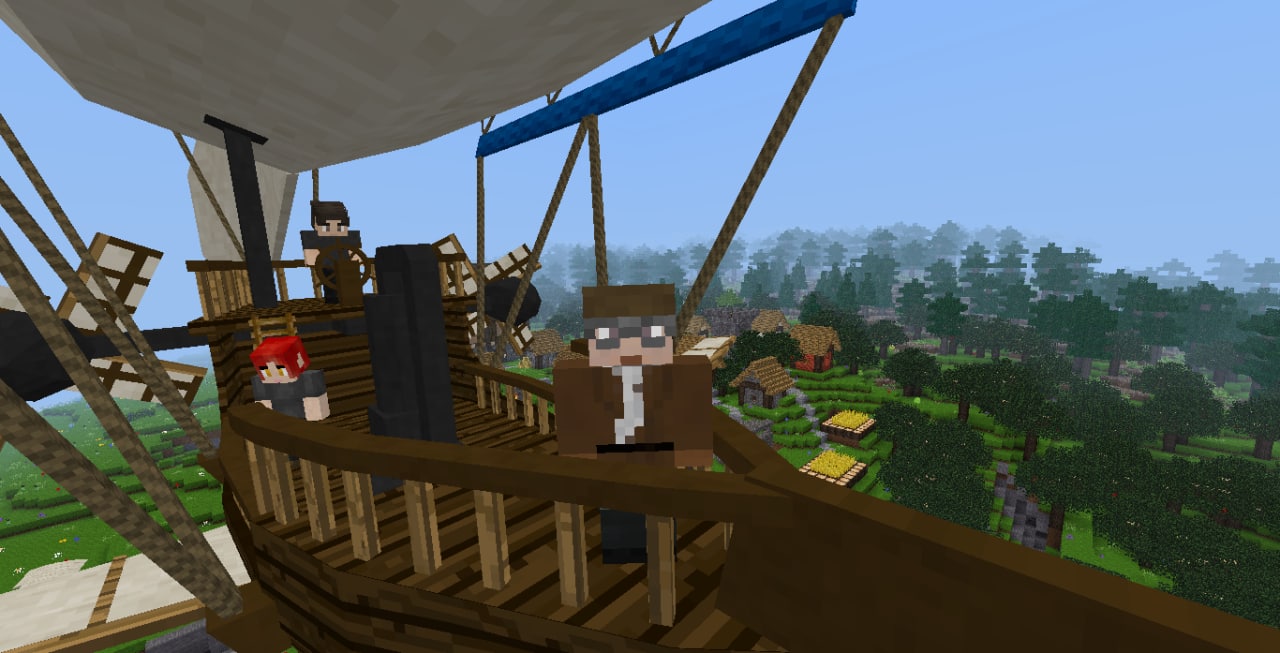
The design or gameplay isn't the issue, the aesthetic is clearly Minecraft.
You can't take Minecraft assets, mix the pixels around a little bit, and then be legally free and clear. If the public looks at pictures of your game, and they say "100% it's Minecraft", you're gonna have a bad time.
I'll be honest, you sound like someone's grandma who calls every game console a "Nintendo" and every game character "Mario". So what if the general public can't tell the difference between Samus and Mario? That doesn't mean we ban Metroid.
They're the same genre, but obviously not the same game. Is only one voxel sandbox game allowed to exist in the world? What's next, only one platformer can exist? Only one action movie is allowed to exist? Only one power metal band in the world?
What are you talking about? There are no Minecraft assets in that screenshot, even with "pixels mixed around". I play both games and can tell you that screenshot is easily distinguished from Minecraft.
"IP" is not a legal term - instead there are copyright, patents and trademarks. If you want to argue that copying an art style violates some law then be specific what laws you think it violates and why.
interesting interpretation. most other articles on the topic have a different interpretation. if the AI can not be the author, then who can? is writing the prompt enough to establish being the creator? i think we need a few more cases to get an answer to that.
Obviously, taking a photo requires much more than clicking a button. Even if you simply pointed and shot, the timing can be special. Copyright requires some creativity, if the creation process is completely mechanical you may not be able to copyright the end result.
Most pirated game assets or code is usually naive contamination from market place re-sellers that don't have a legal right to the kit-bashing content.
Very common to find pitch shifted audio getting resold on Unity store or web, images/3D with intact watermarks/meta-data, and scraped shader code. If you are credulous enough to buy files from a shady online seller, the copyright/trademark liability almost always falls on the person that publishes the IP. You can do everything above board, and still get sued as other license holders may register the asset signature with anti-piracy/YT bots.
For example, you could buy BBC/NBC/Sony libraries off ebay/web for a few bucks, but they will 100% still sue you into bankruptcy if you ever publish content with their media IP.
"AI" vector search can produce similar results of existing scraped works, and almost every LLM knows Disney Mickey Mouse. How LLM are trained means isomorphic plagiarism will occur regardless of data granularity. Just like how mp3 were a lousy highly compressed version of CD audio, the output does not have to be a verbatim copy to trip copyright and trademark IP laws.
Isomorphic plagiarism becomes less obfuscated when compiled into standard executable code. However, some firms actually used human session chat admins for data labeling/edits.
People may still lose even if they are right. If you resell something you didn't actually make yourself or purchased royalty free perpetual rights from the authorized holder, than the liability still falls on you when content rights change.
This is why fun indie games sometimes disappear. Some may not like these rules, but most play by them to survive as a business. =3


1) open source project publishes source
2) AI scrapes source
3) AI generates code for proprietary game similar to that of the source
4) AI tool scans jar files and finds similar code, triggers copyright violation